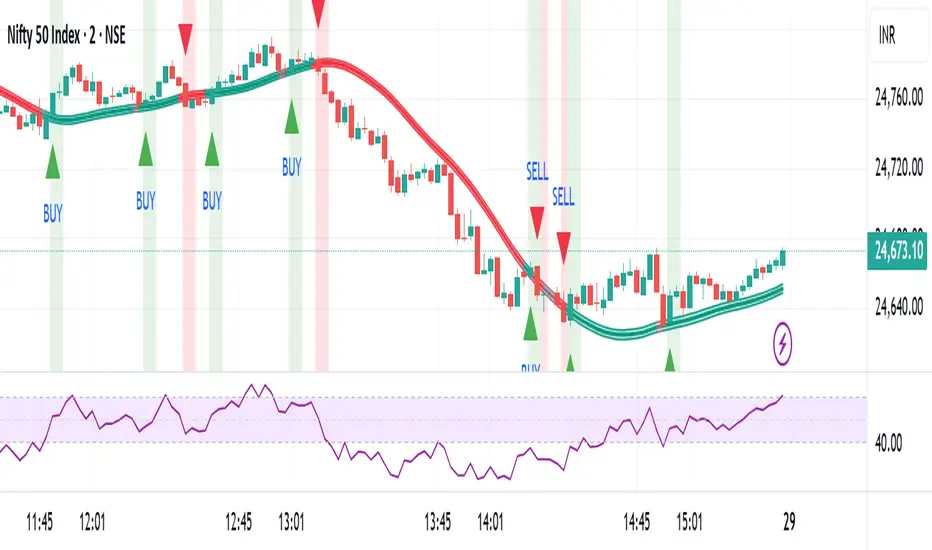
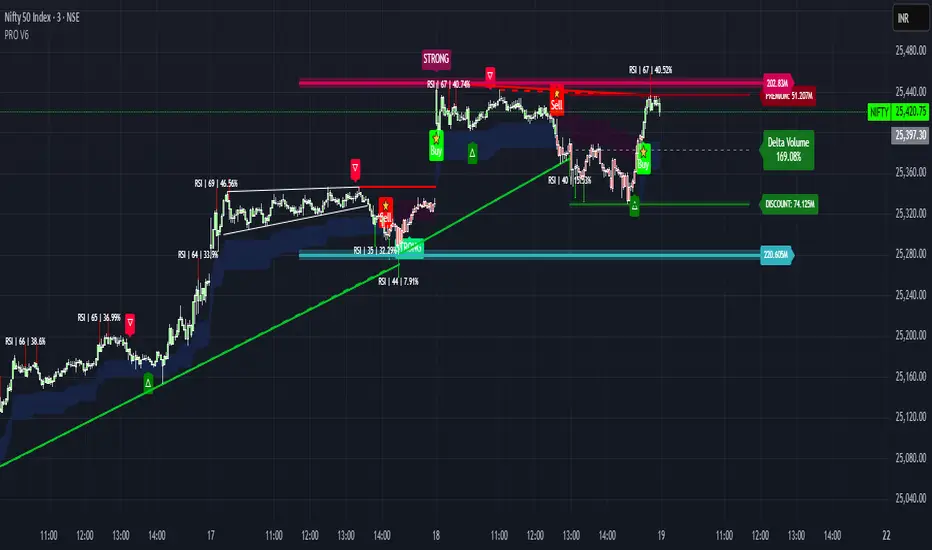
Baseline Buy/Sell Alerts (v6) - FixedGood for indexes,metals and cryptos Thanks Universe Thanks AngelsPine Script® göstergesiFinixFly tarafından8
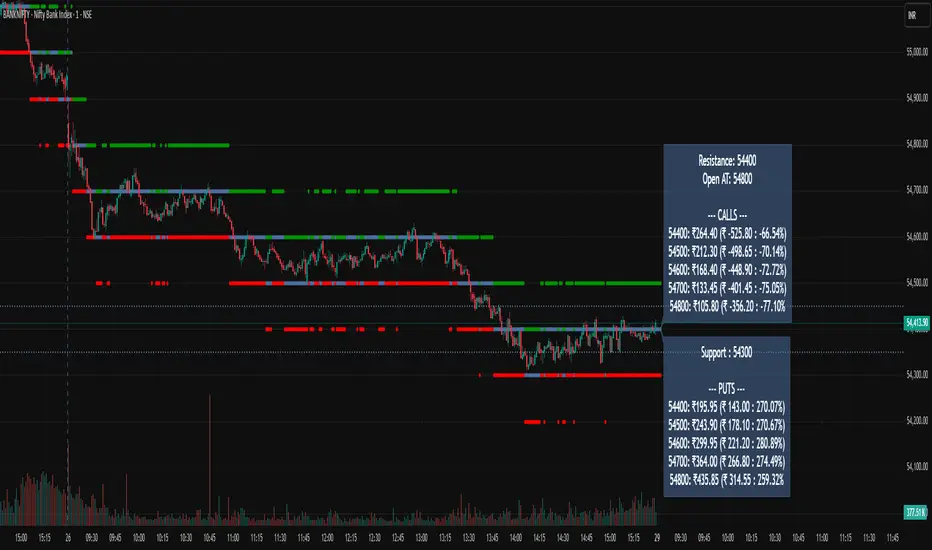
BankNifty Radar @BhupiXBankNifty Radar This indicator automatically detects and plots the most important support and resistance zones where markets often show reversal or breakout moves. These levels are based on key price reactions and are highly useful for identifying potential big moves in Index, Futures, and Options Charts. 🔹 Key Features Auto-detection of major support & resistance levels Works across Index, Futures & Options Charts Highlights zones where strong reversal or breakout is likely Helps traders plan entries, exits, and stop-loss levels Ideal for intraday as well as positional trading 🔹 How to Use Use support levels to identify buying opportunities during pullbacks Use resistance levels to spot selling opportunities or possible breakouts Combine with volume/momentum indicators for higher accuracy Options traders can use these levels to select ATM/OTM strikes with better conviction ⚡ This tool is designed to give traders a clear view of where the market is likely to react, making it easier to catch big moves after reversals or breakouts. This indicator tracks & Draw BankNifty Index & options important support and resistance levels and 10 options Strikes Live prices & Price Change and price change in % in one place. This Indicator Work Only BankNifty Index ,Futures & Option Strike charts charts. 📌 Financial Disclaimer This indicator is created for educational and informational purposes only. It does not constitute financial or investment advice. Past performance is not indicative of future results. Trading in stocks, futures, and options involves substantial risk of loss and may not be suitable for all investors. Please consult with your financial advisor before making any trading or investment decisions. Use this indicator at your own risk.Pine Script® göstergesiBhupix tarafından3
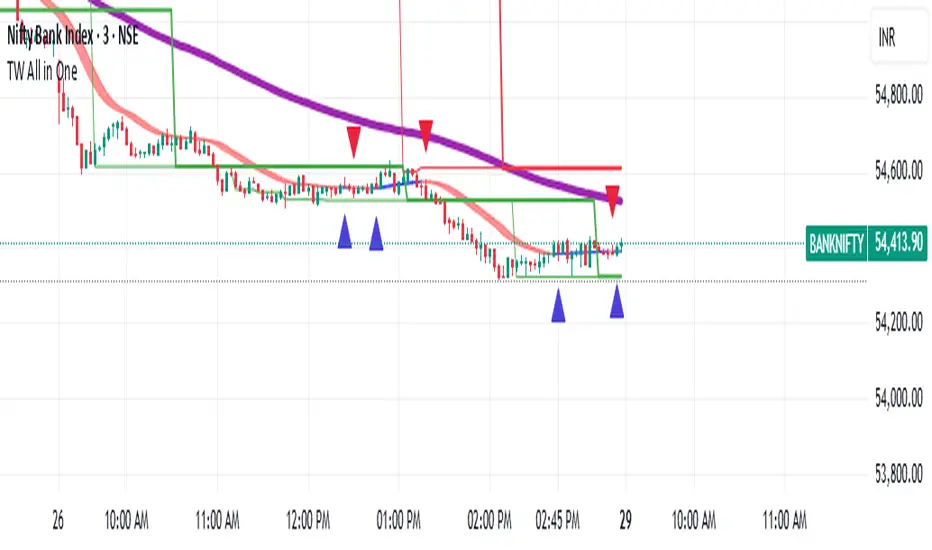
TW All in OneIts a overlap strategy, giving signals for buy and sell. Mostly suitable for Bank Nifty. Nifty and crude oilPine Script® göstergesiamiyashankar tarafından47
1m OPTION BUY_Multi indi-01 (P) SEMI AUTOEnter every monday choose the option price range between 50 tp 100 , set strategy for a week or 3 three days, set upper limit 120 and lower limit 30 and input your own contract size and all parameters as you wish, and execute the alert (this is how the strtegy made). if you dont have any idea of market direction execute this strtegy for put and call both. be aware this strategy may incurred loss . we r not recomending to use this strategy , this is for education purpose only, watch and analyze then take your own decision. Pine Script® göstergesiIQ2869 tarafındanGüncellendi 229
Tristan's Star: 15m Shooting Star DetectorThis script is designed to be used on the 1-minute chart , but it analyzes the market as if you were watching the 15-minute candles. Every cluster of 15 one-minute candles is grouped together and treated as a single 15-minute candle. When that 15-minute “synthetic” candle looks like a shooting star pattern (small body near the low, long upper wick, short lower wick, bearish bias), the script triggers a signal. At the close of that 15-minute cluster, the script will: Plot a single “Sell” label on the last 1-minute bar of the group. Draw a horizontal line across the 15 bars at the high, showing the level that created the shooting star. Optionally display a table cell in the corner with the word “SELL.” This lets you stay on the 1-minute timeframe for precision entries and exits, while still being alerted when the higher-timeframe (15-minute) shows a bearish reversal pattern.Pine Script® göstergesiOhRayOhRay tarafından11217
J. YOUNG INDICATOR (2)QUICK REFERENCE to help with a PRICE FOR OPTIONS and or B/H entry MEDIAN PRICE of the MONTHLY/QUARTERLY aVWAPS to get a more accurate price point Pine Script® göstergesiJyoungtx21 tarafından1134
Smash + Proba + BF + VWAP + VP + SessionsVWAP Addition Yearly, Monthly, Weekly and Daily. Session boxes addition and volume and range in theses boxes. Volume Profile in developpementPine Script® göstergesiJerem_KiK tarafındanGüncellendi 22
Vortex Filter PATThe Vortex Filter is your guide to smarter trend trading and position scaling. This indicator goes beyond simple buy/sell signals by identifying a critical zone for potential averaging, allowing you to improve your position and risk management in real-time. A clear 'Long' or 'Short' signal is generated when a new trend is confirmed. When the price pulls back into the specially defined averaging zone, you receive a signal to "BUY" or "SELL" consider adding to your position. This two-tiered approach to market entry and management is a game-changer for traders who want to build profitable positions and manage risk effectivelyPine Script® göstergesiImpextejas04 tarafından114
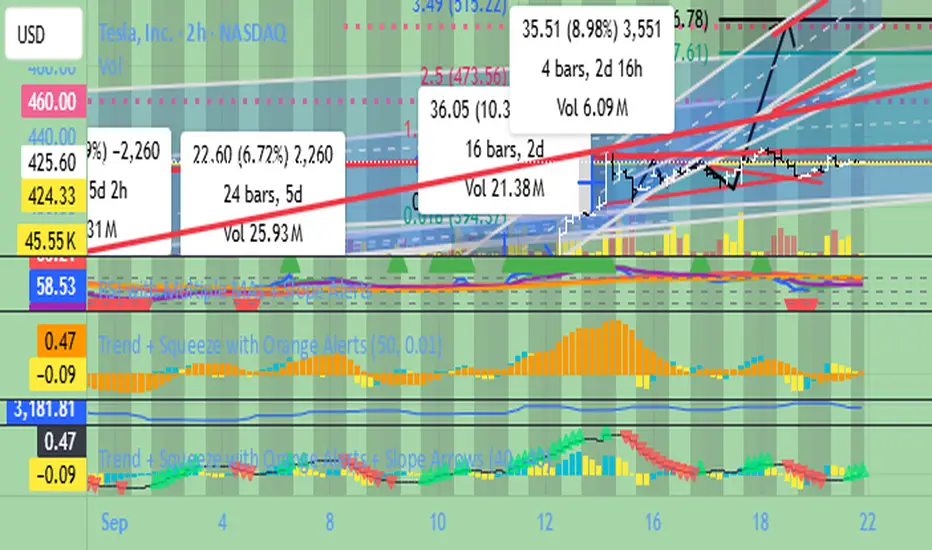
Trend + Squeeze High VolatilityGood for High Volatility Stocks and Options Trend and Squeeze High Volatility Good For High Volatility Stocks and OptionsPine Script® göstergesikevinchow360 tarafından16
Navkar Finalthis script uses macd, rsi, stochastic, moving average, ATR, Bollinger bands and many other indicator to check if possible entry exit conditionsPine Script® göstergesiAkshayShah99 tarafından8
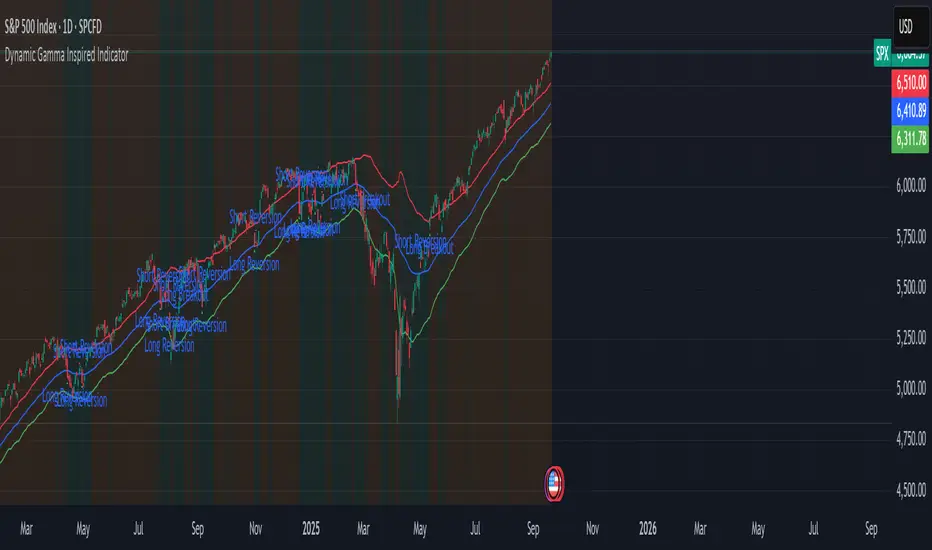
Dynamic Gamma Inspired IndicatorDynamic Gamma Inspired Indicator This indicator identifies potential market regime shifts between low-volatility (mean-reverting) and high-volatility (trending) environments by using a dynamic, volatility-adaptive framework inspired by options market gamma exposure concepts. Core Concepts This indicator uses a volatility-based model that mimics how market maker hedging can influence price stability and volatility. While it's not possible to calculate true Gamma Exposure (GEX) in Pine Script without external options data, this script uses the Average True Range (ATR) as a proxy to create dynamic zones that adapt to current market conditions. Positive Gamma Environment (Green Background) When price is contained within the upper and lower walls, it suggests a period of stability where market makers' hedging may suppress volatility. In this "mean-reversion" regime, prices tend to revert to the central pivot. Negative Gamma Environment (Orange Background) When price breaks outside the walls, it signals a potential increase in volatility, where hedging can amplify price moves. This "trend-amplification" regime suggests the potential for strong breakout or trend-following moves. How It Works The indicator is built on three key components that dynamically adjust to market volatility: Dynamic Pivot (Blue Line) An Exponential Moving Average (EMA) acts as the central "zero gamma" pivot point. Dynamic Walls (Red & Green Lines) These upper and lower bands are calculated by adding or subtracting a multiple of the Average True Range (ATR) from the central EMA pivot. This is similar to how Keltner Channels use ATR to create volatility-based envelopes. The walls expand during high volatility and contract during low volatility. How to Use This Indicator The indicator automatically plots signals based on the current market regime: Mean-Reversion Signals (Inside the Walls) Long Reversion: Appears when the price crosses up through the central pivot, suggesting a potential move toward the upper wall. Short Reversion: Appears when the price crosses down through the central pivot, suggesting a potential move toward the lower wall. Breakout Signals (Outside the Walls) Long Breakout: Appears when the price breaks and closes above the upper wall, signaling the start of a potential uptrend. Short Breakout: Appears when the price breaks and closes below the lower wall, signaling the start of a potential downtrend. Customization You can tailor the indicator to different assets and timeframes by adjusting the following inputs: Central Pivot EMA Length: Determines the period for the central moving average. ATR Length for Walls: Sets the lookback period for the Average True Range calculation. ATR Multiplier for Walls: Adjusts the width of the channel. A larger multiplier creates wider walls, filtering out more noise but providing fewer signals. Disclaimer: This indicator is a tool for analysis and should not be used as a standalone trading signal. Always use proper risk management and combine it with other analysis methods. Past performance is not indicative of future results. Pine Script® göstergesiguttimg tarafından27
Option Strike Previous Day high and LowThis script automatically plots the previous day’s High and Low levels for a selected Call (CE) and Put (PE) option contract. It is designed to help options traders quickly identify important price zones without having to fetch or calculate them manually. Mandatory to Input expiry like. YYMMDD Mandatory to Input Strike like. 25350 ✨ Key Features: • Automatically requests previous day High/Low for CE and PE of the chosen strike. • Full-width horizontal lines for clear visibility across the entire chart. • Configurable appearance: dashed/solid lines, custom width, and label placement (left/right). • Optional manual level input for custom support/resistance marking. • Debug mode available to show the tickers and requested values. ⚙️ How to Use: 1. Choose the underlying root (e.g., NIFTY), expiry (YYMMDD), and strike price. 2. Select whether you want to show CE, PE, or both. 3. Adjust label offset to position tags near the chart’s right edge. 4. Use the manual level input if you want to mark an additional reference line. 💡 Why it’s useful: Option traders often rely on previous day’s option Highs and Lows as intraday reference zones for support, resistance, and breakout levels. This script makes those levels instantly visible and consistently updated, saving time and reducing manual charting errors. 📌 Notes: • Works on any timeframe chart of the underlying. • For best use, apply on the underlying index/stock chart, not on the option itself. • This script does not generate trading signals or make predictions; it provides levels for reference. Pine Script® göstergesivinothblr2015 tarafından1130
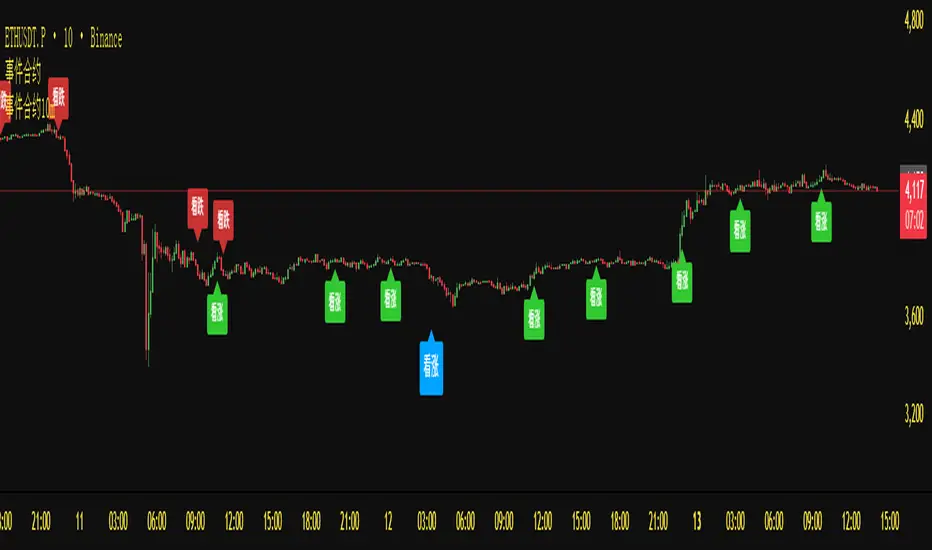
RSI+VOL——Binary(One bar)Overview This indicator integrates Stochastic RSI, MACD trend alignment, ADX trend strength, and multi-dimensional volume analysis to provide intelligent signal guidance and market activity monitoring. It is suitable for short-term, swing, and event-driven trading, offering clear visualization of trend direction, market strength, and volume anomalies. Core Features 1️⃣ Stochastic RSI Signals Automatically identifies overbought and oversold conditions to generate buy and sell reference signals. Signals are filtered with candle closing direction to reduce counter-trend entries. 2️⃣ MACD Trend Alignment Signals trigger only when MACD trend direction aligns with Stochastic RSI, improving accuracy. Real-time trend alignment reduces noise from ranging markets. 3️⃣ ADX Trend Strength Filter Signals trigger only when ADX indicates a significant trend, filtering out low-strength movements. Helps capture primary market directions. 4️⃣ Multi-Dimensional Volume Analysis Differentiates bullish and bearish volume to identify breakout signals. Relative volume (RVOL) ensures signals occur during periods of active trading. Background highlights abnormal spikes and extreme volume, clearly reflecting market activity. 5️⃣ Signal Visualization and Alerts Buy and sell labels with corresponding RSI values are displayed on the chart. Built-in alert conditions support TradingView notifications and strategy integration. Indicator Value Multi-dimensional alignment: combines trend, momentum, and market activity for comprehensive assessment. High-precision signal reference: filters noise and provides clear entry indications. Market activity monitoring: highlights extreme volume to reflect market participation. Broad applicability: suitable for short-term, swing, and event-driven trading across various markets.Pine Script® göstergesiHunterX8869 tarafındanGüncellendi 1122
Option Trend for Nifty & Bank Nifty (Indian Market)This is an advanced multi-system trading indicator for TradingView, offering a comprehensive suite of tools for technical analysis and trading decision support . Main Features Trendline Detection: Identifies bullish and bearish trendlines automatically using swing highs and lows, with optional labeling of key price structure (Higher Highs, Lower Lows, etc.) and customizable line colors and styles. Signal & Trend Systems: Includes both a crossover signal system (for buy/sell entries) and a multi-period trend-following system, which uses enhanced moving averages and dynamic trailing levels to adapt to different market conditions. Supply & Demand Zones: Automatically detects and marks potential supply and demand zones based on pivot structures and ATR buffers, helping spot logical areas for price reaction or reversal. Support & Resistance: Plots periodic support/resistance and macro (long-term) levels, with user-defined periods and the ability to visualize volume delta for each zone. Theil-Sen Estimator: Optionally adds a statistical regression channel using the robust Theil-Sen method to identify trend direction and breaks for long-term analysis. RSI/KDE Analysis: Implements relative strength index (RSI) analysis with kernel density estimation (KDE) to detect pivot points with probability labeling and color-coded signals for high-confidence reversals. Dashboards & Alerts: Provides multitimeframe dashboards summarizing trend, EMA signals, and momentum across up to five timeframes, plus integrated alerting for all major events (entries, exits, zone breaks, etc.). Customization & Usability Extensive input settings for periods, color themes, line widths, and label visibility. Can display visual cloud bands, trend ribbons, and supply/demand boxes as overlays on price charts for enhanced clarity. Open-source and for educational use under permissive licensing, not affiliated with TradingView. This indicator is designed to deliver a full-featured market map, combining price action, trend, support/resistance, and probabilistic signals for discretionary or semi-automated trading.Pine Script® göstergesibalagan93 tarafından23
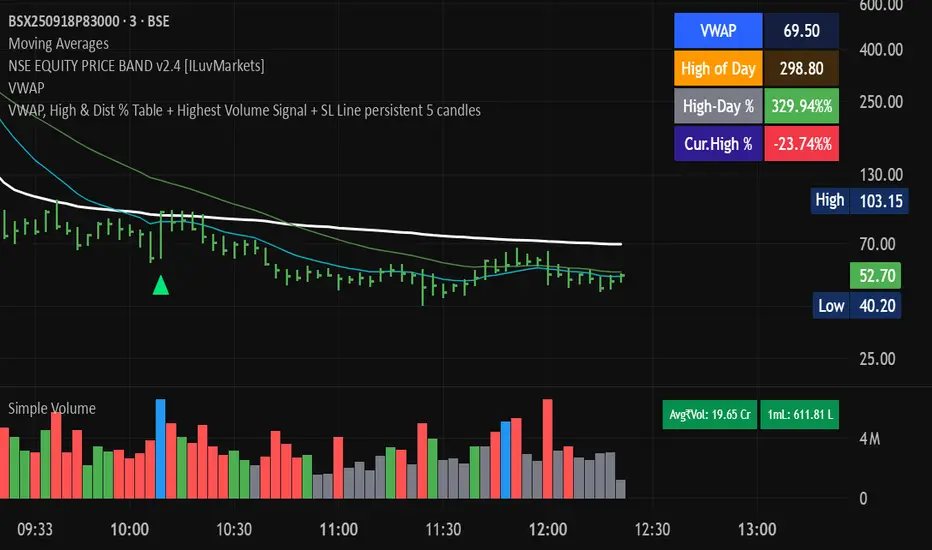
VWAP, High & Distance % Table + Highest Volume Signal I want the value of VWAP, High of the Day and Distance of VWAP from the highs to judge for an Entry if possible.Pine Script® göstergesinikhilmehta687 tarafındanGüncellendi 18
Gabriel's Triple Impulsive Candle DetectorTriple Impulsive Candle Detector Overview, critical for catching impulse moves in either direction. SPX Income System is a rule-based framework designed to identify frequent, high-probability income opportunities on the S&P 500 cash index (SPX/SPY) using 0-DTE credit spreads. The core engine operates on 30-minute Impulse bars during the morning trade window and can be extended with optional modules for afternoon, overnight, and weekly swing opportunities. The methodology centers on a single, mechanical price event called a Impulse Bar (small wick to body ratio) to minimize discretion and keep execution consistent. 🔶What’s Inside Core Strategy: SPX Daily Income Timeframe: 3 kinds of 30-min bars. Window: 09:30–11:30 ET (new setups only) Instrument: SPX (cash index, XSP/SPY), executed with $5-wide credit spreads on 0-DTE SPX options Bullish Setup Entry on the break of setup bar high Use an at the money put credit spread Bearish Setup Entry on the break of setup bar low Use an at the money call credit spread Intent: Enter shortly after setup; manage to >80% max profit or EOD expiration if SPX. If it's another stock, then a 1.5~2x D ATR is suggested. Signal: An Impulse Bar that closes at/near the high (bullish) or low (bearish) of its 30-min range, verified with Volume above average. Risk—limited to the risk of the option spread. The spread is 5 dollars wide The premium collected is $2.50 $5 - 2.50 = $2.50, or the breakeven point. Which means what's left is the risk involved. The risk is $2.50 per spread 🔶Why the 30-Minute Chart? The 30-minute bar is the “chart of choice” because it filters noise and aligns with morning institutional flows. On alternate timeframes, price often retraces half the candle body before following through. On the 30m: the follow-through is more consistent, especially with 2x volume confirmation. Adding support/resistance levels at the impulse bar hl2 strengthens execution. This strategy has roots in MTF Crypto, and SPX/SPY TPO-Order Block logic. 🔶Bonus Examples: 🔹Afternoon SPX Income Second chance window (typically 14:00–15:00 ET) if the morning trade has exited, 60-min bars instead. 🔹ORB 30 – Opening Range Break (first 30 min) Classic ORB with an income twist for early action when time is limited. This can be entered on the 15 minute candle break. 🔹ORB 60 – Opening Range Break (second 30 min) A follow-up ORB variant for traders who miss the first window, verified on a 60-min chart. Enter on the final 3 minutes of the hourly candle or wait for a pullback. 🔹B&B – Bed & Breakfast (Overnight) Identifies income setups via the 10-minute chart in the last 30–60 minutes of the session with next-day open as the exit. 🔹JB – Just Breakfast Uses the prior day’s end-of-day setup to enter at the opening bell, then manages into the daily income flow. I trade 0-date, and selling an ITM spread either partially or fully then gives me a head start on the daily income potential. This may work better if you either roll or the ORB 30 also meets the criteria. 🔹All-Day-Scalper Converts income logic into 30-minute scalps using deep 75/80 delta ITM options as synthetic stock (requires >PDT). Meaning that the option will behave as if it is stock. This strategy comes with a warning: it's better if you can day trade. 🔹Tag ’n Turn—Weekly SPX Income Swing Weekly swing overlay using 30-min Pulse Bars + Bollinger Bands (50) for 3–7 day swings and as a filter for daily income alignment. I use the TTM Squeeze and obtain similar results. Target heuristics (directional days) with a fired squeeze. Part of my Gamma Scalping System. 🔶The Impulse Bar (10~40% Wick to Body Bar) An Impulse Bar is a candle that: Bullish: Closes higher than it opens and within the top ~10% of its high-low range. Bearish: Closes lower than it opens and within the bottom ~10% of its high-low range. Practical tip: Many traders mark 0-10-80-100% levels on the candle range (custom Fib or ruler) to quickly validate Pulse Bars. If it's accompanied by a volume spike, then it's better quality. 🔶SPX Daily Income—Rules & Execution 🔹Rules Chart: 30 min, no indicators required. Pure PA, TPO-based strategy. New Setups: 09:30–11:30 ET Instrument: SPX signals, executed via SPX 0-DTE credit spreads ($5 wide, $2 for SPY) 🔹Entries Bullish: Enter on a break of the setup bar high, use ATM put credit spread Bearish: Enter on a break of the setup bar low, use ATM call credit spread 🔹Exits Primary: Close at >80% of max profit (credit received) Alternate: Hold to EOD expiration Stop: Risk of the spread (defined by width – credit) Target Heuristics (directional days) Optional: 1.5–2× ATR as a reference (mirrors directional follow-through that often accelerates the >80% outcome) Credit Guidance (typical) OTM short strike ≈ $2.40 ITM short strike ≈ $2.50–$2.80 2× ITM short strike ≈ $2.80–$3.00 Trade Management (PDT-Aware) If under PDT, many prefer set-and-forget with GTC buy-back (e.g., $0.20) or EOD expiration. 1:00 PM ET time check Trending day ±$15–$20 SPX: usually no action, run to expiration Non-trending day ±$5 SPX: consider taking 40–60% if available (optional) to avoid 50/50 end-of-day decay dynamics Rationale: Without a favorable trend by ~1 PM, the odds of a late push decline; choosing a controlled partial outcome can improve long-run expectancy and reduce variance. 🔶Examples (Conceptual) 🔹Bullish: A green dot marks a bullish impulse bar; minor follow-through pushes the spread to >80% quickly. 🔹Bearish: A red triangle marks a bearish Impulse Bar; a modest down move is often sufficient for >80–95%. 🔹Tag ’n Turn—Weekly Swing (Filter & Stand-Alone) Chart: 30-minute Overlay: Bollinger Bands 50 (mean-reversion lens), or KC or TTM. Setup: Tag of upper/lower band + Pulse Bar, enter on break of Pulse Bar in that direction Target: Opposite Bollinger Band Use Case: 3–7 day swings and a directional filter for Daily Income signals (trade with weekly bias) 🔹Afternoon SPX Income: Same Pulse logic, 14:00–15:00 ET window. 🔹ORB 30 / ORB 60: Uses 30/60-min opening range; can relax Pulse threshold (up to 40% bars) for early positioning when time-constrained. 🔹B&B (Overnight): Lasts 30–60 minutes; closes the next day at open or after the first 30-minute bar. 🔹JB (Just Breakfast): Enter at open using prior day’s signal; optionally roll into Daily Income if eligible. 🔹All-Day-Scalper: Deep ITM options (~0.75–0.80 delta) as synthetic stock. Entry: Long ITM option Stop: ~40% of option price Target: 70–150% or 30-minute timed exit Note: Time-intensive; for accounts above PDT. 🔹Brokerage: Must efficiently support SPX options; a <10% spread between OI and Volume is ideal. Preferences vary; Tastytrade, Thinkorswim, and Interactive Brokers are common choices. Use what’s reliable, available in your region, and cost-effective. 🔶Alerts (Check-in) Bullish Impulse Detected (within 09:30–11:30 ET) Bearish Impulse Detected (within 09:30–11:30 ET) Afternoon Pulse (14:00–15:00 ET) ORB 30/60 Trigger B&B Window Open (last 60 mins) JB at Open Tag ’n Turn: Band Tag + Impulse (Bull/Bear) 🔶Inputs (Typical) Session windows (morning, afternoon, last hour) ~5~15 Average Bar Impulse threshold (strict 10% vs relaxed up to 40% for ORB variants) Marker/label styles (bull/bear colors, dots vs arrows) Filters (optional ATR TP, band touch BB(50-SMA, 2 Stdv.) for Tag ’n Turn) Alert toggles (on-close for webhooks) 🔶Best Practices One playbook, many Doors: Start with daily income; add afternoon or B&B/JB only after you’re consistent. Credit discipline: Don’t chase poor pricing; stick to the credit guidance. Time awareness: If no trend by ~1 PM ET, consider variance control. Weekly bias: When using Tag ’n Turn, align daily trades with the weekly swing direction for added confluence. Risk is defined as width – credit = max risk per spread. Size, accordingly, 1~2%. 🔶Disclosures & Risk This is not financial advice. Options involve risk and are not suitable for all investors. Past performance (including backtests or theoretical studies) does not guarantee future results. Slippage, fills, assignment risk, and latency can materially impact outcomes. Trade a plan you fully understand and always size for durability. On the Daily, the Impulse bars, are often a signal that you should plan for it to return back to half of the Candle's body, and plan accordingly. Plot a horizontal support/resistance level and see how price reacts to it. Keep house-money, and use 1~2% Risk, reduce exposure when VIX is low and increase it when VIX is high. TL;DR (Summary) Signal: 30-min Pulse Bar (strict 10% close in range) Window: 09:30–11:30 ET (new setups) Execution: 0-DTE $5-wide SPX credit spreads Exit: >80% max profit or EOD Add-ons: Afternoon, ORB 30/60, B&B/JB overnights, All-Day-Scalper, Tag ’n Turn weekly swing/filter Philosophy: Fully rule-based, minimal discretion, production-line consistency 0-date.Pine Script® göstergesiGabrielAmadeusLau tarafından1128
Implied Volatility RangeThe Implied Volatility Range is a forward-looking tool that transforms option market data into probability ranges for future prices. Based on the lognormal distribution of asset prices assumed in modern option pricing models, it converts the implied volatility curve into a volatility cone with dynamic labels that show the market’s expectations for the price distribution at a specific point in time. At the selected future date, it displays projected price levels and their percentage change from today’s close across 1, 2, and 3 standard deviation (σ) ranges: 1σ range = ~68.2% probability the price will remain within this range. 2σ range = ~95.4% probability the price will remain within this range. 3σ range = ~99.7% probability the price will remain within this range. What makes this indicator especially useful is its ability to incorporate implied volatility skew. When only ATM IV (%) is entered, the indicator displays the standard Black–Scholes lognormal distribution. By adding High IV (%) and Low IV (%) values tied to strikes above and below the current price, the indicator interpolates between these inputs to approximate the implied volatility skew. This adjustment produces a market-implied probability distribution that indicates whether the option market is leaning bullish or bearish, based on the data entered in the menu: ATM IV (%) = Implied volatility at the current spot price (at-the-money). High IV (%) = Implied volatility at a strike above the current spot price. High Strike = Strike price corresponding to the High IV input (OTM call). Low IV (%) = Implied volatility at a strike below the current spot price. Low Strike = Strike price corresponding to the Low IV input (OTM put). Expiration (Day, Month, Year) = Option expiration date for the projection. Once these inputs are entered, the indicator calculates implied probability ranges and, if both High IV and Low IV values are provided, adjusts for skew to approximate the option market’s distribution. If no implied volatility data is supplied, the indicator defaults to a lognormal distribution based on historical volatility, using past realized volatility over the same forward horizon. This keeps the tool functional even without implied volatility inputs, though in that case the output represents only an approximation of ATM IV, not the actual market view. In summary, the Implied Volatility Range is a powerful tool that translates implied volatility inputs into a clear and practical estimate of the market’s expectations for future prices. It allows traders to visualize the probability of price ranges while also highlighting directional bias, a dimension often difficult to interpret from traditional implied volatility charts. It should be emphasized, however, that this tool reflects only the market’s expectations at a specific point in time, which may change as new information and trading activity reshape implied volatility.Pine Script® göstergesiQuantitativeAlpha tarafından11164
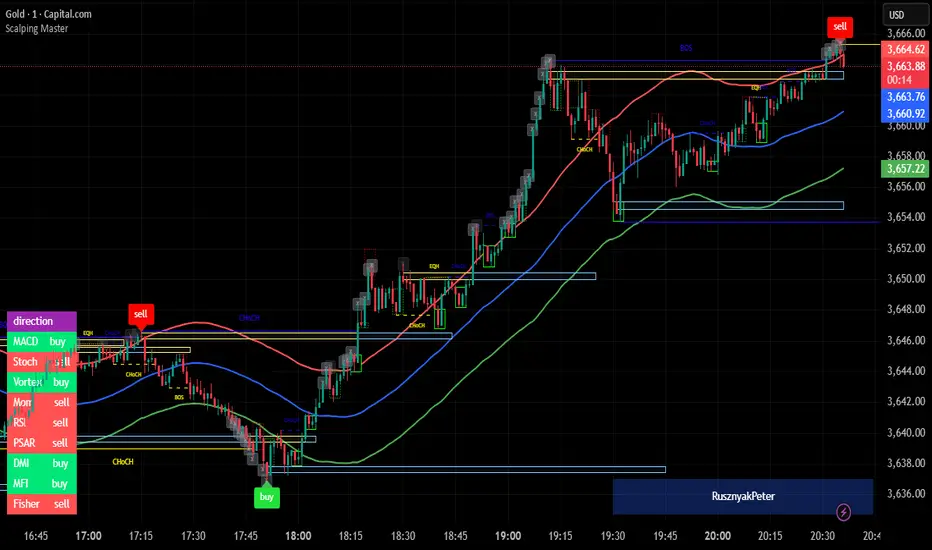
Scalping MasterMarket Structure Analysis: Swing Structure: Detects higher highs (HH), lower highs (LH), higher lows (HL), aur lower lows (LL) ko identify karta hai using pivot points (based on ta.highest aur ta.lowest). Internal Structure: Chhote timeframes ke liye internal swing points aur break of structure (BOS)/change of character (CHoCH) ko track karta hai. BOS/CHoCH Detection: Bullish aur bearish structure breaks (BOS) aur trend reversals (CHoCH) ko label karta hai. Order Blocks (OB): Internal Order Blocks: Chhote timeframe ke order blocks ko plot karta hai, jo liquidity zones ko represent karte hain. Swing Order Blocks: Bade timeframe ke order blocks ko show karta hai. Filtering: ATR ya Cumulative Mean Range ke basis par volatile order blocks ko filter karta hai. Fair Value Gaps (FVG): Price gaps (bullish aur bearish) ko detect aur plot karta hai. Auto-threshold aur timeframe customization ke saath FVGs ko filter karta hai. FVGs ko extend karne ka option deta hai (visual representation ke liye). Equal Highs/Lows (EQH/EQL): Equal highs aur lows ko identify karta hai, jo support/resistance zones ke liye useful hote hain. Bars confirmation aur sensitivity threshold ke saath customizable hai. Previous Highs/Lows (MTF): Daily, weekly, aur monthly high/low levels ko plot karta hai. Line style (solid, dashed, dotted) aur colors customizable hain. Premium/Discount Zones: Market ke premium, equilibrium, aur discount zones ko highlight karta hai, jo price action ke liye key areas hote hain. Visual Customization: Color Themes: Colored ya monochrome themes ke options. Candle Coloring: Trend ke hisaab se candles ko color karta hai. Labels aur Lines: Swing points, strong/weak highs/lows, aur structure breaks ke liye labels aur lines plot karta hai. Modes: Historical Mode: Past data ke saath complete structure dikhata hai. Present Mode: Sirf recent structure aur signals dikhata hai, clutter reduce karne ke liye. Alerts: Bullish/Bearish BOS, CHoCH, order block breaks, aur EQH/EQL ke liye alerts set karne ka option. Swing Points aur Trailing: Strong/weak high aur low points ko track karta hai. Trailing maximum/minimum ko extend karta hai for real-time analysis. Kya Kya Mila Kar Bana Hai? Yeh indicator Smart Money Concepts ke core principles par based hai aur in elements ko combine karta hai: Pivot Point Analysis: ta.highest aur ta.lowest functions se swing highs/lows detect karta hai. Internal aur swing structure ke liye alag-alag lengths (e.g., length aur 5 for internal swings). Price Action Concepts: Break of Structure (BOS): Jab price pivot high/low ko break karta hai. Change of Character (CHoCH): Jab trend reverse hota hai. Confluence filtering ke saath accuracy improve karta hai. Order Blocks: Liquidity zones ko identify karne ke liye high/low ranges aur ATR/cumulative mean range ka use. Bullish aur bearish order blocks ke liye customizable colors. Fair Value Gaps: Gaps in price action ko detect karne ke liye OHLC data ka analysis. Timeframe aur auto-threshold ke saath flexibility. MTF (Multi-Timeframe) Analysis: Daily, weekly, monthly high/low levels ke liye ta.valuewhen aur time-based calculations. Zones Detection: Premium, equilibrium, aur discount zones ke liye price range calculations. Visual Tools: Lines, labels, aur boxes ke saath market structure ko visually represent karta hai (line.new, label.new, box.new). Extendable lines aur boxes for better visibility. User Inputs: Customizable settings jaise timeframe, colors, lengths, aur filters, jo user ko flexibility dete hain. Technical Components PineScript Functions: ta.crossover, ta.crossunder, ta.highest, ta.lowest, ta.atr, ta.cum for calculations. Arrays: Order blocks ke coordinates store karne ke liye (array.new_float, array.new_int, array.new_box). Drawing Tools: Lines, labels, aur boxes ke saath dynamic plotting. Conditional Logic: BOS, CHoCH, aur other signals ke liye complex conditions. Timeframe Support: Multi-timeframe analysis ke liye input.timeframe.Pine Script® göstergesiTradeSnipers tarafından44102
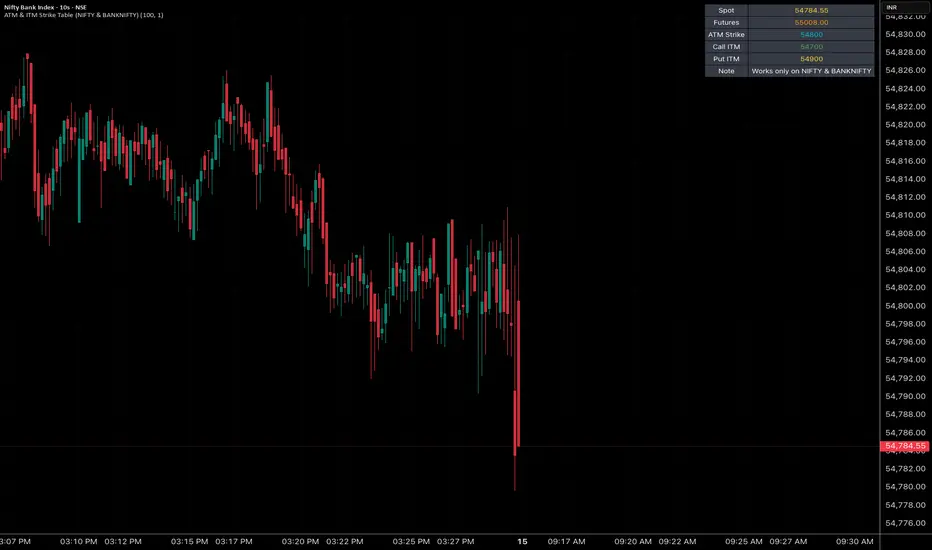
ATM & ITM Strike Table (NIFTY & BANKNIFTY)This script is like a cheat sheet for option traders. When you put it on your chart, it shows you a small table with: The current spot price (the real market price). The futures price (another version of the same index that sometimes trades a bit higher or lower). The ATM strike (the strike price closest to the market price). Which call option and put option are “in the money” and most relevant right now. A little note to remind you if you’re looking at the right chart. In short: It saves you from doing mental math every time by automatically pointing out the key option strike prices you should be aware of.Pine Script® göstergesijabez4jc tarafından34
Multi Straddle-Strangle ChartThis powerful indicator is designed for options traders who want to visualize and track the combined premium of multiple straddle and strangle strategies in a single, dedicated pane. Quickly analyze and compare up to five different options strategies at a glance, directly on your chart. This tool is perfect for monitoring volatility, tracking potential profits/losses on a position, and spotting key support and resistance levels based on option premiums. Key Features: Plot Up to 5 Strategies: Simultaneously plot any combination of up to 5 straddles or strangles. Real-Time Data: Fetches live data for both Call and Put options to give you an up-to-the-second view of the combined price. Dynamic Symbol Generation: Automatically detects the underlying symbol (e.g., NIFTY, BANKNIFTY, stocks) and builds the correct option symbols based on your input. Customizable Inputs: Easily configure the expiry date, strike prices and line colors for each of the 5 lines. In-Chart Summary Table: A clean and clear table in the corner of your chart provides a quick summary of each enabled strategy and its current price. Important Note on Usage: This tool requires you to input a strike price in all fields, even if you do not plan to use all five lines. This is necessary because of a fundamental rule in the Pine Script language: every input must have a constant, non-empty default value. The indicator is optimized to only fetch data for the lines you have explicitly enabled with the "Enable Line X" checkbox.Pine Script® göstergesiSharpStrat tarafından22142
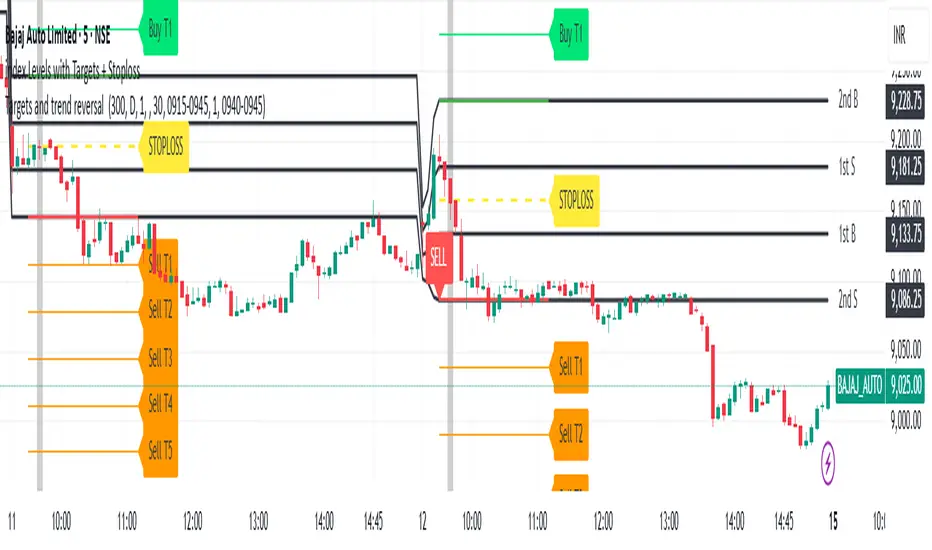
Targets and trend reversal This Indicator works great for Targets and Trend Reversal..Pine Script® göstergesiprashanthgurram1977 tarafından65
Targets and trend reversal This inddicator is more advanced which indicates clear Targets and Tend revarsal.Pine Script® göstergesiprashanthgurram1977 tarafından1143
KILLZONE & CHECK LIST ICAKILLZONE & CHECK LIST ICA | The Inner Circle Alchemist ✨ Features: Display of precise trading killzones on the chart Marking the high, low, and mid-level of each killzone Option to show/hide killzone names Daily separators at custom times (e.g. 17:00 or 00:00) Highlighting Midnight Open, 8:30 Open, and New York Stock Exchange Open Display of previous day, week, and month highs & lows (optional) A clean and practical trading checklist on the bottom-right of the chart Visual customization, such as showing your name/brand on the chart Clear indication of weekdays ⚡️ A perfect mix of professional tools & visual style to keep you one step ahead! ID on All Platforms: TheInnerCircleAlchemist #Forex #Trading #Indicator #Killzone #TradingChecklist #PriceAction #DayTrading #SwingTrading #SmartMoney #MarketStructure #TradingTools #ChartAnalysis #TechnicalAnalysis #ForexStrategy #TraderLife #ForexTrading Pine Script® göstergesisomuparida2002 tarafından161