Candlestick analysis
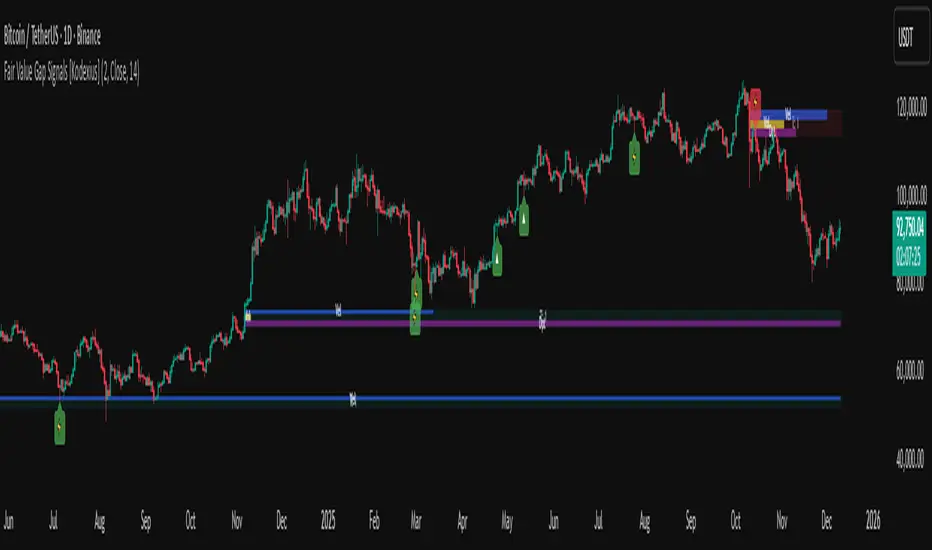
Fair Value Gap Signals [Kodexius]Fair Value Gap Signals is an advanced market structure tool that automatically detects and tracks Fair Value Gaps (FVGs), evaluates the quality of each gap, and highlights high value reaction zones with visual metrics and signal markers.
The script is designed for traders who focus on liquidity concepts, order flow and mean reversion. It goes beyond basic FVG plotting by continuously monitoring how price interacts with each gap and by quantifying three key aspects of each zone:
-Entry velocity inside the gap
-Volume absorption during tests
-Structural integrity and depth of penetration
The result is a dynamic, information rich visualization of which gaps are being respected, which are being absorbed, and where potential reversals or continuations are most likely to occur.
All visual elements are configurable, including the maximum number of visible gaps per direction, mitigation method (close or wick) and an ATR based filter to ignore insignificant gaps in low volatility environments.
🔹 Features
🔸 Automated Fair Value Gap Detection
The script detects both bullish and bearish FVGs based on classic three candle logic:
Bullish FVG: current low is strictly above the high from two bars ago
Bearish FVG: current high is strictly below the low from two bars ago
🔸 ATR Based Gap Filter
To avoid clutter and low quality signals, the script can ignore very small gaps using an ATR based filter.
🔸Per Gap State Machine and Lifecycle
Each gap is tracked with an internal status:
Fresh: gap has just formed and has not been tested
Testing: price is currently trading inside the gap
Tested: gap was tested and left, waiting for a potential new test
Rejected: price entered the gap and then rejected away from it
Filled: gap is considered fully mitigated and no longer active
This state machine allows the script to distinguish between simple touches, multiple tests and meaningful reversals, and to trigger different alerts accordingly.
🔸 Visual Ranking of Gaps by Metrics
For each active gap, three additional horizontal rank bars are drawn on top of the gap area:
Rank 1 (Vel): maximum entry velocity inside the gap
Rank 2 (Vol): relative test volume compared to average volume
Rank 3 (Dpt): remaining safety of the gap based on maximum penetration depth
These rank bars extend horizontally from the creation bar, and their length is a visual score between 0 and 1, scaled to the age of the gap. Longer bars represent stronger or more favorable conditions.
🔸Signals and Rejection Markers
When a gap shows signs of rejection (price enters the gap and then closes away from it with sufficient activity), the script can print a signal label at the reaction point. These markers summarize the internal metrics of the gap using a tooltip:
-Velocity percentage
-Volume percentage
-Safety score
-Number of tests
🔸 Flexible Mitigation Logic (Close or Wick)
You can choose how mitigation is defined via the Mitigation Method input:
Close: the gap is considered filled only when the closing price crosses the gap boundary
Wick: a full fill is detected as soon as any wick crosses the gap boundary
🔸 Alert Conditions
-New FVG formed
-Price entering a gap (testing)
-Gap fully filled and invalidated
-Rejection signal generated
🔹Calculations
This section summarizes the main calculations used under the hood. Only the core logic is covered.
1. ATR Filter and Gap Size
The script uses a configurable ATR length to filter out small gaps. First the ATR is computed:
float atrVal = ta.atr(atrLength)
Gap size for both directions is then measured:
float gapSizeBull = low - high
float gapSizeBear = low - high
If useAtrFilter is enabled, gaps smaller than atrVal are ignored. This ties the minimum gap size to the current volatility regime.
2. Fair Value Gap Detection
The basic FVG conditions use a three bar structure:
bool fvgBull = low > high
bool fvgBear = high < low
For bullish gaps the script stores:
-top as low of the current bar
-bottom as high
For bearish gaps:
-top as high of the current bar
-bottom as low
This defines the price range that is considered the imbalance area.
3. Depth and Safety Score
Depth measures how far price has penetrated into the gap since its creation. For each bar, the script computes a currentDepth and updates the maximum depth:
float currentDepth = 0.0
if g.isBullish
if l < g.top
currentDepth := g.top - l
else
if h > g.bottom
currentDepth := h - g.bottom
if currentDepth > g.maxDepth
g.maxDepth := currentDepth
The safety score expresses how much of the gap remains intact:
float depthRatio = g.maxDepth / gapSize
float safetyScore = math.max(0.0, 1.0 - depthRatio)
safetyScore near 1: gap is mostly untouched
safetyScore near 0: gap is mostly or fully filled
4. Velocity Metric
Velocity captures how aggressively price moves inside the gap. It is based on the body to range ratio of each bar that trades within the gap and rewards bars that move in the same direction as the gap:
float barRange = h - l
float bodyRatio = math.abs(close - open) / barRange
float directionBonus = 0.0
if g.isBullish and close > open
directionBonus := 0.2
else if not g.isBullish and close < open
directionBonus := 0.2
float currentVelocity = math.min(bodyRatio + directionBonus, 1.0)
The gap keeps track of the strongest observed value:
if currentVelocity > g.maxVelocity
g.maxVelocity := currentVelocity
This maximum is later used as velScore when building the velocity rank bar.
5. Volume Accumulation and Volume Score
While price is trading inside a gap, the script accumulates the traded volume:
if isInside
g.testVolume += volume
It also keeps track of the number of tests and the volume at the start of the first test:
if g.status == "Fresh"
g.status := "Testing"
g.testCount := 1
g.testStartVolume := volume
An average volume is computed using a 20 period SMA:
float volAvg = ta.sma(volume, 20)
The expected volume is approximated as:
float expectedVol = volAvg * math.max(1, (bar_index - g.index) / 2)
The volume score is then:
float volScore = math.min(g.testVolume / expectedVol, 1.0)
This produces a normalized 0 to 1 metric that shows whether the gap has attracted more or less volume than expected over its lifetime.
6. Rank Bar Scaling
All three scores are projected visually along the time axis as horizontal bars. The script uses the age of the gap in bars as the maximum width:
float maxWidth = math.max(bar_index - g.index, 1)
Then each metric is mapped to a bar length:
int len1 = int(math.max(1, maxWidth * velScore))
g.rankBox1.set_right(g.index + len1)
int len2 = int(math.max(1, maxWidth * volScore))
g.rankBox2.set_right(g.index + len2)
int len3 = int(math.max(1, maxWidth * safetyScore))
g.rankBox3.set_right(g.index + len3)
This creates an intuitive visual representation where stronger metrics produce longer rank bars, making it easy to quickly compare the relative quality of multiple FVGs on the chart.
EMA21 Pullback BuyEMA21 Pullback Buy is a tool designed to identify constructive pullbacks to the 21-period EMA in strong uptrends.
It highlights candles where:
• The previous close was above EMA21
• The current low touches or dips below EMA21
• The candle closes back above EMA21
These candles are considered potential “support tests” in a trending stock.
You can configure a maximum number of valid tests to avoid late-stage entries.
The script:
• Colors the test candles (optional)
• Marks them with a small circle
• Triggers a buy signal (green triangle) on the first bullish candle that breaks above the test candle’s high
Optional alerts are included for both:
• New EMA21 test
• Buy trigger after valid test
The goal is to help traders find low-risk entries in clean, trending stocks — without chasing breakouts or reacting emotionally. Best used with strong RS names and proper trend context.

CRR HUT NEON TARGET You look for this combo:
Trend up
White EMA 20 above red EMA 200.
Price above EMA 20 and EMA 30.
HUD BUY status
Row says:
“COMPRA MICRO 10-20p” (aggressive scalp) or
“COMPRA SCALPING” or
“COMPRA NORMAL”
Green / teal text and green “●” on the left.
Micro engine conditions
Multi-TF bullish (1m–5m–15m–30m agree, multiTfBull = true).
RSI > 50 and MACD bullish on 1m.
ATR filter OK (sufAtrBuy = true) → volatility is not dead.
If aggressive mode ON: it accepts big bullish candle (pump) + at least not bearish on 15m.
Fibo Long Zone (extra confluence, not mandatory)
Last big up move detected.
Green 0–25% band (long zone).
Best: price pulls back into that 0–25% long zone and HUD gives BUY (green bar / triangle).
Execution (Block A – Fibo Targets)
When longSignal triggers, script draws:
ENTRY LONG line at entryPrice.
SL below low – ATR * SLmult.
TP1 / TP2 / TP3 = +1R / +2R / +3R.
Stop moves to break-even and then trails as TP1/TP2/TP3 are hit.
👉 Summary BUY sentence:
Buy when trend is UP, HUD shows green BUY (COMPRA MICRO/SCALPING/NORMAL), volatility is enough, and (ideally) price is in the green 0–25% pullback zone of the last strong up move.
3. WHEN TO SELL (SHORT)
Mirror logic:
Trend down
White EMA 20 below red EMA 200.
Price below EMA 20 and EMA 30.
HUD SELL status
Row says:
“VENTA MICRO 10-20p” (aggressive scalp) or
“VENTA SCALPING” or
“VENTA NORMAL”
Red / orange text and red “●” on the right.
Micro engine conditions
Multi-TF bearish (1m–5m–15m–30m agree, multiTfBear = true).
RSI < 50 and MACD bearish on 1m.
ATR filter OK (sufAtrSell = true).
If aggressive mode ON: it accepts big bearish candle (drop) + at least not bullish on 15m.
Fibo Short Zone (extra confluence)
Last big down move detected.
Red 0–25% band (short zone).
Best: price pulls back into that 0–25% short zone and HUD gives SELL.
Execution (Block A – Fibo Targets)
When shortSignal triggers, script draws:
ENTRY SHORT line at entryPrice.
SL above high + ATR * SLmult.
TP1 / TP2 / TP3 = –1R / –2R / –3R.
Stop moves to break-even and then trails as TP1/TP2/TP3 are hit.
👉 Summary SELL sentence:
Sell when trend is DOWN, HUD shows red SELL (VENTA MICRO/SCALPING/NORMAL), volatility is enough, and (ideally) price is in the red 0–25% pullback zone of the last strong down move.
4. EXTRA FILTERS / CONFIRMATIONS
Use these only as extra confluence, not as the main trigger:
SMC (BOS + Liquidity) filter
Optional: useSMCfilter = true.
Longs: recent BOS UP + liquidity sweep low (SWEEP LOW).
Shorts: recent BOS DOWN + liquidity sweep high (SWEEP HIGH).
Trendline Breakouts (ChartPrime block)
Long: green “Target” label above price + breakout arrow below bar → extra confirmation to follow an up breakout.
Short: red “Target” label below price + breakout arrow above bar.
Angle Market Structure (BigBeluga)
Green counts 1–2–3 above highs → bullish strength zones.
Pink counts 1–2–3 below lows → bearish strength zones.
Buy closer to +1/+2 after demand; sell closer to –1/–2 after supply.
Target Trend (TT)
TT candles green → bullish bias, TT Up triangles below price.
TT candles brown → bearish bias, TT Down triangles above price.
Best: BUY when HUD BUY + TT is green/up; SELL when HUD SELL + TT is brown/down.
5. WHEN TO STAY OUT
Don’t trade when:
HUD shows “NEUTRO (NO COMPRA)” and “NEUTRO (NO VENTA)”.
ATR filters fail (low volatility) → sufAtrBuy or sufAtrSell false.
Multi-TF is mixed (no clear bull or bear alignment).
Price is far from Fibo zones and far from EMAs (chasing extended move).

Continuation Model by XausThis report summarizes the historical performance of the Institutional Daily Bias Probability Model on
EURUSD daily data for the 2025 calendar year. The model combines three components: 1.
Continuation bias around the previous day's high/low (PDH/PDL). 2. Reversal bias based on failed
continuation, failed breakouts, and exhaustion. 3. Neutral bias to identify liquidity-building days when no
directional trades should be taken. A fixed 25-pip stop loss (0.0025) is assumed for R-multiple
calculations. Trades are only taken when Neutral score < 50 and either Continuation or Reversal score
is at least 70, with Neutral overriding, then Reversal, then Continuation.

CRR Dashboard 1-5-15-1D1. What this indicator does (simple)
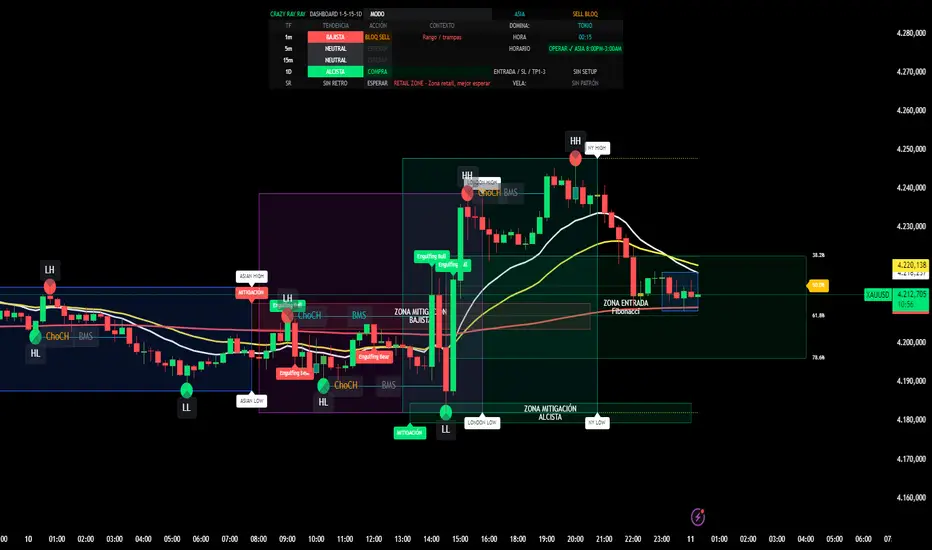
It’s a multi-timeframe institutional dashboard for XAU (or any pair) that tells you:
Trend & action on 1m / 5m / 15m / 1D
Best sessions & hours to trade (Asia, London, NY)
If the market is Institutional ON or just Retail zone
Smart Money structure (HH/HL/LL/LH, BOS, ChoCH, Fibo zones, mitigation boxes)
No-pullback entries (SIN RETRO) with automatic TP1–TP3
Extra BUY/SELL filters to block stupid trades (anti-stupid buy/sell)
You don’t need to understand every line of code. You just need to read the HUD + labels.
2. When NOT to trade
Before thinking BUY/SELL, look at the HUD (top center):
Time advice row (HORARIO)
If it says things like:
“NO OPERAR (ROLLOVER)”
“NO OPERAR (HORAS MUERTAS)”
“NO OPERAR (DESPUÉS 3:30 PM)”
👉 Do not trade.
Global status (top right of HUD)
If it shows:
“BUY BLOQ”, “SELL BLOQ”, or “BUY/SELL BLOQ”
👉 Market is dangerous for that side. Avoid entries in that direction.
Institutional status text (SR row, column “INST”)
If it says “RETAIL ZONE”, the move is weak / choppy.
👉 Only A+ setups, or better: skip.
3. BUY – how to use it (step-by-step)
A) Time & session
In the HUD, check:
Session name: LONDON or NEW YORK (or strong Asia scalp).
Time advice:
✅ “OPERAR ✔ LONDRES 3:00–5:00”
✅ “OPERAR ✔ NY OPEN 8:30–10:30”
✅ “OPERAR ✔ NY PM 1:30–3:30”
Institutional text:
✅ “INSTITUTIONAL ON – Momento pro…”
👉 If sessionStrong + Institutional ON = good environment to BUY.
B) Trend & bias
Look at the TF rows in the HUD:
1m / 5m / 15m / 1D:
TENDENCIA: should be mostly ALCISTA (green background).
ACCIÓN: should say “COMPRA” (not “VENTA” and not “BLOQ BUY”).
Mode box:
If MODO says:
“ALCISTA – SOLO COMPRAS” → you only look for BUY.
Global status (top right):
Best BUY statuses:
“BUY PRO ✅”
“BUY REV LL ✅”
or at least “BIAS BUY”
If you see “BUY TRAP ❌”, do NOT buy.
C) Entry types for BUY
You basically have 3 BUY styles:
1️⃣ BUY SIN RETRO (pure momentum)
Internal condition: entryBuyNoRetro
On chart:
You will see “BUY SIN RETRO” in the SR row (HUD)
And alert: “CRR BUY INSTITUCIONAL 1M”
Use it like this:
Trend up on 1m EMAs (15 > 30 > 200)
MACD gives bullish shift
Price crosses above EMA200
Session strong + Institutional ON
👉 You take the BUY with no pullback, pure breakout.
2️⃣ BUY PRO INSTITUCIONAL (full checklist)
Internal: fullBuySetup
You’ll see label “BUY PRO” below the candle.
Global status often shows: “BUY PRO ✅”
This is a mega-filtered BUY:
Institutional context OK (allowBuyInst = true)
Candle is bullish institutional pattern (engulfing, strong body, hammer, etc.)
Multi-TF bias bullish
Session strong
No blockers (not buyBlockerOn, not sellBlockerOn)
👉 This is your A+ professional BUY.
3️⃣ BUY REVERSAL LL (from discount & LL)
Internal: buyReversalLL
You’ll see label: “BUY REV LL” under the candle.
Global status may show: “BUY REV LL ✅”
Logic:
Market had bearish SMC (LLs)
You are near discount Fibo zone (38–61–78%)
Recent LL (support)
Price now above EMA200
Bullish candle pattern + strong session
👉 Reversal BUY from discount zone after taking liquidity.
D) Stop loss & take profits for BUY
When a valid Buy SIN RETRO signal appears:
Script automatically sets:
Entry price
SL (below swing low)
TP1 / TP2 / TP3 using your RR settings (tp1RR, tp2RR, tp3RR)
You see them in HUD:
Row: “ENTRADA / SL / TP1–3”
Text like:
BUY E: 2420.00 SL: 2415.00 T1: 2425.00 T2: 2427.50 T3: 2430.00
Basic management idea:
At TP1: close part, move SL to breakeven.
At TP2 / TP3: trail or close more.
4. SELL – how to use it (mirror of BUY)
Same idea but opposite side.
A) Time & session
Same rules: only when timeAdvice says OPERAR ✔ and Institutional ON.
Avoid rollover / dead hours / after 3:30 PM.
B) Trend & bias for SELL
TF rows (1m/5m/15m/1D):
TENDENCIA: mostly BAJISTA (red).
ACCIÓN: “VENTA”, not “COMPRA”, and not “BLOQ SELL”.
MODO: ideally “BAJISTA – SOLO VENTAS”.
Global status:
Best: “SELL PRO ✅”, “SELL REV HH ✅”, or “BIAS SELL”.
If you see “BUY BLOQ” it’s fine for sells; if “SELL BLOQ”, don’t sell.
C) Entry types for SELL
1️⃣ SELL SIN RETRO
Momentum no-pullback sell
MACD shift bearish + EMA200 break down
Strong session + institutional ON
👉 Use when entrySellNoRetro is true and “SELL SIN RETRO” appears.
2️⃣ SELL PRO INSTITUCIONAL
Label: “SELL PRO” above candle.
Global: “SELL PRO ✅”.
Full SMC + Fibo + multi-TF + candle + session confirmation.
3️⃣ SELL REVERSAL HH
Label: “SELL REV HH” above candle.
From premium zone (Fibo 61–78%) near a recent HH.
Bearish institutional candle from liquidity sweep high.
D) SL & TP for SELL
On Sell SIN RETRO, script sets:
Entry = close
SL = above swing high
TP1/TP2/TP3 below
Managed exactly like BUY but inverted.
5. Ultra-short “How to use” checklist (English)
For BUY:
Trade only when HUD time says “OPERAR ✔ …” and INSTITUTIONAL ON.
Mode near “ALCISTA – SOLO COMPRAS”, most TF rows show COMPRA.
Global status is BUY PRO ✅, BUY REV LL ✅ or BIAS BUY (not BUY BLOQ, not BUY TRAP ❌).
Take entries on:
BUY SIN RETRO,
BUY PRO,
or BUY REV LL,
with clear candle pattern + SL/TP line in HUD.
For SELL:
Same hours & Institutional ON.
Mode near “BAJISTA – SOLO VENTAS”, TF rows mostly VENTA.
Global status SELL PRO ✅, SELL REV HH ✅ or BIAS SELL (not SELL BLOQ).
Take SELL SIN RETRO, SELL PRO, or SELL REV HH with SL/TP from HUD.
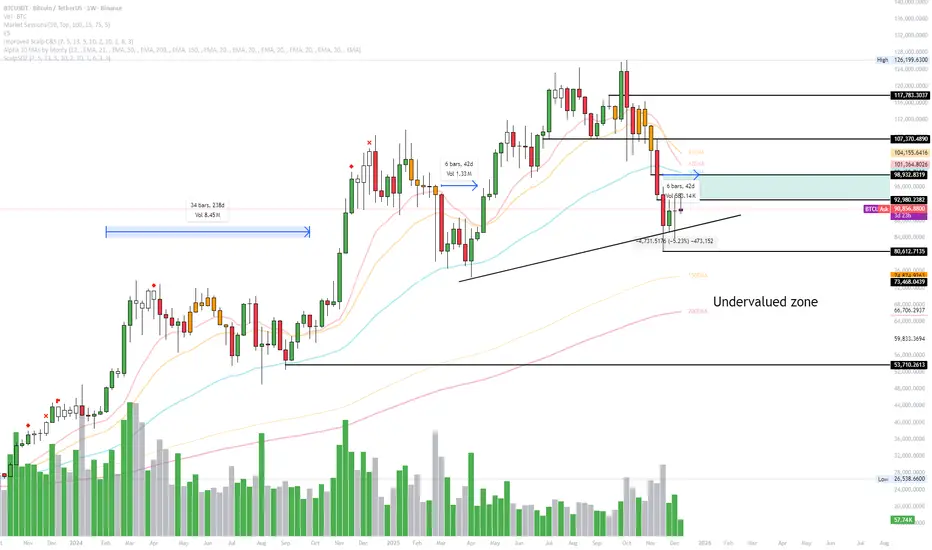
MTF Switch Level (Single TF)Multi-timeframe Switch Level (Single TF)
This indicator marks the most recent “switch level” created by breakout / breakdown behaviour on the current timeframe.
How it works
– After a bullish breakout (close above the previous bar’s high), the script sets a bearish switch level at that previous high.
– After a bearish breakdown (close below the previous bar’s low), it sets a bullish switch level at that previous low.
– A single horizontal line extends from the latest switch level.
– The line and “S” label turn bullish when price is above the level and bearish when price is below it.
– Optional alerts fire when price crosses the active switch level.
Use-cases
– Visualise where breakout traders are likely trapped.
– Define a simple “above = bullish / below = bearish” bias line.
– Combine with higher-timeframe analysis or other tools for context.
Inputs
– Enable/disable bullish and bearish switch conditions.
– Line length, colour, style, thickness.
– Label position and offsets.
– Alert conditions for crosses.
Disclaimer
This tool is for charting and educational purposes only and is not financial advice or a signal service. Always do your own research and risk management.

Reversal Reactor - Multi-Pattern Candle Reversal ScannerReversal Reactor - Multi-Pattern Candle Reversal Scanner
⚪ Overview
Reversal Reactor is a comprehensive candle-pattern and volume-pressure detection engine designed to highlight possible reversal environments.
It identifies abnormal volume surges, major single-candle reversal structures, and multi-candle formations such as Morning/Evening Stars — all refined through adjustable shadow-to-body ratios and adaptive lookback logic.
⚪ Core Features
Big-Volume Candle Detection : green or red full body.
Flags candles with unusually high volume relative to a volume EMA. These moments often reflect climactic pushes, absorption, forced liquidations, or rapid sentiment flips.
Reversal Candle Pattern Suite
A unified engine that detects major reversal structures with individual on/off control:
• Engulfing — Strong directional assertion via body-wide engulfing of prior candle.
• Morning Star — Three-stage bullish reversal following sustained selling.
• Evening Star — Bearish transition structure after an extended advance.
• Hammer — Long lower or upper wick showing strong rejection from one side of the market..
• Shooting Star — Long upper wick showing aggressive upside rejection.
• Hanging Man — Bearish exhaustion signal forming near range highs.
• Doji — Neutral indecision candle marking potential transition zones.
Shadow-to-Body Ratio Control
Fine-tunes wick-dominant pattern detection (hammer/star types) by requiring the shadow to exceed the body by a customizable multiplier, reducing low-quality signals.
Adaptive Lookback Logic
Allows users to adjust historical evaluation depth, improving sensitivity across different volatility regimes and asset behaviors. Default setting is recommended.
⚪ How Traders Use It
• Spot exhaustion near key support/resistance.
• Validate reversal attempts with volume confirmation.
• Filter for clean candle structures before entering momentum shifts.
Disclaimer
This indicator is intended for educational and informational purposes only. It does not constitute financial advice, nor does it guarantee performance or profitability. Always conduct your own analysis and manage risk appropriately when trading.

Failed 2 + 3→1 & 1→3 & 1 bar Alerts Failed 2 + Enhanced Strength + 3→1 & 1→3 & Inside Bar Alerts (with Dashboard)
This indicator is a strict, rule-based market structure and reversal framework built on The Strat methodology. It detects Failed 2 reversals, compression/expansion sequences (3→1 and 1→3), and confirmed Inside Bars, then grades Failed 2 signals using a multi-factor strength scoring system. A real-time dashboard displays the most recent Failed 2 signal and its strength.
The script is designed for bar-close accuracy, objective signal qualification, and visual clarity, without directional bias baked into the dashboard.
1. Core Signal Types Detected
A. Strict Failed 2 Reversals
Only true, textbook Failed 2 structures are detected. No loose or interpretive logic is used.
Failed 2 Up (F2U)
A bearish reversal following an attempted break higher:
Current bar makes a higher high than the prior bar
Current bar does NOT make a lower low
Close is below the prior bar’s high
Candle closes red (close < open)
Failed 2 Down (F2D)
A bullish reversal following an attempted break lower:
Current bar makes a lower low than the prior bar
Current bar does NOT make a higher high
Close is above the prior bar’s low
Candle closes green (close > open)
These rules ensure the market attempted continuation and failed, which is the defining characteristic of a Failed 2.
B. Inside Bars (IB)
An Inside Bar is defined as:
High is lower than the prior bar’s high
Low is higher than the prior bar’s low
Inside Bars are only confirmed on bar close.
⚠️ Important filtering rule:
Inside Bar labels are NOT displayed if the bar is part of a 3→1 or 1→3 sequence, preventing duplicate or misleading labels.
C. 3→1 and 1→3 Sequences
3→1 Compression
Prior bar is a 3-bar (engulfs the previous bar)
Current bar is an Inside Bar
This represents volatility compression and potential energy build-up.
1→3 Expansion
Prior bar is an Inside Bar
Current bar is a 3-bar
This represents range expansion and initiative activity.
2. Failed 2 Strength Scoring System (0–5 Points)
Each Failed 2 signal is objectively graded using five independent criteria. Each criterion contributes 1 point.
Scoring Components
Rejection Strength
Measures how deeply price rejected back inside the prior bar’s range
Strong rejection = 1 point
Range vs ATR
Current bar range > 75% of ATR
Indicates expansion and participation
Relative Volume
Volume > 1.2× the moving average volume
Confirms real interest, not low-liquidity noise
Wick Dominance
Upper wick dominance for F2U
Lower wick dominance for F2D
Wick must exceed 50% of total candle range
Key Level Proximity
Close is within a configurable percentage of:
Prior High (for F2U)
Prior Low (for F2D)
Strength Tiers
0–2 points → Weak
3 points → Strong
4–5 points → Very Strong
Strength is displayed both visually on the chart and numerically in the dashboard.
3. Visual Labels
Failed 2 Labels
Displayed only when enabled:
F2U / F2D → Weak
F2U! / F2D! → Strong
F2U!! / F2D!! → Very Strong
Color intensity increases with strength:
Red tones for Failed 2 Up
Green tones for Failed 2 Down
Labels are positioned:
Above the bar for F2U
Below the bar for F2D
Sequence Labels
3→1: Green label below the bar
1→3: Orange label above the bar
Inside Bar Label
Label text: IB
Only shown on confirmed close
Only shown if not part of a sequence
Small, unobtrusive visual style
4. Alerts (Bar-Close Accurate)
The indicator provides four independent alert conditions:
Strict Failed 2
Triggers on bar close
Fires for either F2U or F2D
3→1 Sequence
Compression detected on bar close
1→3 Sequence
Expansion detected on bar close
Inside Bar
Confirmed Inside Bar on bar close
All alerts are non-repainting and designed for automation or discretionary execution.
5. Dashboard (Signal Memory System)
The dashboard provides context continuity beyond the signal bar itself.
What It Displays
Current Bar Signal
F2U, F2D, or “none”
Strength
Numeric score (e.g., 4/5)
Persists after the signal
Sequence
3→1, 1→3, or none
Persistence Logic
When a Failed 2 occurs:
Strength and direction are stored
They remain visible for a configurable number of minutes (default: 2)
This allows traders to:
Enter on pullbacks
Maintain context after the signal bar closes
Customization
Toggle dashboard on/off
Choose screen corner placement
Custom text color
⚠️ The dashboard is neutral:
It does not infer bias
It only reports factual, most-recent structure
6. Inputs Summary
Toggle labels for:
Failed 2
Sequences
Inside Bars
ATR length for strength normalization
Volume average length
Key level proximity threshold
Strength persistence duration (minutes)
Dashboard visibility and positioning

Swing HL**摆动点标注(Swing HL)**
本指标用于在价格图表上标示摆动高点与摆动低点,以辅助用户观察价格结构、波段节奏及潜在支撑/阻力区域。标注以圆点形式叠加在主图上,可通过参数灵活控制显示周期、敏感度及视觉样式,适合作为价格结构分析的辅助工具。
### 参数及用法说明
1. **最小显示时间框架(minSwingTf)**
* 用途:设定摆动点开始显示的最小周期。
* 当前图表周期小于该设置时,不显示任何摆动标注。
* 建议:
* 做中短线结构分析时,可设置为 240 分钟或更高;
* 若需要在更小周期观察结构,可适当降低该参数。
2. **left / right(leftBars / rightBars)**
* 用途:共同控制摆动高点、低点识别的“严格程度”和频率。
* 调整建议:
* 数值较小:标注更频繁,适合关注细节波动、短线结构;
* 数值较大:只保留更明显的摆动点,适合观察中期或波段结构;
* 当图表上摆动点过多、显得拥挤时,可适当增大这两个参数。
3. **标注颜色(dotColor)**
* 用途:设置摆动点圆标的颜色。
* 建议根据图表背景及主图颜色进行调整,以保证摆动点清晰可见但不过于抢眼。
4. **线宽(dotWidth)**
* 用途:控制圆点标注的线宽,从而影响圆点的视觉大小。
* 当需要在高密度数据或缩放较小时保持清晰,可适当增大该数值。
### 使用建议
* 可将本指标作为结构辅助层叠加在任何交易系统之上,用于直观划分价格的波段高低点。
* 进行多周期分析时,可在较大周期(如 4H、日线)上利用本指标确认整体结构,再配合小周期执行入场与风控。
* 当摆动点过多时,可通过提高 `minSwingTf` 或增加 `left` / `right` 参数,使结构标注更加简洁清晰。
* 本指标仅提供价格摆动结构的可视化标注,不直接构成完整的交易信号或策略规则,建议与个人既有分析方法结合使用。
---
**Swing HL – Swing High/Low Marker**
This indicator marks swing highs and swing lows on the price chart to assist in reading price structure, swing rhythm, and potential support/resistance zones. Markers are plotted as dots on the main chart, and display behavior can be fully controlled via user inputs such as minimum timeframe, sensitivity, and visual style. It is designed to serve as a structural overlay for discretionary or systematic analysis.
### Inputs and Usage
1. **Minimum Display Timeframe (minSwingTf)**
* Purpose: Defines the minimum timeframe on which swing markers will be shown.
* When the current chart timeframe is below this setting, all swing markers are hidden.
* Guidance:
* For swing or position-style structure analysis, consider using 4H or higher;
* For intraday structural work, you may lower this value as needed.
2. **left / right (leftBars / rightBars)**
* Purpose: Jointly control how strict and how frequent swing highs and lows are marked.
* Tuning:
* Smaller values: More frequent swings, suitable for detailed, lower-timeframe structure;
* Larger values: Only more pronounced swings are kept, suitable for higher-level trend and swing mapping;
* If the chart becomes crowded with markers, increasing these values will simplify the structure.
3. **Marker Color (dotColor)**
* Purpose: Sets the color of the swing markers.
* It is recommended to choose a color that contrasts with the background and main price plot while remaining visually unobtrusive.
4. **Line Width (dotWidth)**
* Purpose: Controls the line width of the dot markers, effectively adjusting their perceived size.
* On dense charts or when zoomed out, a larger value can help maintain readability.
### Practical Notes
* Use this indicator as a structural overlay to highlight swing highs and lows alongside your existing trading tools and methods.
* In multi-timeframe workflows, it can help outline the main structure on higher timeframes (e.g., 4H, Daily), which you then refine on lower timeframes for execution.
* If too many swing points appear, either increase `minSwingTf` or raise the `left` / `right` values to obtain a cleaner structural view.
* The script is intended as a visualization aid for price swings; it does not, by itself, define entry, exit, or risk management rules and should be integrated into a broader analytical framework.

Dynamic Trend Channel - Adaptive Support & Resistance SystemA powerful trend-following indicator that adapts to market conditions in real-time. The Dynamic Trend Channel uses ATR-based volatility measurements to create intelligent support and resistance zones that adjust automatically to price action.
Key Features:
✓ Adaptive channel width based on market volatility (ATR)
✓ Color-coded trend identification (Green = Bullish, Red = Bearish)
✓ Smooth, flowing bands that reduce noise
✓ Breakout signals for high-probability entries
✓ Real-time info table showing trend status and price positioning
✓ Customizable settings for all timeframes


Volume Orderblock Breakout — Naaganeunja Lite v3.6final 3.6 modified
Upgrade for stable signals when candle is finished it stay forever, no signal same side
you can not be confused about signal so we can play with trading
FUCKING fantastic trading
MODIFY AGAIN we can earn the fuckin money

Exhaustion IndicatorThe ScalpSQZ indicator is designed to identify four critical market states using volatility structure, momentum behavior, and exhaustion conditions. It enhances scalping precision by visually marking transitions between consolidation, squeeze conditions, and momentum reversals through color-coded candles.
1. Squeeze Conditions (Orange Candles)
Orange candles highlight volatility compression, detected when Bollinger Bands contract inside the Keltner Channels. This structure signals that market volatility is tightening and a significant expansion move is likely to follow. The squeeze represents a pre-breakout environment and serves as the earliest warning of a potential directional shift.
2. Consolidation Conditions (Yellow Candles)
Yellow candles identify phases of low directional momentum. These conditions occur when RSI remains near neutral values, MACD histogram activity is minimal, and the Rate of Change stays muted. This combination indicates that the market is balanced and non-trending, often preceding a volatility spike or a new trend. Consolidation helps traders avoid low-probability entries during indecisive price action.
3. Momentum Exhaustion — Overbought Fade (White Candles)
White candles signal potential top-side exhaustion. This occurs when RSI enters overbought territory while the MACD histogram begins to weaken compared to the previous bar. This condition does not necessarily call a reversal but warns that bullish momentum is deteriorating and upside continuation may be limited. It is particularly useful for identifying trend fatigue and tightening stop-loss placement.
4. Momentum Exhaustion — Oversold Fade (Purple Candles)
Purple candles identify bottom-side exhaustion and appear when RSI reaches oversold levels, MACD momentum begins improving, and the current close shows buyer defense relative to the previous low. This condition suggests selling pressure is diminishing and a potential reversal or relief bounce may be forming. Purple candles serve as an early indication of bearish trend exhaustion.
Color Priority System
The indicator follows a fixed hierarchy to ensure clarity:
Squeeze (orange) has the highest priority, followed by consolidation (yellow). Exhaustion signals (white for tops, purple for bottoms) apply only when no squeeze or consolidation conditions are active. This structure ensures that the most critical market states are always highlighted first.
Purpose and Application
ScalpSQZ helps traders identify optimal environments for breakouts, anticipate trend exhaustion, and avoid low-quality trades during choppy or low-momentum conditions. It is suitable for scalping, day trading, and swing trading across any asset class or timeframe.
Volume Orderblock Breakout — Naaganeunja Lite v3.6 Upgrade for stable signals when candle is finished it stay forever, no signal same side
you can not be confused about signal so we can play with trading
FUCKING fantastic trading
MODIFY AGAIN we can earn the fuckin money

Quicksilver Institutional Trend [1H] The "God Candle" Catcher Most retail traders fail because they lack institutional tooling.
The Quicksilver Institutional Trend is designed to keep you in the trade during massive expansion moves and keep you out during the chop. It replaces "guessing" with a structured, math-based Trend Cloud.
THE LOGIC (Institutional Engine):
Visual Trend Cloud: A dynamic ribbon that identifies the dominant 1H market regime.
Momentum Filter (ADX): The bars change color based on Trend Strength.
Bright Green/Red: High Momentum (Institutional Volume). Stay in the trade.
Dark Green/Red: Low Momentum. Prepare to exit.
Liquidity Zones: Automatically draws Support & Resistance lines at recent institutional pivot points.
👨💻 NEED A CUSTOM BOT?
Stop trading manually. We can convert YOUR specific strategy into an automated algorithm.
Quicksilver Algo Systems specializes in building custom solutions for:
TradeLocker Studio (Python)
TradingView (Pine Script)
cTrader (C#)
MetaTrader 4/5 (MQL)
We don't just sell indicators; we engineer automated execution systems tailored to your exact risk parameters.
🚀 HOW TO HIRE US:
If you have a strategy you want automated, we are currently accepting new custom development projects.
Contact the Lead Developer directly:
📧 Email: quicksilveralgo@gmail.com
(Include "Custom Bot Request" in the subject line for priority review).
🔥 UNLOCK THE NEXT INDICATOR:
We are releasing our "Sniper Scalper" logic next week.
Hit the BOOST (Rocket) Button 🚀 above.
Click FOLLOW on our profile.
Comment "QAS" below if you want to be notified.
Disclaimer: Trading involves substantial risk. Educational purposes only.

Cloud Matrix [CongTrader]🚀 Cloud Matrix — Advanced Multi-Layer Ichimoku System
Cloud Matrix is an enhanced trend-analysis system built on the public-domain Ichimoku Kinko Hyo methodology.
This indicator delivers a multi-dimensional view of trend, momentum, and market structure, allowing traders to evaluate market conditions at a glance.
Cloud Matrix is not a simple Ichimoku clone. It introduces advanced confirmation logic, multi-timeframe trend filtering, and a modern visual framework designed for today’s dynamic markets.
🔥 Key Features & Highlights
1️⃣ Smart Preset Engine (4 Modes)
Choose from optimized presets for different markets and volatility levels:
Traditional 9/26/52
Crypto Fast 10/30/60
Crypto Medium 20/60/120
Custom Mode
→ Fast, adaptable, and beginner-friendly.
2️⃣ Advanced Trend Confirmation Engine
Cloud Matrix uses a 5-factor scoring system to filter high-quality signals:
Tenkan vs Kijun
Price vs Cloud
Cloud Twist
Chikou Position
Close vs Kijun
A bullish/bearish signal only triggers when multiple Ichimoku conditions align, reducing noise dramatically.
3️⃣ Higher-Timeframe EMA200 Filter
One of the signature strengths of Cloud Matrix:
EMA200 from a higher timeframe
Helps you follow the dominant macro trend
Avoids counter-trend traps
Ideal for swing and position traders
4️⃣ Intelligent Auto Signals
The indicator includes refined and clean signals for:
Bullish / Bearish TK Cross
Bullish / Bearish Kumo Breakout
All signals support:
Labels
Alerts
“Alert on Close” mode to avoid repaint-related confusion
5️⃣ Enhanced Kumo Cloud Visualization
Adjustable opacity (strong / soft)
Clear bullish/bearish cloud shading
Improved readability on fast markets
6️⃣ Real-Time Market State Dashboard
A compact dashboard shows all key Ichimoku conditions:
Price vs Cloud
Cloud Twist (Bullish/Bearish)
Tenkan–Kijun Relationship
Chikou Status
HTF EMA Trend
Active Preset
→ Designed for instant market diagnostics.
🎯 How Traders Use Cloud Matrix
Perfect for:
Trend following
Swing trading
Crypto, Stocks, Forex
Early breakout detection
Filtering low-quality setups
📌 Suggested Usage
Bullish Bias When:
Price is above the Cloud
Cloud Twist is bullish
Tenkan crosses above Kijun
Chikou is above price
HTF EMA200 is bullish
Bearish Bias When:
Opposite conditions apply.
⚠️ Important Note
This indicator is for analysis and educational purposes only.
It does not provide financial advice or guaranteed trading results.
Ichimoku concepts belong to the public domain; this is a modernized expansion built for study and research.
✍️ Author
CongTrader – 2025
Designed to help traders see the market through a multi-layered, structured lens..

UNDETECTED FX - Psychologic LevelsThis indicator automatically plots major 250-pip psychological levels on XAUUSD and highlights the price zones around them. These levels act as strong reaction points where liquidity, reversals, and institutional activity commonly occur.
What the Indicator Does
✔ Plots every 250-pip level starting from a user-defined base (e.g., 4050 → 4075 → 4100 → 4125 → …)
✔ Each level is represented by a thick black horizontal line for maximum visual clarity
✔ Around every 250-pip level, the indicator draws a liquidity zone
Top of zone: +200 pips
Bottom of zone: –200 pips
(configured as ± zoneHalf in settings)
✔ Uses extend: both, so levels stretch across the entire chart and stay fixed, no matter how far you scroll
✔ Zones are filled with a customizable color for clear premium/discount visualization
✔ The indicator never repaints and requires no updates after drawing — all levels are fixed on their price coordinates
Why It’s Useful
🔹 Helps quickly identify institutional levels where gold often reacts
🔹 Acts as a framework for scalping, intraday trading, and swing bias
🔹 Makes it easy to spot liquidity sweeps, rejections, and premium/discount areas
🔹 Clearly shows market structure breaks around key psychological levels
🔹 Forces discipline by creating predefined, fixed levels for trading decisions
Best Use Case
XAUUSD scalpers
Intraday traders who rely on precision entries
Traders who use psychological levels, liquidity grabs, or smart-money concepts
Anyone wanting a clean, non-cluttered chart with high-impact levels only

Smart Scalper V7 [Churn Filter]Indicator uses relative volume by time as well as ADX to highlight if volume is high to prevent trading in chop or being faked out.
Dec 1
Release Notes
How to Read the "Traffic Light" 🚦
You asked: "How do I work out if volume is higher or lower?" Look at the White Horizontal Line running across the indicator.
Height (Quantity):
Above the Line: Volume is High (The crowd is here).
Below the Line: Volume is Low (Everyone is at lunch).
Color (Quality):
🟢 Green: High Volume + Strong Trend. (Best for Entries).
🟡 Yellow: High Volume but NO Trend. This is usually a Reversal or a Trap. (Big fight, no winner yet).
🟠 Orange: Trending, but on Low Volume. The price is drifting. Don't trust it—it can snap back easily.
🔴 Red: Low Volume, No Trend. The "Kill Zone." Do not trade.

Volume Orderblock Breakout — Naaganeunja Lite v3.6Upgrade for stable signals when candle is finished it stay forever
you can not be confused about signal so we can play with trading
FUCKING fantastic trading

Session Fibonacci Tracker with Dynamic Range FreezeSession Fibonacci Tracker with Dynamic Range Freeze
This indicator plots Fibonacci retracement and extension levels based on session high/low ranges with a unique "freeze" mechanism that locks levels during volatility and recalculates only when price returns to the established range.
How It Works:
The indicator uses a three-stage process to maintain stable Fibonacci levels:
Range Establishment: At the start of each session (default 1800 ET), the indicator tracks the session high and low. Fibonacci levels are calculated with dynamic anchoring - when price is above the session open, 0 anchors at the high with 1 at the low; when below, 0 anchors at the low with 1 at the high.
Freeze Mechanism: Once the range is established, it immediately freezes. If a candle closes outside this range, the Fibonacci levels remain locked at their current values even as new session highs or lows form. This prevents levels from constantly recalculating during trending moves.
Recalculation: The frozen range only updates when price action (high or low) touches back inside the established range. At this point, levels recalculate based on the current session high/low, then freeze again.
Key Features:
Customizable Fibonacci levels: All retracement (0.236, 0.382, 0.500, 0.618, 0.786) and extension levels (-1.0, -0.618, -0.272, 1.272, 1.618, 2.0) can be enabled/disabled and adjusted to custom values
Time-based line extension prevents historical buffer overflow errors
Works across all timeframes
Session start time fully customizable
Visual status indicator shows whether levels are frozen or active
All lines and labels are fully customizable (colors, width, labels, prices)
Use Cases:
This indicator is particularly useful for traders who want stable reference levels during volatile periods. Traditional Fibonacci tools recalculate with every new extreme, making them difficult to use as support/resistance during trends. This implementation keeps levels stable until price returns to consolidation, providing consistent reference points for entries, exits, and stop placement.
Settings:
Session Settings: Configure session start time (default 1800 ET)
Fibonacci Levels: Enable/disable and customize each retracement level value
Extension Levels: Enable/disable and customize each extension level value
Visual Settings: Adjust line extension, width, labels, and price display
Colors: Customize colors for open line, 0 level, 1 level, retracements, and extensions

ZKNZCN Önceki Bar H/L (Ayrı Kontrol)Bir önceki barın high & low noktalarını çizgi halinde görmeyi sağlar.

(5+15+60min+1D)EMA20+Y'SH/L+count简介: 这是一个专为 5分钟图表 (5min Chart) 日内交易者设计的综合辅助工具。它结合了多周期趋势均线、美股核心交易时段的时间周期计数以及关键流动性位置(前一日高低点)的智能突破监测。该脚本针对美股个股及 24/7 交易的 BTC/ETH 进行了优化,强制锁定纽约时间进行运算。
核心功能:
1. 多周期 EMA 监控系统 (MTF EMAs)
5min EMA20 (蓝色):日内短期趋势核心线(默认开启)。
60min EMA20 (绿色):小时级别趋势参考(默认开启)。
15min EMA20 (红色) & 1D EMA20 (橙色):可选开启,用于捕捉更大周期的支撑阻力。
特点:所有均线采用最细线宽,平滑显示,右上角表格实时展示当前价格。
2. 美股时段 Bar Count 计数器
时间锚定:以纽约时间 (New York Time) 09:30 开盘为起点(Bar 0)。
显示规则:仅在 K 线底部显示 偶数 序号 (0, 2, 4, 6 ...),直至第 82 根 K 线停止。
关键时间窗 (Time Pivots):
Bar 18 (约 NY 10:55) 和 Bar 40 (约 NY 12:45) 会被自动高亮。
字体变为 蓝色粗体,且对应 K 线实体变为蓝色,提示潜在的变盘或宏观流动性注入时刻。
3. 智能 PDH/PDL 射线 (Smart Rays)
精确锚点:前一日高点 (PDH) 和低点 (PDL) 的射线不是从开盘画起,而是从昨日形成高低点的具体时间点射出,精确还原价格行为。
自动阻断 (Breakout Logic):一旦当前价格触碰或突破该射线,射线将自动停止延伸,直观展示“阻力/支撑已失效”。
自动清理:每日自动清除旧线,仅保留当天的参考线,保持图表整洁。
4. 视觉优化
每日分割线:自动绘制灰色虚线分隔交易日。
图表限制:脚本仅在 5分钟图表上可见,切换周期自动隐藏,避免干扰大周期分析。
设置说明:
可在设置面板中自由开关各周期 EMA 的显示。
可开关底部的计数数字显示。
English Version (for TradingView Publishing)
Title: 5min Intraday Precision Toolkit: MTF EMAs + NY Session Count + Smart Rays
Introduction: This is a comprehensive auxiliary tool designed specifically for 5-minute chart intraday traders. It combines multi-timeframe trend EMAs, time cycle counting based on the US Session, and smart breakout monitoring for key liquidity levels (Previous Day High/Low). Optimized for US Equities and Crypto (BTC/ETH) using New York Time.
Key Features:
1. Multi-Timeframe EMA System
5min EMA20 (Blue): Core short-term intraday trend (On by default).
60min EMA20 (Green): Hourly trend reference (On by default).
15min EMA20 (Red) & 1D EMA20 (Orange): Optional overlays for higher timeframe support/resistance.
Visuals: All EMAs are rendered with fine lines for a clean look, accompanied by a top-right dashboard table.
2. NY Session Bar Count
Time Anchor: Starts counting from 09:30 New York Time (Bar 0).
Display Logic: Displays only EVEN numbers (0, 2, 4...) at the bottom of the bars, stopping at count 82.
Time Pivots:
Bar 18 (~10:55 NY) and Bar 40 (~12:45 NY) are highlighted.
Labels turn Bold Blue, and the specific candles are colored Blue to indicate potential reversal or liquidity injection times.
3. Smart PDH/PDL Rays
Precise Origin: Rays for Previous Day High (PDH) and Previous Day Low (PDL) originate from the exact timestamp they were created yesterday, not just the daily open.
Breakout Stop Logic: Rays automatically stop extending once price touches or breaks them, clearly indicating that the level has been tested.
Auto-Clean: Automatically removes old rays from previous days to keep the chart clean.
4. Visual Optimization
Daily Separators: Automatic vertical dotted lines marking new days.
Visibility: All elements are hidden on non-5m charts to prevent clutter.
Settings:
Toggle visibility for individual EMAs.
Toggle visibility for the bottom bar counter.
