Williams AD + MA“I’ve added an MA to the Williams Accumulation/Distribution (AD) indicator. You can use it to infer potential trend inflection points and to assess the persistence of the trend.”Pine Script® göstergesichart_plan tarafından6
MCL RSI Conflux v2.5 — Multi-Timeframe Momentum & Z-Score Full Description Overview The MCL RSI Conflux v2.5 is a multi-timeframe momentum model that integrates daily, weekly, and monthly RSI values into a unified composite. It extends the classical RSI framework with adaptive overbought/oversold thresholds and statistical normalization (Z-score confluence). This combination allows traders to visualize cross-timeframe alignment, identify synchronized momentum shifts, and detect exhaustion zones with higher statistical confidence. Methodology The script extracts RSI data from three major time horizons: Daily RSI (short-term momentum) Weekly RSI (intermediate trend) Monthly RSI (macro bias) Each RSI is optionally smoothed, weighted, and aggregated into a Composite RSI. A Z-score transformation then measures how far each RSI deviates from its historical mean, revealing when momentum strength is statistically extreme or aligned across timeframes. Key Features Multi-Timeframe RSI Engine – Computes RSI across D/W/M intervals with individual weighting controls. Adaptive Overbought/Oversold Bands – Automatically adjusts OB/OS thresholds based on rolling volatility (standard deviation of daily RSI). Composite RSI Score – Weighted consensus RSI that represents total market momentum. Z-Score Confluence Analysis – Identifies when all three timeframes are statistically synchronized. Z-Composite Histogram – Displays aggregated Z-score strength around the midline (50). Divergence Detection – Flags confirmed pivot-based bull and bear divergences on the daily RSI. Dynamic Gradient Background – Shifts from red to green based on composite momentum regime. Customizable Control Panel – Displays RSI values, Z-scores, state, and adaptive bands for each timeframe. Integrated Alerts – For crossovers, risk-on/off thresholds, alignment, and Z-confluence events. Interpretation All RSI values above 50: multi-timeframe bullish alignment. All RSI values below 50: multi-timeframe bearish alignment. Composite RSI > 60: risk-on environment; momentum expansion. Composite RSI < 45: risk-off environment; momentum contraction. Adaptive OB/OS hits: potential exhaustion or mean reversion setup. Green Z-ribbon: all Z-scores positive and aligned (statistical confirmation). Red Z-ribbon: all Z-scores negative and aligned (broad market weakness). Divergences: short-term warning signals against the prevailing momentum bias. Practical Application Use the Composite RSI as a global momentum gauge for position bias. Trade only in the direction of higher-timeframe alignment (avoid countertrend RSI). Combine Z-ribbon confirmation with Composite RSI crosses to filter noise. Use divergence labels and adaptive thresholds for risk reduction or exit timing. Ideal for swing traders and macro momentum models seeking trend synchronization filters. Recommended Settings Market Mode k-Band Lookback Use Case Stocks / ETFs Adaptive 0.85 200 Medium-term rotation filter Crypto Adaptive 1.00 150 Volatility-responsive swing filter Commodities Fixed 70/30 100 Mean reversion model Alerts Included Daily RSI crossed above/below Weekly RSI Composite RSI > Risk-On threshold Composite RSI < Risk-Off threshold All RSI aligned above/below 50 Z-Score Conformity (All positive or all negative) Overbought/Oversold triggers Author’s Note This indicator was designed for research and systematic confluence analysis within Mongoose Capital Labs. It is not financial advice and should be used in combination with independent risk assessment, volume confirmation, and higher-timeframe context.Pine Script® göstergesiTheRealMongoose tarafından12
Local Hurst Slope [Dynamic Regime]1. HOW THE INDICATOR WORKS (Math → Market Edge)Step Math Market Intuition 1. Log-Returns r_t = log(P_t / P_{t-1}) Removes scale, makes series stationary 2. R/S per τ R = max(cum_dev) - min(cum_dev) S = stdev(segment) Measures memory strength over window τ 3. H(τ) = log(R/S) / log(τ) Di Matteo (2007) H > 0.5 → Trend memory H < 0.5 → Mean-reversion 4. Slope = dH/d(log τ) Linear regression of H vs log(τ) Slope > 0.12 → Trend accelerating Slope < -0.08 → Reversion emerging LEADING EDGE: The slope changes 3–20 bars BEFORE price confirms → You enter before the crowd, exit before the trap Slope > +0.12 + Strong Trend = Bullish = Long Slope +0.05 to +0.12 = Weak Trend = Cautious = Hold/Trail Slope -0.05 to +0.05 = Random = No Edge Slope-0.08 to -0.05 = Weak Reversion = Bearish setup = Prepare Short Slope < -0.08 = Strong Reversion = Bearish= Short PRO TIPS Only trade in direction of 200-day SMA Filters false signals Avoid trading 3 days before/after earnings Volatility kills edge Use on ETFs (SPY, QQQ) Cleaner than single stocks Combine with RSI(14) RSI < 30 + Hurst short = nuclear reversal Pine Script® göstergesiTruSignal_Strategies tarafından8
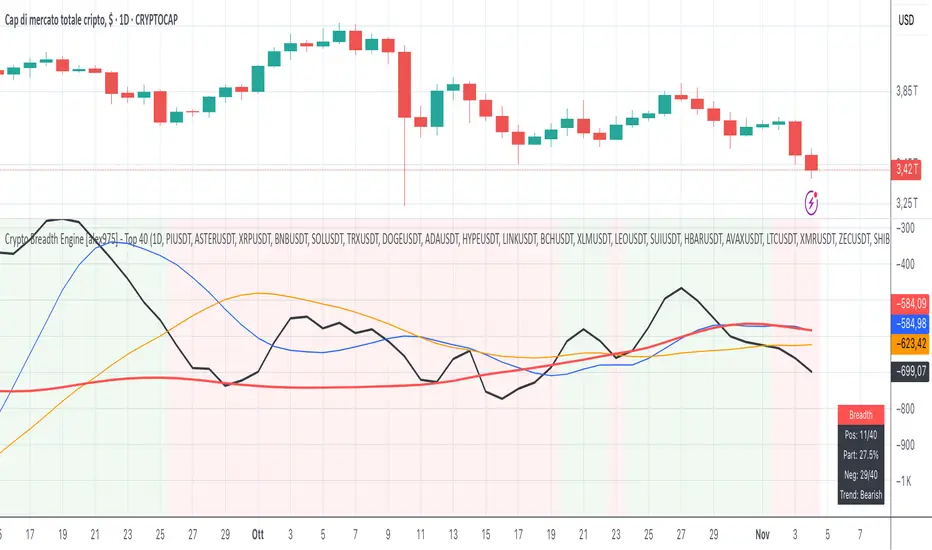
Crypto Breadth Engine [alex975] A normalized crypto market breadth indicator with a customizable 40 coin input panel — revealing whether rallies are broad and healthy across major coins and altcoins or led by only a few. 📊 Overview The Crypto Breadth Engine measures the real participation strength of the crypto market by analyzing the direction of the 40 largest cryptocurrencies by market capitalization. ⚙️ How It Works Unlike standard breadth tools that only count assets above a moving average, this indicator measures actual price direction: +1 if a coin closes higher, –1 if lower, 0 if unchanged. The total forms a Breadth Line, statistically normalized using standard deviation to maintain consistent readings across timeframes and volatility conditions. 🧩 Dynamic Input Mask All 40 cryptocurrencies are fully editable via the input panel, allowing users to easily replace or customize the basket (Top 40, Layer-1s, DeFi, Meme Coins, AI Tokens, etc.) without touching the code. This flexibility keeps the indicator aligned with the evolving crypto market. 🧭 Trend Bias The indicator classifies market structure as Bullish, Neutral, or Bearish, based on how the Breadth Line aligns with its moving averages (10, 20, 50). 💡 Dashboard A compact on-chart table displays in real time: • Positive and negative coins • Participation percentage • Current trend bias 🔍 Interpretation • Rising breadth → broad, healthy market expansion • Falling breadth → narrowing participation and structural weakness Ideal for TOTAL, TOTAL3, or custom crypto baskets on 1D,1W. Developed by alex975 – Version 1.0 (2025). ------------------------------------------------------------------------------------- 🇮🇹 Versione Italiana 📊 Panoramica Il Crypto Breadth Engine misura la partecipazione reale del mercato crypto, analizzando la direzione delle 40 principali criptovalute per capitalizzazione. Non si limita a contare quante coin sono sopra una media mobile, ma calcola la variazione effettiva del prezzo: +1 se sale, –1 se scende, 0 se invariato. La somma genera una Breadth Line normalizzata statisticamente, garantendo letture coerenti su diversi timeframe e fasi di volatilità. 🧩 Mascherina dinamica L’indicatore include una mascherina d’input interattiva che consente di modificare o sostituire liberamente i 40 ticker analizzati (Top 40, Layer-1, DeFi, Meme Coin, ecc.) senza intervenire nel codice. Questo lo rende sempre aggiornato e adattabile all’evoluzione del mercato crypto. ⚙️ Funzionamento e Trend Bias Classifica automaticamente il mercato come Bullish, Neutral o Bearish in base alla relazione tra la breadth e le medie mobili (10, 20, 50 periodi). 💡 Dashboard Una tabella compatta mostra in tempo reale: • Numero di coin positive e negative • Percentuale di partecipazione • Stato attuale del trend 🔍 Interpretazione • Breadth in crescita → mercato ampio e trend sano • Breadth in calo → partecipazione ridotta e concentrazione su pochi asset Ideale per analizzare TOTAL, TOTAL3 o panieri personalizzati di crypto. Funziona su timeframe 1D, 4H, 1W. Sviluppato da alex975 – Versione 1.0 (2025). Pine Script® göstergesiAlex975 tarafından4417
VIX OscillatorVIX Oscillator for catching vol signals on the same chart as your index of choice. - Configurable levels that alert you when certain thresholds are broken - Shaded background that make it simple to tell when you are in low vol/high vol regimes - Moving line tracking price so that you can easily see bull/bear divergences against SPX building Pine Script® göstergesiMarket_Weather tarafındanGüncellendi 16
TICK OscillatorOscillator that makes it easy to see when TICK is hitting extreme readings or establishing a bullish/bearish divergence vs the indices. - Green coloration means a reading of >+400 - Red coloration means a reading of <-400 - Orange means a reading in between -400 and +400 This was inspired by John F Carter's book "Mastering The Trade", where I first learned about utilizing TICK in my trading. Pine Script® göstergesiMarket_Weather tarafından29
Liquidity & Momentum Master (LMM)💎 Liquidity & Momentum Master (LMM) A professional dual-system indicator that combines: 📦 High-Volume Support/Resistance Zones and 📊 RSI + Bollinger Band Combo Signals — to visualize both smart money footprints and momentum reversals in one clean tool. 🧱 1. High-Volume Liquidity Zones (Support/Resistance Boxes) Conditions Visible only on 1H and higher timeframes (1H, 4H, 1D, etc.) Detects candles with abnormally high volume and strong ATR-based range Separates bullish (support) and bearish (resistance) zones Visualization All boxes are white, with adjustable transparency (alphaW, alphaBorder) Each box extends to the right automatically Only the most important (Top-N) zones are kept — weaker ones are removed automatically Interpretation White boxes = price areas with heavy liquidity and volume concentration Price approaching these zones often leads to bounces or rejections Narrow spacing = consolidation, wide spacing = potential large move 💎 2. RSI Exit + BB-RSI Combo Signals RSI Exit (Overbought/Oversold Recovery) RSI drops from overbought (>70) → plots red “RSI” above the candle RSI rises from oversold (<30) → plots green “RSI” below the candle Works on 15m, 30m, 1H, 4H, 1D → Indicates short-term exhaustion recovery BB-RSI Combo (Momentum Reversal Confirmation) Active on 1H and higher only Requires both: ✅ RSI divergence (bullish or bearish) ✅ Bollinger Band re-entry (after temporary breakout) Combo Buy (Green Diamond) Bullish RSI divergence Candle closes back above lower Bollinger Band Combo Sell (Red Diamond) Bearish RSI divergence Candle closes back below upper Bollinger Band → Confirms stronger reversal momentum compared to standard RSI signalsPine Script® göstergesiHSeungpyo tarafından71
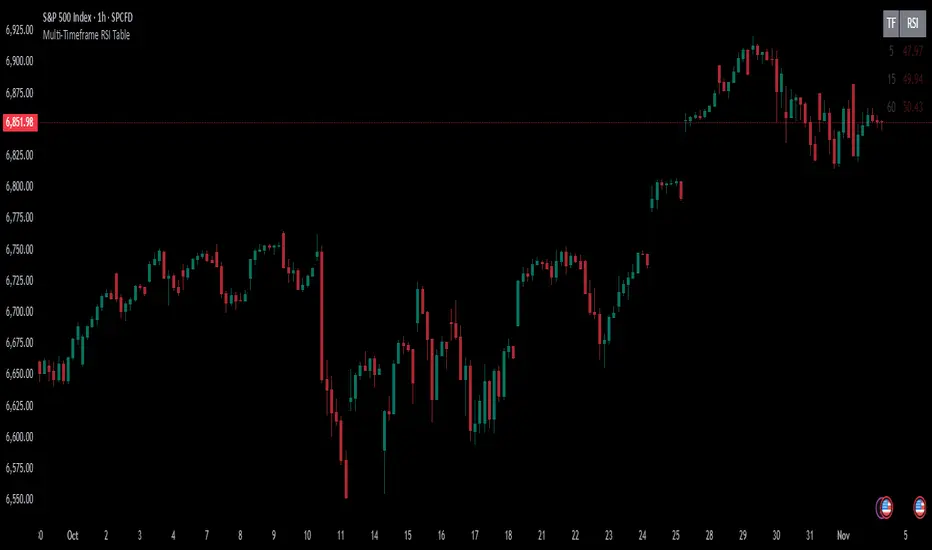
Multi-Timeframe RSI TableIt can print RSI values of any four chosen periods in a tabular format on the chart itself. The table can be placed in any of the six positions, as required. If the RSI values are more than 40 or less than 40, these values are shown in bright Red, else it is light Red.Pine Script® göstergesiashishk_70 tarafındanGüncellendi 4
Flow Control Oscillator (FCO)Flow Control Oscillator (FCO) The Flow Control Oscillator (FCO) is a momentum-based indicator that combines volume analysis and money flow to determine who is in control of the market—buyers or sellers—and how strong that control is. Unlike pure price-based oscillators, FCO integrates both price action and volume distribution to provide a more complete picture of market dynamics. How It Works Core Components: Money Flow Index (MFI) - Scaled to -1 to +1 range Measures the flow of money into and out of an asset Identifies buying and selling pressure based on price and volume Chaikin Money Flow (CMF) - Already in -1 to +1 range Measures the accumulation/distribution of volume Shows whether volume is accumulating (buying) or distributing (selling) Combined Flow Control Line (FCO Line) - Equal-weighted composite of MFI and CMF Smoothed with SMA (default: 3 periods) Values above 0 = Buyers in control Values below 0 = Sellers in control Signal Line - WMA of the FCO line (default: 6 periods) Used for timing entries and confirming momentum shifts Momentum Histogram- Shows the rate of change in buyer/seller control Weighted by ADX (Average Directional Index) when enabled Larger bars = stronger momentum ADX weighting filters out choppy, unreliable signals Key Zones Neutral Zone (-0.3 to +0.3): Balanced market, low conviction Healthy Trend Zone (±0.3 to ±0.7): Clear control without exhaustion Warning Zone (±0.7 to ±1.0): Extended, approaching exhaustion Extreme Zone (beyond ±1.0): Overbought/oversold, reversal likely What To Look For Reversal Setups: FCO in extreme zone (beyond ±1.0) FCO crosses Signal line in opposite direction Momentum histogram shrinking (weakening pressure) Interpretation: Buyers or sellers are exhausted and losing control Trend Strength Setups: FCO crosses zero line (control shift) Momentum histogram growing in the same direction ADX confirms strong trend (no orange background) Signal line moving in same direction as FCO Interpretation: New control being established with building momentum Divergences: Price makes new high/low but FCO doesn't confirm Indicates weakening momentum despite price movement Early warning of potential reversal Choppy Market Warning: Orange background (ADX < 20) Small momentum bars regardless of FCO position Interpretation: Weak trend, avoid trading or use tight stops Best Practices: Use with context: Combine with support/resistance levels (like VWAP) for confluence Multi-timeframe confirmation: Check higher timeframe FCO for overall bias Wait for confirmation: Let signals develop rather than predicting turns Respect extreme zones: Best reversal opportunities occur when FCO is beyond ±1.0 Filter with ADX: Pay attention to background coloring—avoid choppy conditions The indicator includes comprehensive alert conditions for: Reversal setups (extreme + cross + weakening momentum) Trend strength signals (zero cross + growing momentum + strong ADX) FCO/Signal crossovers Extreme overbought/oversold conditions Control shifts (buyers/sellers taking control) Pine Script® göstergesiWalrusQuant tarafındanGüncellendi 22125
Tristan's Tri-band StrategyTristan's Tri-band Strategy - Confluence Trading System Strategy Overview: This strategy combines three powerful technical indicators - RSI, Williams %R, and Bollinger Bands - into a single visual trading system. Instead of cluttering your chart with separate indicator panels, all signals are displayed directly on the price chart using color-coded gradient overlays, making it easy to spot high-probability trade setups at a glance. How It Works: The strategy identifies trading opportunities when multiple indicators align (confluence), suggesting strong momentum shifts: 📈 Long Entry Signals: RSI drops to 30 or below (oversold) Williams %R reaches -80 to -100 range (oversold) Price touches or breaks below the lower Bollinger Band All three conditions must align during your selected trading session 📉 Short Entry Signals: RSI rises to 70 or above (overbought) Williams %R reaches 0 to -20 range (overbought) Price touches or breaks above the upper Bollinger Band All three conditions must align during your selected trading session Visual Indicators: (faint) Green gradients below candles = Bullish oversold conditions (buying opportunity) (faint) Red/Orange gradients above candles = Bearish overbought conditions (selling opportunity) Stacked/brighter gradients = Multiple indicators confirming the same signal (higher probability) will stack and show brighter / less faint Blue Bollinger Bands = Volatility boundaries and mean reversion zones Exit Strategy: Long trades exit when price reaches the upper Bollinger Band OR RSI becomes overbought (≥70) Short trades exit when price reaches the lower Bollinger Band OR RSI becomes oversold (≤30) Key Features: ✅ Session Filters - Trade only during NY (9:30 AM-4 PM), London (3 AM-11:30 AM), or Asia (7 PM-1 AM EST) sessions ✅ No Repainting - Signals are confirmed on candle close for realistic backtesting and live trading ✅ Customizable Parameters - Adjust RSI levels, BB standard deviations, Williams %R periods, and gradient visibility ✅ Visual Clarity - See all three indicators at once without switching between panels ✅ Built-in Alerts - Get notified when entry and exit conditions are met How to Use Effectively: Choose Your Trading Session - For day trading US stocks, enable only the NY session. For forex or 24-hour markets, select the sessions that match your schedule. Look for Gradient Stacking - The brightest, most visible gradients occur when both RSI and Williams %R signal together. These are your highest-probability setups. Confirm with Price Action - Wait for the candle to close before entering. The strategy enters on the next bar's open to prevent repainting. Respect the Bollinger Bands - Entries occur at the outer bands (price extremes), and exits occur at the opposite band or when momentum reverses. Backtest First - Test the strategy on your preferred instruments and timeframes. Works best on liquid assets with clear trends and mean reversion patterns (stocks, major forex pairs, indices). Adjust Gradient Visibility - Use the "Gradient Strength" slider (lower = more visible) to make signals stand out on your chart style. Best Timeframes: 5-minute to 1-hour charts for intraday trading; 4-hour to daily for swing trading (I have also found the 3 hour timeframe to work really well for some stocks / ETFs.) Best Markets: Liquid instruments with volatility - SPY, QQQ, major stocks, EUR/USD, GBP/USD, major indices Risk Management: This is a mean reversion strategy that works best in ranging or choppy markets. In strong trends, signals may appear less frequently. Always use proper position sizing and stop losses based on your risk tolerance. ---------------------------------------------- Note: Past performance does not guarantee future results. This strategy is provided for educational purposes. Always backtest thoroughly and practice proper risk management before live trading.RetryClaude can make mistakes. Please double-check responses. Sonnet 4.5Pine Script® stratejisiOhRayOhRay tarafından53
RSI Exit + BB-RSI Combo📊 RSI Exit + BB-RSI Combo Indicator This indicator combines RSI overbought/oversold exit signals with Bollinger Band re-entry conditions to highlight potential reversal or retracement zones. 1️⃣ RSI Exit Signal - When RSI drops below 70 after being overbought → 🔴 "RSI" label - When RSI rises above 30 after being oversold → 🟢 "RSI" label - Works on 15m / 30m / 1h / 4h / 1D timeframes 2️⃣ BB-RSI Combo Signal - When an RSI divergence forms and - The candle body re-enters the Bollinger Band on 1H+ timeframe → Combo signal (💎 diamond) is shown 💡 How to Use - Use RSI exit signals to spot overextension corrections - Use combo signals to identify high-probability reversal or rebound setups - Suitable for both swing and short-term trading Pine Script® göstergesiHSeungpyo tarafından83
[FGL] Stochastic ATR Trend IndicatorThis indicator: Detects trend direction using ATR-based dynamic bands around SMA. Generates buy/sell signals using Stochastic crossover conditions filtered by trend. Colors candles to show trend direction. Plots a visual “trend zone” band on the chart. INPUT PARAMETERS: Stochastic Length → Period for the stochastic oscillator. Smooth K and Smooth D → Smoothing parameters for %K and %D lines. ATR Length → Period used for SMA-based trend detection. LOGIC FLOW Determine trend using long ATR-based SMA channel. Detect momentum change with Stochastic cross. Confirm both momentum and price align with trend. Generate buy/sell signal + change candle color. STRATEGIC INTERPRETATION Best use: Trend-following momentum entries. Avoids: Countertrend false signals by filtering with trend value. Signals: Buy: In uptrend + bullish stochastic crossover. Sell: In downtrend + bearish stochastic crossover. Pine Script® göstergesiFrogile tarafından46
Volume Weighted Stochastic RSIThis indicator calculates the Stochastic RSI, enhanced with optional Volume Weighting (VWStochRSI). It measures the level of a (Volume-Weighted) RSI relative to its high-low range over a set period, providing a sensitive momentum oscillator. Key Features: Volume-Weighted Core: The indicator is built on a Relative Strength Index (RSI) that can be optionally volume-weighted (Volume weighted). Customizable Smoothing: The %K and %D lines are smoothed using a customizable moving average. The MA type (Smooth Method) can be selected (e.g., EMA, SMA, WMA) and will also be volume-weighted if the main Volume weighted option is enabled. Full Divergence Suite (Class A, B, C): The primary feature is the integrated divergence engine. It automatically detects and plots all three major types of divergences: Regular (A): Signals potential trend reversals. Hidden (B): Signals potential trend continuations. Exaggerated (C): Signals weakness at double tops/bottoms. Divergence Filtering and Visualization: Price Tolerance Filter: Divergence detection is enhanced with a percentage-based price tolerance (pivPrcTol) to filter out insignificant market noise. Persistent Visualization: Divergence markers are plotted for the entire duration of the signal and are visually anchored to the %K line level of the confirming pivot. Note on Confirmation (Lag): Divergence signals rely on a pivot confirmation method to ensure they do not repaint. The Start of a- divergence is only detected after the confirming pivot is fully formed (a delay based on Pivot Right Bars). The End of a divergence is detected either instantly (if the signal is invalidated by price action) or with a delay (when a new, non-divergent pivot is confirmed). Multi-Timeframe (MTF) Capability: MTF VWStochRSI Lines: The %K and %D lines can be calculated on a higher timeframe, with standard options to handle gaps (Fill Gaps) and prevent repainting (Wait for...). Limitation: The Divergence detection engine (pivDiv) is disabled if a timeframe other than the chart's timeframe is selected. Divergences are only calculated on the active chart timeframe. Integrated Alerts: Includes 20 comprehensive alerts for: The start and end of all 6 divergence types. The %K line crossing the %D line. The %K line crossing the Overbought, Oversold, or 50-level lines. DISCLAIMER For Informational/Educational Use Only: This indicator is provided for informational and educational purposes only. It does not constitute financial, investment, or trading advice, nor is it a recommendation to buy or sell any asset. Use at Your Own Risk: All trading decisions you make based on the information or signals generated by this indicator are made solely at your own risk. No Guarantee of Performance: Past performance is not an indicator of future results. The author makes no guarantee regarding the accuracy of the signals or future profitability. No Liability: The author shall not be held liable for any financial losses or damages incurred directly or indirectly from the use of this indicator. Signals Are Not Recommendations: The alerts and visual signals (e.g., crossovers) generated by this tool are not direct recommendations to buy or sell. They are technical observations for your own analysis and consideration.Pine Script® göstergesiAustrianTradingMachine tarafındanGüncellendi 27
Volume Weighted Relative Strength IndexThis indicator calculates the Relative Strength Index (RSI) and enhances it with optional volume weighting (VWRSI). It also includes a customizable signal line and a built-in divergence detection engine. Key Features: Volume-Weighted Calculation: An option (Volume weighted) allows for volume to be incorporated into the calculation of both the RSI itself and its moving average signal line, making the oscillator more sensitive to high-volume price changes. Customizable Signal Line: Includes an optional moving average of the VWRSI, which serves as a signal line. The type of MA (Smooth Method) and its length can be customized. Full Divergence Suite (Class A, B, C): The primary feature is the integrated divergence engine. It automatically detects and plots all three major types of divergences: Regular (A): Signals potential trend reversals. Hidden (B): Signals potential trend continuations. Exaggerated (C): Signals weakness at double tops/bottoms. Divergence Filtering and Visualization: Price Tolerance Filter: Divergence detection is enhanced with a percentage-based price tolerance (pivPrcTol) to filter out insignificant market noise. Persistent Visualization: Divergence markers are plotted for the entire duration of the signal and are visually anchored to the VWRSI level of the confirming pivot. Note on Confirmation (Lag): Divergence signals rely on a pivot confirmation method to ensure they do not repaint. The Start of a- divergence is only detected after the confirming pivot is fully formed (a delay based on Pivot Right Bars). The End of a divergence is detected either instantly (if the signal is invalidated by price action) or with a delay (when a new, non-divergent pivot is confirmed). Multi-Timeframe (MTF) Capability: MTF VWRSI Line: The VWRSI and its signal line can be calculated on a higher timeframe, with standard options to handle gaps (Fill Gaps) and prevent repainting (Wait for...). Limitation: The Divergence detection engine (pivDiv) is disabled if a timeframe other than the chart's timeframe is selected. Divergences are only calculated on the active chart timeframe. Integrated Alerts: Includes 20 comprehensive alerts for: The start and end of all 6 divergence types. The VWRSI crossing its signal line. The VWRSI crossing the Overbought, Oversold, or 50-level lines. DISCLAIMER For Informational/Educational Use Only: This indicator is provided for informational and educational purposes only. It does not constitute financial, investment, or trading advice, nor is it a recommendation to buy or sell any asset. Use at Your Own Risk: All trading decisions you make based on the information or signals generated by this indicator are made solely at your own risk. No Guarantee of Performance: Past performance is not an indicator of future results. The author makes no guarantee regarding the accuracy of the signals or future profitability. No Liability: The author shall not be held liable for any financial losses or damages incurred directly or indirectly from the use of this indicator. Signals Are Not Recommendations: The alerts and visual signals (e.g., crossovers) generated by this tool are not direct recommendations to buy or sell. They are technical observations for your own analysis and consideration.Pine Script® göstergesiAustrianTradingMachine tarafındanGüncellendi 45
v2.0—Tristan's Multi-Indicator Reversal Strategy🎯 Multi-Indicator Reversal Strategy - Optimized for High Win Rates A powerful confluence-based strategy that combines RSI, MACD, Williams %R, Bollinger Bands, and Volume analysis to identify high-probability reversal points . Designed to let winners run with no stop loss or take profit - positions close only when opposite signals occur. Also, the 3 hour timeframe works VERY well—just a lot less trades. 📈 Proven Performance This strategy has been backtested and optimized on multiple blue-chip stocks with 80-90%+ win rates on 1-hour timeframes from Aug 2025 through Oct 2025: ✅ V (Visa) - Payment processor ✅ MSFT (Microsoft) - Large-cap tech ✅ WMT (Walmart) - Retail leader ✅ IWM (Russell 2000 ETF) - Small-cap index ✅ NOW (ServiceNow) - Enterprise software ✅ WM (Waste Management) - Industrial services These stocks tend to mean-revert at extremes, making them ideal candidates for this reversal-based approach. I only list these as a way to show you the performance of the script. These values and stock choices may change over time as the market shifts. Keep testing! 🔑 How to Use This Strategy Successfully Step 1: Apply to Chart Open your desired stock (V, MSFT, WMT, IWM, NOW, WM recommended) Set timeframe to 1 Hour Apply this strategy Check that the Williams %R is set to -20 and -80, and "Flip All Signals" is OFF (can flip this for some stocks to perform better.) Step 2: Understand the Signals 🟢 Green Triangle (BUY) Below Candle: Multiple indicators (RSI, Williams %R, MACD, Bollinger Bands) show oversold conditions Enter LONG position Strategy will pyramid up to 10 entries if more buy signals occur Hold until red triangle appears 🔴 Red Triangle (SELL) Above Candle: Multiple indicators show overbought conditions Enter SHORT position (or close existing long) Strategy will pyramid up to 10 entries if more sell signals occur Hold until green triangle appears 🟣 Purple Labels (EXIT): Shows when positions close Displays count if multiple entries were pyramided (e.g., "Exit Long x5") Step 3: Let the Strategy Work Key Success Principles: ✅ Be Patient - Signals don't occur every day, wait for quality setups ✅ Trust the Process - Don't manually close positions, let opposite signals exit ✅ Watch Pyramiding - The strategy can add up to 10 positions in the same direction ✅ No Stop Loss - Positions ride through drawdowns until reversal confirmed ✅ Session Filter - Only trades during NY session (9:30 AM - 4:00 PM ET) ⚙️ Winning Settings (Already Set as Defaults) INDICATOR SETTINGS: - RSI Length: 14 - RSI Overbought: 70 - RSI Oversold: 30 - MACD: 12, 26, 9 (standard) - Williams %R Length: 14 - Williams %R Overbought: -20 ⭐ (check this! And adjust to your liking) - Williams %R Oversold: -80 ⭐ (check this! And adjust to your liking) - Bollinger Bands: 20, 2.0 - Volume MA: 20 periods - Volume Multiplier: 1.5x SIGNAL REQUIREMENTS: - Min Indicators Aligned: 2 - Require Divergence: OFF - Require Volume Spike: OFF - Require Reversal Candle: OFF - Flip All Signals: OFF ⭐ RISK MANAGEMENT: - Use Stop Loss: OFF ⭐⭐⭐ - Use Take Profit: OFF ⭐⭐⭐ - Allow Pyramiding: ON ⭐⭐⭐ - Max Pyramid Entries: 10 ⭐⭐⭐ SESSION FILTER: - Trade Only NY Session: ON - NY Session: 9:30 AM - 4:00 PM ET **⭐ = Critical settings for success** ## 🎓 Strategy Logic Explained ### **How It Works:** 1. **Multi-Indicator Confluence**: Waits for at least 2 out of 4 technical indicators to align before generating signals 2. **Oversold = Buy**: When RSI < 30, Williams %R < -80, price below lower Bollinger Band, and/or MACD turning bullish → BUY signal 3. **Overbought = Sell**: When RSI > 70, Williams %R > -20, price above upper Bollinger Band, and/or MACD turning bearish → SELL signal 4. **Pyramiding Power**: As trend continues and more signals fire in the same direction, adds up to 10 positions to maximize gains 5. **Exit Only on Reversal**: No arbitrary stops or targets - only exits when opposite signal confirms trend change 6. **Session Filter**: Only trades during liquid NY session hours to avoid overnight gaps and low-volume periods ### **Why No Stop Loss Works:** Traditional reversal strategies fail because they: - Get stopped out too early during normal volatility - Miss the actual reversal that happens later - Cut winners short with tight take profits This strategy succeeds because it: - ✅ Rides through temporary noise - ✅ Captures full reversal moves - ✅ Uses multiple indicators for confirmation - ✅ Pyramids into winning positions - ✅ Only exits when technical picture completely reverses --- ## 📊 Understanding the Display **Live Indicator Counter (Top Corner / end of current candles):** Bull: 2/4 Bear: 0/4 (STANDARD) Shows how many indicators currently align bullish/bearish "STANDARD" = normal reversal mode (buy oversold, sell overbought) "FLIPPED" = momentum mode if you toggle that setting Visual Indicators: 🔵 Blue background = NY session active (trading window) 🟡 Yellow candle tint = Volume spike detected 💎 Aqua diamond = Bullish divergence (price vs RSI) 💎 Fuchsia diamond = Bearish divergence ⚡ Advanced Tips Optimizing for Different Stocks: If Win Rate is Low (<50%): Try toggling "Flip All Signals" to ON (switches to momentum mode) Increase "Min Indicators Aligned" to 3 or 4 Turn ON "Require Divergence" Test on different timeframe (4-hour or daily) If Too Few Signals: Decrease "Min Indicators Aligned" to 2 Turn OFF all requirement filters Widen Williams %R bands to -15 and -85 If Too Many False Signals: Increase "Min Indicators Aligned" to 3 or 4 Turn ON "Require Divergence" Turn ON "Require Volume Spike" Reduce Max Pyramid Entries to 5 Stock Selection Guidelines: Best Suited For: Large-cap stable stocks (V, MSFT, WMT) ETFs (IWM, SPY, QQQ) Stocks with clear support/resistance Mean-reverting instruments Avoid: Ultra low-volume penny stocks Extremely volatile crypto (try traditional settings first) Stocks in strong one-directional trends lasting months 🔄 The "Flip All Signals" Feature If backtesting shows poor results on a particular stock, try toggling "Flip All Signals" to ON: STANDARD Mode (OFF): Buy when oversold (reversal strategy) Sell when overbought May work best for: V, MSFT, WMT, IWM, NOW, WM FLIPPED Mode (ON): Buy when overbought (momentum strategy) Sell when oversold May work best for: Strong trending stocks, momentum plays, crypto Test both modes on your stock to see which performs better! 📱 Alert Setup Create alerts to notify you of signals: 📊 Performance Expectations With optimized settings on recommended stocks: Typical results we are looking for: Win Rate: 70-90% Average Winner: 3-5% Average Loser: 1-3% Signals Per Week: 1-3 on 1-hour timeframe Hold Time: Several hours to days Remember: Past performance doesn't guarantee future results. Always use proper risk management.Pine Script® stratejisiOhRayOhRay tarafındanGüncellendi 44841
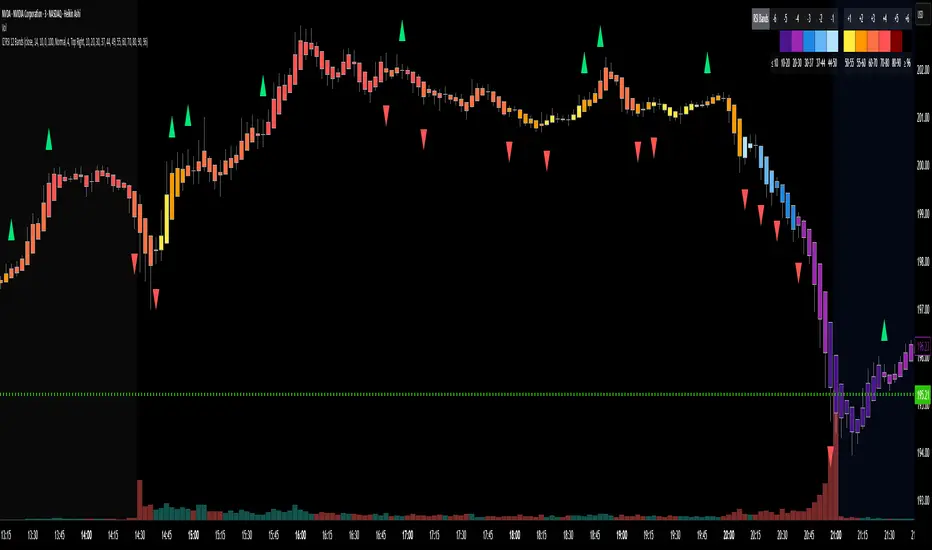
RSI Candle 12-Band SpectrumExperience RSI like never before. This multi-band visualizer transforms relative strength into a living color map — directly over price action — revealing momentum shifts long before traditional RSI signals. 🔹 12 Dynamic RSI Bands – A full emotional spectrum from oversold to overbought, colored from deep blue to burning red. 🔹 Adaptive Pulse System – Highlights every shift in RSI state with an intelligent fade-out pulse that measures the strength of each rotation. 🔹 Precision Legend Display – Clear RSI cutoff zones with user-defined thresholds and color ranges. 🔹 Multi-Timeframe Engine – Optionally view higher-timeframe RSI context while scalping lower frames. 🔹 Stealth Mode – Borders-only visualization for minimal chart impact on dark themes. 🔹 Complete Customization – Adjustable band levels, color palettes, and fade behavior. 🧠 Designed for professional traders who move with rhythm, not randomness.Pine Script® göstergesirrtaker86 tarafındanGüncellendi 12
GTI BGTI: RSI Suite (Standard • Stochastic • Smoothed) A three-layer momentum and trend toolkit that combines Standard RSI, Stochastic RSI, and a Smoothed/“Macro” RSI to help you read intraday swings, trend transitions, and high-probability reversal/continuation spots. All in one pane with intuitive coloring and optional divergence markers and alerts. Why this works * Stochastic RSI (K/D) visualizes fast momentum swings and timing. * Standard RSI moves more gradually, helping confirm trend transitions that may span several Stochastic cycles. * Smoothed RSI (Average → Macro) adds a second-pass filter and slope persistence to reveal the macro direction while suppressing noise. Used together, Stochastic guides entries/exits around local highs/lows, while the RSI layers improve confidence when a small swing is likely part of a larger turn. What you’ll see * Standard RSI (yellow; pink above Bull line, aqua below Bear line). * Stochastic RSI (K/D) with contextual colors: * Greens when RSI is weak/oversold (bearish conditions → watch for bullish reversals/continuations). * Reds when RSI is strong/overbought (bullish conditions → watch for bearish reversals/continuations). * Smoothed (Macro) RSI with trend color: * Red when macro is ascending (bullish), * Aqua when macro is descending (bearish). * Divergences (optional markers): * Bearish: RSI Lower High + Price Higher High (red ⬇). * Bullish: RSI Higher Low + Price Lower Low (green ⬆). * No repaint: pivots confirm after the chosen right-bars window. How to use it * Bullish Reversal * Macro RSI is reversing at a higher low after price has been in a overall downtrend * Stochastic RSI is switching from green to red in an overall downtrend * Bullish Oversold * Macro RSI is reversing from a significantly low level after price has a short but strong dip during an overall uptrend * Stochastic RSI is switching from green to red in an overall uptrend * Bullish Continuation * Macro RSI is ascending with a strong slope or forming a higher low above the 50 line * Stochastic RSI is reaching a bottom but still painted red * Bearish Reversal * Macro RSI is reversing at a lower high after price has been in a overall uptrend * Stochastic RSI is switching from red to green in an overall uptrend * Bearish Overbought * Macro RSI is reversing from a significantly high level after price has a short but strong jump during an overall downtrend * Stochastic RSI is switching from red to green in an overall downtrend * Bearish Continuation * Macro RSI is descending with a strong slope or forming a lower high below the 50 line * Stochastic RSI is reaching a top but still painted green * Divergences: Use as signals of exhaustion—best when aligned with Macro RSI color/slope and key levels (e.g., Bull/Bear lines, 50 midline). *** IMPORTANT *** * Stack confluence, don’t single-signal trade. Look for: * 1) Macro RSI color & slope (red = ascending/bullish, aqua = descending/bearish) * 2) Standard RSI location (above/below Bull/Bear lines or 50) * 3) Stoch flip + direction * 4) Price structure (HH/HL vs LH/LL) * 5) Divergence type (regular vs hidden) at meaningful levels * Trade with the macro * Prioritize longs when Macro RSI is red or just flipped up * Prioritize shorts when Macro RSI is aqua or just flipped down * Counter-trend setups = smaller size and faster management. * Location > signal * The same crossover/divergence is higher quality near Bull (~60)/Bear(~40) or extremes than in the mid-range chop around 50. * Early vs confirmed * Use the early pivot heads-up for anticipation, but scale in only after the confirmed pivot (right-bars complete). If early signal fails to confirm, stand down. * Define invalidation upfront * For divergence entries, place stops beyond the pivot extreme (LL/HH). If Macro RSI flips against your trade or RSI breaks back through 50 with slope, exit or tighten. * Multi-timeframe alignment * Best results come when entry timeframe (e.g., 1H) aligns with higher-TF macro (e.g., 4H/D). If they disagree, treat it as mean-reversion only. * Avoid common traps * Skip: isolated Stochastic flips without RSI support, divergences without price HH/LL confirmation, and serial divergences when Macro RSI slope is strong against the idea. * Parameter guidance * Start with defaults; then tune: confirmBars 3–7, minSlope 0.05–0.15 RSI pts/bar, pivot left/right tighter for faster but noisier signals, wider for cleaner but fewer. * Alerts = workflow, not auto-trades * Use Macro Flip + Divergence alerts as a checklist trigger; enter only when your confluence rules are met and risk is defined. Key inputs (tweak to your market/timeframe) * RSI / Stochastic lengths and K/D smoothing. * Bull / Bear Lines (default 61.1 / 43.6). * Average RSI Method/Length (SMA/EMA/RMA/WMA) + Macro Smooth Length. * Trend confirmation: bars of persistence and minimum slope to reduce flip noise. * Pivot look-back (left/right) for divergence confirmation strictness. Alerts included * Macro Flip Up / Down (Smoothed RSI regime change). * RSI Bullish/Bearish Divergence (confirmed at pivot). * Stochastic RSI continuation/divergence (optional). Tips * Level + Slope matter. High/low RSI level flags conditions; slope confirms impulse/continuation. * Let Stochastic time the swing; let Macro RSI filter the trend. * Tighten or loosen pivot windows to trade fewer/cleaner vs. more/faster signals.Pine Script® göstergesitheValleyMan tarafından55183
RSI + MFIRSI and MFI combined, width gradient fields if OS or OB, shows divergences separate for wicks and bodies, shows dots when mfi and rsi oversold at the same time. Pine Script® göstergesiwilinskilukasz tarafından68
RSI + Elder Bull-Bear pressure RSI + Bull/Bear (Elder-Ray enhanced RSI) What it is An extended RSI that overlays Elder-Ray Bull/Bear Power on the same, zero-centered scale. You get classic RSI regime cues plus a live read of buy/sell pressure, with optional smoothing, bands, and right-edge value labels. Key features RSI with bands – default bands 30 / 50 / 70 (editable). Bull/Bear Power (Elder) – ATR-normalized; optional EMA/SMA/RMA/HMA smoothing. One-pane overlay – RSI and Bull/Bear share a common midline (RSI-50 ↔ panel 0). Right-edge labels – always visible at the chart’s right margin with adjustable offsets. How to read it Cyan line = RSI (normalized) Above the mid band = bullish regime; below = bearish regime. Green = Bull Power, Red = Bear Power Columns/lines above 0 show buy pressure; below 0 show sell pressure. Smoothing reduces noise; zero-line remains your key reference. Trade logic (simple playbook) Entry BUY (primary): RSI crosses up through 50 (regime turns bullish), and Bull (green) crosses up through 0 (buy pressure confirms). SELL (primary): RSI crosses down through 50, and Bear (red) crosses down through 0 (sell pressure confirms). Alternative momentum entries Aggressive BUY: Bull (green) pushes above RSI-80 band (strong upside impulse). Aggressive SELL: Bear (red) pushes below RSI-30 band (strong downside impulse). Exits / trade management In a long: consider exiting or tightening stops if Bear (red) dips below the 0 line (rising sell pressure) or RSI loses 50. In a short: consider exiting or tightening if Bull (green) rises above 0 or RSI reclaims 50. Tip: “0” on the panel is your pressure zero-line (maps to RSI-50). Most whipsaws happen near this line; smoothing (e.g., EMA 21) helps. Defaults (on first load) RSI bands: 30 / 50 / 70 with subtle fills. Labels: tiny, pushed far right (large offsets). Bull/Bear smoothing: EMA(21), smoothed line plot mode. RSI plotted normalized so it overlaps the pressure lines cleanly. Tighten or loosen the Bull/Bear thresholds (e.g., Bull ≥ +0.5 ATR, Bear ≤ −0.5 ATR) to demand stronger confirmation. Settings that matter Smoothing length/type – balances responsiveness vs. noise. Power/RSI Gain – visual scaling only (doesn’t change logic). Band placement – keep raw 30/50/80 or switch to “distance from 50” if you prefer symmetric spacing. Label offsets – move values clear of the last bar/scale clutter. Good practices Combine with structure/ATR stops (e.g., 1–1.5× ATR, swing high/low). In trends, hold while RSI stays above/below 50 and the opposite pressure line doesn’t dominate. In ranges, favor signals occurring near the mid band and take profits at the opposite band. Disclaimer: This is a research/visual tool, not financial advice at any kind. Test your rules on multiple markets/timeframes and size positions responsibly.Pine Script® göstergesiPDK1977 tarafından35
Dynamic Fractal Flow [Alpha Extract]An advanced momentum oscillator that combines fractal market structure analysis with adaptive volatility weighting and multi-derivative calculus to identify high-probability trend reversals and continuation patterns. Utilizing sophisticated noise filtering through choppiness indexing and efficiency ratio analysis, this indicator delivers entries that adapt to changing market regimes while reducing false signals during consolidation via multi-layer confirmation centered on acceleration analysis, statistical band context, and dynamic omega weighting—without any divergence detection. 🔶 Fractal-Based Market Structure Detection Employs Williams Fractal methodology to identify pivotal market highs and lows, calculating normalized price position within the established fractal range to generate oscillator signals based on structural positioning. The system tracks fractal points dynamically and computes relative positioning with ATR fallback protection, ensuring continuous signal generation even during extended trending periods without fractal formation. 🔶 Dynamic Omega Weighting System Implements an adaptive weighting algorithm that adjusts signal emphasis based on real-time volatility conditions and volume strength, calculating dynamic omega coefficients ranging from 0.3 to 0.9. The system applies heavier weighting to recent price action during high-conviction moves while reducing sensitivity during low-volume environments, mitigating lag inherent in fixed-period calculations through volatility normalization and volume-strength integration. 🔶 Cascading Robustness Filtering Features up to five stages of progressive EMA smoothing with user-adjustable robustness steps, each layer systematically filtering microstructure noise while preserving essential trend information. Smoothing periods scale with the chosen fractal length and robustness steps using a fixed smoothing multiplier for consistent, predictable behavior. 🔶 Adaptive Noise Suppression Engine Integrates dual-component noise filtering combining Choppiness Index calculation with Kaufman’s Efficiency Ratio to detect ranging versus trending market conditions. The system applies dynamic damping that maintains full signal strength during trending environments while suppressing signals during choppy consolidation, aligning output with the prevailing regime. 🔶 Acceleration and Jerk Analysis Framework Calculates second-derivative acceleration and third-derivative jerk to identify explosive momentum shifts before they fully materialize on traditional indicators. Detects bullish acceleration when both acceleration and jerk turn positive in negative oscillator territory, and bearish acceleration when both turn negative in positive territory, providing early entry signals for high-velocity trend initiation phases. 🔶 Multi-Layer Signal Generation Architecture Combines three primary signal types with hierarchical validation: acceleration signals, band crossover entries, and threshold momentum signals. Each signal category includes momentum confirmation, trend-state validation, and statistical band context; signals are further conditioned by band squeeze detection to avoid low-probability entries during compression phases. Divergence is intentionally excluded for a purely structure- and momentum-driven approach. 🔶 Dynamic Statistical Band System Utilizes Bollinger-style standard deviation bands with configurable multiplier and length to create adaptive threshold zones that expand during volatile periods and contract during consolidation. Includes band squeeze detection to identify compression phases that typically precede expansion, with signal suppression during squeezes to prevent premature entries. 🔶 Gradient Color Visualization System Features color gradient mapping that dynamically adjusts line intensity based on signal strength, transitioning from neutral gray to progressively intense bullish or bearish colors as conviction increases. Includes gradient fills between the signal line and zero with transparency scaling based on oscillator intensity for immediate visual confirmation of trend strength and directional bias. All analysis provided by Alpha Extract is for educational and informational purposes only. The information and publications are not meant to be, and do not constitute, financial, investment, trading, or other types of advice or recommendations.Pine Script® göstergesiAlphaExtract tarafından11118
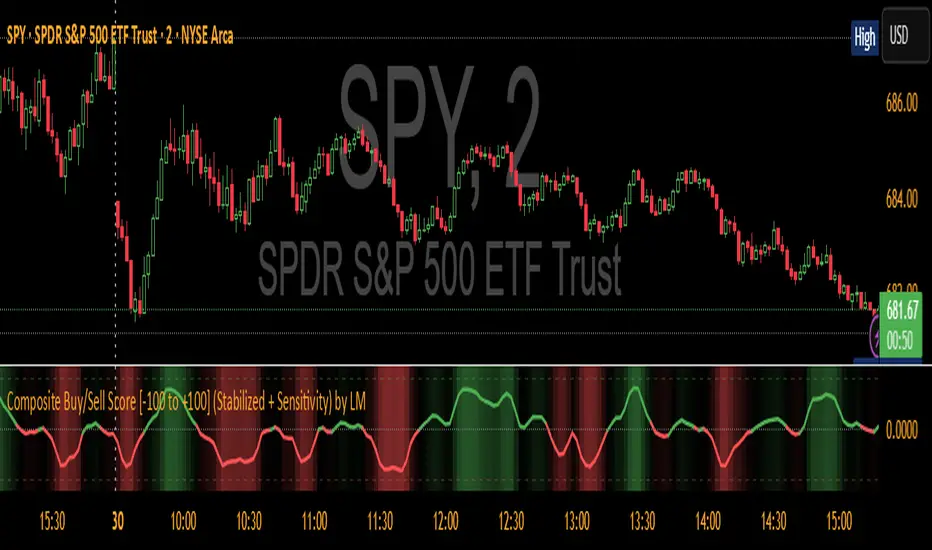
Composite Buy/Sell Score [-100 to +100] by LMComposite Buy/Sell Score (Stabilized + Sensitivity) by LM Description: This indicator calculates a composite trend strength score ranging from -100 to +100 by combining multiple popular technical indicators into a single, smoothed metric. It is designed to give traders a clear view of bullish and bearish trends, while filtering out short-term noise. The score incorporates signals from: PPO (Percentage Price Oscillator) – measures momentum via the difference between fast and slow EMAs. ADX (Average Directional Index) – detects trend strength. RSI (Relative Strength Index) – identifies short-term momentum swings. Stochastic RSI – measures RSI momentum and speed of change. MACD (Moving Average Convergence Divergence) – detects momentum shifts using EMA crossovers. Williams %R – highlights overbought/oversold conditions. Each component is weighted, smoothed, and optionally confirmed across a configurable number of bars, producing a stabilized composite score that reacts more reliably to significant trend changes. Key Features: Smoothed Composite Score The final score is smoothed using an EMA to reduce volatility and emphasize meaningful trends. A Sensitivity Multiplier allows traders to exaggerate the score for stronger trend signals or dampen it for quieter markets. Customizable Inputs You can adjust each indicator’s parameters, smoothing lengths, and confirm bars to suit your preferred timeframe and trading style. The sensitivity multiplier allows fine-tuning the responsiveness of the trend line without changing underlying indicator calculations. Visual Representation Score Line: Green for positive (bullish) trends, red for negative (bearish) trends, gray near neutral. Reference Lines: 0 = neutral +100 = maximum bullish -100 = maximum bearish Adaptive Background: Optionally highlights the background intensity proportional to trend strength. Strong green for bullish trends, strong red for bearish trends. Multi-Indicator Integration Combines momentum, trend, and overbought/oversold signals into a single metric. Helps identify clear entry/exit trends while avoiding whipsaw noise common in individual indicators. Recommended Use: Trend Identification: Look for sustained movement above 0 for bullish trends and below 0 for bearish trends. Exaggerated Trends: Use the Sensitivity Multiplier to emphasize strong trends. Filtering Noise: The smoothed score and confirmBars settings help reduce false signals from minor price fluctuations. Inputs Overview: Input Purpose PPO Fast EMA / Slow EMA / Signal Controls PPO momentum sensitivity ADX Length / Threshold Detects trend strength RSI Length / Overbought / Oversold Measures short-term momentum Stoch RSI Length / %K / %D Measures speed of RSI changes MACD Fast / Slow / Signal Measures momentum crossover Williams %R Length Detects overbought/oversold conditions Final Score Smoothing Length EMA smoothing for final composite score Confirm Bars for Each Signal Number of bars used to confirm individual indicator signals Sensitivity Multiplier Scales the final composite score for exaggerated trend response Highlight Background by Trend Strength Enables adaptive background coloring This indicator is suitable for traders looking for a single, clear trend metric derived from multiple indicators. It can be applied to any timeframe and can help identify both strong and emerging trends in the market.Pine Script® göstergesiLouisMont tarafındanGüncellendi 33
RSI Trendline Pro - Multi Confirmation Overview RSI Trendline Pro is an advanced Pine Script indicator that automatically draws trendlines on the RSI (Relative Strength Index) to detect support and resistance breakouts. It generates high-quality trading signals through a multi-confirmation system. Key Features Auto Trendlines: Detects pivot points on RSI to create intelligent support and resistance lines Multi-Confirmation System: Combines Volume, Stochastic RSI, ADX, and Divergence filters to reduce false signals RSI Divergence Detection: Automatically identifies bullish/bearish divergences between price and RSI Live Dashboard: Displays RSI value, active trendlines, ADX strength, and last signal info on a visual panel Smart Breakout Detection: Identifies trendline breaks and generates LONG/SHORT signals How to Use Add to TradingView: Paste code into Pine Editor and add to chart Configure Parameters: RSI Length: RSI period (default: 14) Pivot Strength: Trendline sensitivity (lower = more lines) Filters: Enable/disable Volume, Divergence, Stoch RSI, and ADX confirmations Follow Signals: LONG (Green): When RSI breaks resistance upward SHORT (Red): When RSI breaks support downward Divergence: "D" markers indicate potential trend reversals Alert Setup Script offers 4 alert types: LONG Breakout: Resistance break SHORT Breakout: Support break Bullish/Bearish Divergence: Divergence detection Any Signal: Combined alert for all signals Best Practices Prioritize high-volume breakouts (Volume Filter enabled) Trends are stronger when ADX > 25 Confirm divergence signals with price action Trade when 2-3 confirmations alignPine Script® göstergesilast_satoshi tarafından27
Cora Combined Suite v1 [JopAlgo]Cora Combined Suite v1 (CCSV1) This is an 2 in 1 indicator (Overlay & Oscillator) the Cora Combined Suite v1 . CCSV1 combines a price-pane Overlay for structure/trend with a compact Oscillator for timing/pressure. It’s designed to be clear, beginner-friendly, and largely automatic: you pick a profile (Scalp / Intraday / Swing), choose whether to run as Overlay or Oscillator, and CCSV1 tunes itself in the background. What’s inside — at a glance 1) Overlay (price pane) CoRa Wave: a smooth trend line based on a compound-ratio WMA (CRWMA). Green when the slope rises (bull bias), Red when it falls (bear bias). Asymmetric ATR Cloud around the CoRa Wave Width expands more up when buyer pressure dominates and more down when seller pressure dominates. Fill is intentionally light, so candlesticks remain readable. Chop Guard (Range-Lock Gate) When the cloud stays very narrow versus ATR (classic “dead water”), pullback alerts are muted to avoid noise. Visuals don’t change—only the alerting logic goes quiet. Typical Overlay reads Trend: Follow the CoRa color; green favors long setups, red favors shorts. Value: Pullbacks into/through the cloud in trend direction are higher-quality than chasing breaks far outside it. Dominance: A visibly asymmetric cloud hints which side is funding the move (buyers vs sellers). 2) Oscillator (subpane or inline preview) Stretch-Z (columns): how far price is from the CoRa mean (mean-reversion context), clipped to ±clip. Near 0 = equilibrium; > +2 / < −2 = stretched/extended. Slope-Z (line): z-score of CoRa’s slope (momentum of the trend line). Crossing 0 upward = potential bullish impulse; downward = potential bearish impulse. VPO (stepline): a normalized Volume-Pressure read (positive = buyers funding, negative = sellers). Rendered as a clean stepline to emphasize state changes. Event Bands ±2 (subpane): thin reference lines to spot extension/exhaustion zones fast. Floor/Ceiling lines (optional): quiet boundaries so the panel doesn’t feel “bottomless.” Inline vs Subpane Inline (overlay): the oscillator auto-anchors and scales beneath price, so it never crushes the price scale. Subpane (raw): move to a new pane for the classic ±clip view (with ±2 bands). Recommended for systematic use. Why traders like it Two in one: Structure on the chart, timing in the panel—built to complement each other. Retail-first automation: Choose Scalp / Intraday / Swing and let CCSV1 auto-tune lengths, clips, and pressure windows. Robust statistics: On fast, spiky markets/timeframes, it prefers outlier-resistant math automatically for steadier signals. Optional HTF gate: You can require higher-timeframe agreement for oscillator alerts without changing visuals. Quick start (simple playbook) Run As Overlay for structure: assess trend direction, where value is (the cloud), and whether chop guard is active. Oscillator for timing: move to a subpane to see Stretch-Z, Slope-Z, VPO, and ±2 bands clearly. Profile Scalp (1–5m), Intraday (15–60m), or Swing (4H–1D). CCSV1 adjusts length/clip/pressure windows accordingly. Overlay entries Trade with CoRa color. Prefer pullbacks into/through the cloud (trend direction). If chop guard is active, wait; let the market “breathe” before engaging. Oscillator timing Look for Funded Flips: Slope-Z crossing 0 in the direction of VPO (i.e., momentum + funded pressure). Use ±2 bands to manage risk: stretched conditions can stall or revert—better to scale or wait for a clean reset. Optional HTF gate Enable to green-light only those oscillator alerts that align with your chosen higher timeframe. What each signal means (plain language) CoRa turns green/red (Overlay): trend bias shift on your chart. Cloud width tilts asymmetrically: one side (buyers/sellers) is dominating; extensions on that side are more likely. Stretch-Z near 0: fair value around CoRa; pullback timing zone. Stretch-Z > +2 / < −2: extended; watch for slowing momentum or scale decisions. Slope-Z cross up/down: new impulse starting; combine with VPO sign to avoid unfunded crosses. VPO positive/negative: net buying/selling pressure funding the move. Alerts included Overlay Pullback Long OK Pullback Short OK Oscillator Funded Flip Up / Funded Flip Down (Slope-Z crosses 0 with VPO agreement) Pullback Long Ready / Pullback Short Ready (near equilibrium with aligned momentum and pressure) Exhaustion Risk (Long/Short) (Stretch-Z beyond ±2 with weakening momentum or pressure) Tip: Keep chart alerts concise and use strategy rules (TP/SL/filters) in your trade plan. Best practices One glance workflow Read Overlay for direction + value. Use Oscillator for trigger + confirmation. Pairing Combine with S/R or your preferred execution framework (e.g., your JopAlgo setups). The suite is neutral: it won’t force trades; it highlights context and quality. Markets Works on crypto, indices, FX, and commodities. Where real volume is available, VPO is strongest; on synthetic volume, treat VPO as a soft filter. Timeframes Use the Profile preset closest to your style; feel free to fine-tune later. For multi-TF trading, enable the HTF gate on the oscillator alerts only. Inputs you’ll actually use (the rest can stay on Auto) Run As: Overlay or Oscillator. Profile: Scalp / Intraday / Swing. Oscillator Render: “Subpane (raw)” for a classic panel; “Inline (overlay)” only for a quick preview. HTF gate (optional): require higher-timeframe Slope-Z agreement for oscillator alerts. Everything else ships with sensible defaults and auto-logic. Limitations & tips Not a strategy: CCSV1 is a decision support tool; you still need your entry/exit rules and risk management. Non-repainting design: Signals finalize on bar close; intrabar graphics can adjust during the bar (Pine standard). Very flat sessions: If price and volume are extremely quiet, expect fewer alerts; that restraint is intentional. Who is this for? Beginners who want one clean overlay for structure and one simple oscillator for timing—without wrestling settings. Intermediates seeking a coherent trend/pressure framework with HTF confirmation. Advanced users who appreciate robust stats and clean engineering behind the visuals. Disclaimer: Educational purposes only. Not financial advice. Trading involves risk. Use at your own discretion.Pine Script® göstergesiJopAlgo tarafından14