Planetary IngressDisplays planetary ingresses, the moments when a planet crosses from one zodiac sign into another. This indicator marks historical ingresses directly on your chart and projects upcoming ones with precise date, time, and retrograde status.
Powered by the open-source BlueprintResearch Planetary Ephemeris library , which implements truncated VSOP87 (planets) and ELP2000 (Moon) series for high-accuracy celestial calculations entirely within Pine Script.
█ FEATURES
• All 10 celestial bodies — Sun, Moon, Mercury, Venus, Mars, Jupiter, Saturn, Uranus, Neptune, and Pluto
• Geocentric or Heliocentric views — toggle between Earth-centered (standard astrology) and Sun-centered perspectives
• Retrograde indicator — shows ℞ symbol when a planet is in apparent retrograde motion (geocentric only)
• Future ingress projection — displays the following sign change as a dotted vertical line with customizable date/time and timezone
• Color-coded by zodiac sign — 12 fully customizable colors for each sign
• Per-sign visibility controls — easily show/hide specific signs
• Per-sign alerts — get notified when a planet enters selected signs
• Fully customizable labels — adjust size, colors, transparency, and placement
█ HOW TO USE
1. Select your planet from the dropdown
2. Choose Geocentric (traditional) or Heliocentric view
3. Historical ingresses appear as labels above price bars with a planet symbol and a zodiac sign
4. The next future ingress is shown as a dotted vertical line with projected date/time
5. Hover over labels for exact degree position (e.g., "0°Ari00'")
6. Set up alerts via "Alert on Ingress" settings for specific sign entries
█ LIMITATIONS & ACCURACY
This indicator uses optimized, truncated VSOP87 and ELP2000 series tailored for Pine Script performance. It delivers excellent accuracy for trading and analytical purposes, but is not intended for professional astronomical use.
Expected Ingress Timing Accuracy (Geocentric view):
• Sun, Moon, Mercury, Venus, Mars: Within hours to ±1 day
• Jupiter, Saturn: Within ±1–2 days
• Uranus, Neptune: Within ±3–7 days
• Pluto: Within ±1–2 weeks (simplified Meeus method, valid 1900–2100)
Heliocentric view: Inner and faster-moving planets match geocentric accuracy. Outer planets (especially Uranus/Neptune) may occasionally show larger variances (up to ±1 month in rare cases) due to their extremely slow motion amplifying minor truncation effects in the series.
Why outer planets vary more:
Slower planets take weeks or months to cross a single degree. Even minor positional discrepancies from truncated terms can shift ingress timing by days or weeks—most noticeable with the outermost bodies.
Recommendation: For mission-critical timing, always cross-reference with professional tools such as JPL Horizons , Swiss Ephemeris, or Astro.com.
█ ROADMAP
Accuracy improvements are an ongoing priority. The modular library design allows targeted upgrades to individual planets without breaking existing functionality.
Planned Enhancements:
• Higher-precision outer planet calculations (Uranus, Neptune)
• Improved heliocentric outer planet accuracy
• Enhanced Pluto method
• Additional series terms where beneficial
Updates will be released through the BlueprintResearch/lib_ephemeris library—follow for notifications.
█ OPEN SOURCE
This indicator is part of the fully open-source Planetary Ephemeris project. The core ephemeris library is public for study, modification, and reuse in your own scripts:
• BlueprintResearch/lib_ephemeris — Main planetary calculation engine
Licensed under MPL 2.0 — free to use and modify, with changes to the library shared back to the community.
Retrograde
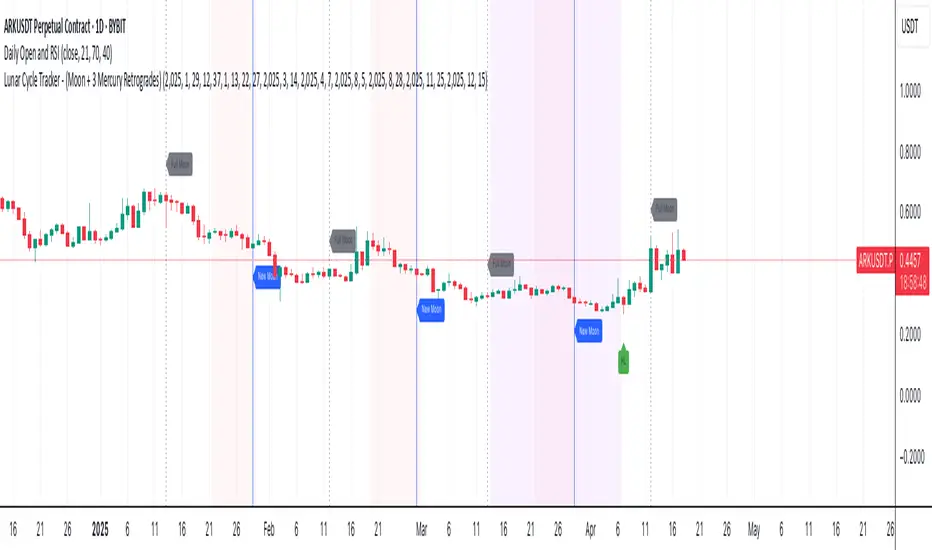
Lunar Cycle Tracker - (Moon + 3 Mercury Retrogrades)This script overlays the lunar and Mercury retrograde cycles directly onto your chart, helping traders visualize natural timing intervals that may influence market behavior.
Key Features:
🌑 New Moon & Full Moon Markers:
Vertical lines and labels indicate new and full moon events each month. You can fully customize their colors.
🌗 Last Quarter Moon Fill:
A soft pink background highlights the last quarter moon phase (from 7.4 days after the full moon to the next new moon).
🪐 Three Mercury Retrograde Zones:
Highlight up to three retrograde periods per year with customizable date inputs and background color. Great for spotting potential reversal or volatility windows.
Customization:
Moon event dates and colors
Manual input for Mercury retrograde periods (year, month, day)
Full compatibility with all timeframes (1H, 4H, daily, etc.)
Great for astro-cycle traders, Gann-based analysts, or anyone who respects time symmetry in the markets.
Fully customizable & works across all timeframes.
This tool was created by AngelArt as part of a larger astro-market model using lunar timing and planetary retrogrades for cycle-based market analysis.
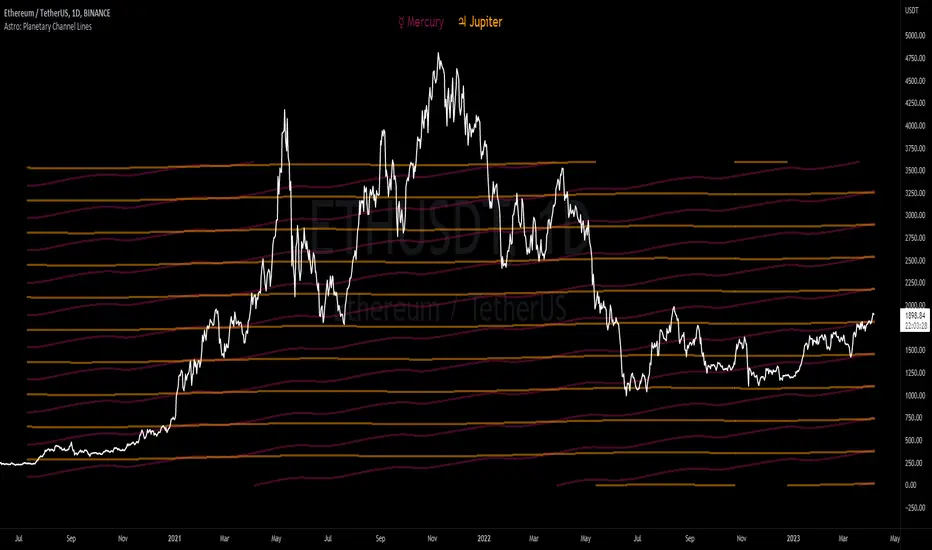
Astro: Celestial Body Channel LinesThis is fork of the previous Astro: Planetary Channel Lines indicator that now includes over a dozen different celestial bodies, made possible after the most recent update of the AstroLib library.
Celestial Body Channel Lines is an approach to financial astrology that involves using the positions of the celestial bodies to predict trends and patterns in the stock market. The idea behind celestial body lines is that the positions of the bodies in the sky at the time of a market event can significantly influence that event.
The celestial body lines approach involves mapping the bodies' positions onto a stock market graph, with each body's position representing a specific line. These lines are thought to indicate areas of support and resistance, as well as potential turning points in the market.
This indicator includes geocentric/heliocentric celestial body lines on the chart for up to two bodies, price scaling & vertical offset, mirror/inversion switch, retrograde highlighting, and aspect recognition with customizable precision.
Astro: Planetary Channel LinesPlanetary Channel Lines is an approach to financial astrology that involves using the positions of the planets to predict trends and patterns in the stock market. The idea behind planetary lines is that the positions of the planets in the sky at the time of a market event can significantly influence that event.
The planetary lines approach involves mapping the planets' positions onto a stock market graph, with each planet's position representing a specific line. These lines are thought to indicate areas of support and resistance, as well as potential turning points in the market.
This indicator includes geocentric/heliocentric planetary lines on the chart for up to two planets, price scaling & vertical offset, retrograde highlighting, and aspect recognition with customizable precision.