DCA Zones: MA100 Buffer (Buy-the-Dip Highlight)Highlights potential DCA buy zones when price drops X% below the 100-period MA.Pine Script® göstergesiMasherak tarafından5
Bitcoin Halving Cycles [DotGain]Halving Cycles A lightweight, time-anchored Bitcoin halving cycle visualizer built for clean charting, repeatable process planning, and simple profit/DCA timing references. This Code was heavily inspired by KevinSvenson_ who created Bitcoin Halving Cycle Profit . What this indicator does This script plots the key “cycle landmarks” relative to each halving date: Halving (⛏) – the cycle anchor Profit START – marks the beginning of the post-halving profit window (default: 40 weeks ) Profit END / Last Call – marks the final phase of the profit window (default: 77 weeks ) DCA START – marks the point where long-term accumulation becomes the focus again (default: 135 weeks ) How to read it Vertical lines = the exact cycle milestones Bottom labels = description of each milestone aligned to its line (keeps the chart clean) Green background (optional) = active Profit Zone on existing bars Red background (optional) = optional warning zone after Profit END HUD Panel (top-right) The HUD gives you a fast “where are we in the cycle?” view with two modes: Current Cycle Shows: Halving date, Weeks since, and time remaining to Profit START / Last Call / DCA START within the current cycle. Next Halving (Projection) Shows: Countdown to the next enabled future halving, plus the projected weeks from today to Profit START / Last Call / DCA START after that future halving. Future Halvings (manual) You can manually add up to 3 future halving dates (Halving #1–#3). This is useful for forward planning and cycle projection even before the event happens. Enable Halving #1 / #2 / #3 Set Year / Month / Day for each Optional: show/hide future markers & projections Note: background zones only shade existing bars . Future projections are shown via lines/labels. Settings overview Show all cycles – plots every enabled cycle (historical + optional future). If disabled, only the current cycle is drawn. Show Profit Zone background – green shading during the active profit window (current cycle only). Show vertical markers + labels – toggles all milestone lines + labels. Show HUD – toggles the HUD panel. HUD Mode – switch between Current Cycle and Next Halving (Projection). Cycle Logic – edit offsets in weeks (Profit START / Profit END / DCA START). Optional Warning Zone – show a post-profit warning shading for a chosen number of weeks. Have fun :) Disclaimer This Halving Cycles indicator is provided for informational and educational purposes only. It does not, and should not be construed as, financial, investment, or trading advice. This indicator is an independent implementation of a time-based Bitcoin halving cycle visualization tool and is not affiliated with, or endorsed by, any third-party trading systems, strategies, protocols, or trademarked methodologies. The cycle zones, milestone markers, and countdown values displayed by this indicator are generated by a predefined set of algorithmic rules based on historical halving dates and user-defined time offsets. They do not constitute a direct recommendation to buy, sell, or hold any financial instrument or digital asset. All trading and investing in financial markets involves a substantial risk of loss. You may lose part or all of your invested capital. Past performance does not guarantee future results. This indicator highlights historical and projected time-based market cycles and may produce false, lagging, incomplete, or misleading signals. Market behavior is influenced by many external factors and can deviate significantly from historical patterns or expectations. The creator DotGain assumes no responsibility or liability for any financial losses, damages, or decisions made based on the use of this indicator or the information it provides. You are solely responsible for your own trading and investment decisions. Always conduct your own research (DYOR), use proper risk management, validate insights with additional tools or analysis, and consider your personal financial situation and risk tolerance before making any financial decision.Pine Script® göstergesiDotGain tarafından31
Mean Reversion Mirror📌 Mean Reversion Mirror — Multi‑Level Mean Reversion Strategy Mean Reversion Mirror is an advanced modular mean‑reversion strategy built around dynamic and static deviation levels from a moving average. The strategy automatically scales into positions across six levels (LONG and SHORT), using both dynamic MA‑based deviation levels and static levels that lock in after entry. 🔍 Core Concept Price tends to revert toward its mean. This strategy exploits that behavior by opening an initial base entry at the first deviation and adding positions as the imbalance grows. Each additional level improves the average entry price and increases the probability of exiting profitably. ⚙️ Key Features 📈 Six Dynamic Deviation Levels Levels are calculated as percentage deviations from a selected MA (WMA, SMA, EMA, RMA, HMA). This makes the strategy adaptive to volatility and market structure. 📉 Six Static Levels Once triggered, each level becomes fixed and no longer changes. This creates a stable averaging grid independent of future MA movement. 🎯 Flexible Take‑Profit System fixed take‑profit or trailing take‑profit with dynamic offset 🖐 Manual Entry Support You can manually set a price for LONG or SHORT, and the strategy will execute the base entry automatically. 📊 Rich Visualization dynamic deviation levels static levels dotted “last chance” levels average position price take‑profit line compact mini‑table with key position metrics 📦 Two Operating Modes STK Mode — fixed unit size Classic Mode — quantity calculated from USD value 🧠 Entry Logic The strategy uses sequences B1–B6 (LONG) and S1–S6 (SHORT): B1/S1 — base entry B2–B6 / S2–S6 — averaging entries as deviation increases L6/S6 — “last chance” level with its own size Each level activates only after the previous one. 📌 Who This Strategy Is For mean‑reversion traders grid/averaging system users pullback‑based investors traders who want clear visual levels users who prefer manual control over entry points ⚠️ Disclaimer This strategy is not financial advice. Always backtest and adjust parameters according to your risk tolerance before using it in live markets.Pine Script® stratejisiolegask68 tarafından967
Trade Manager + MOST RSI📌 Trade Manager + MOST RSI — Adaptive Position Management Strategy Overview This strategy combines the MOST‑RSI trend‑reversal model with a fully customizable position management system. It is designed for traders who want a flexible, visual, and systematic approach to scaling into positions, managing risk, and automating exits. The script supports both automatic entries (based on MOST‑RSI signals) and manual entries (user‑defined price levels), making it suitable for hybrid discretionary + algorithmic trading. ✨ Key Features MOST‑RSI Entry Logic Adaptive RSI‑based trend detection VAR‑smoothed moving average Automatic LONG/SHORT signal generation Configurable sensitivity through MOST Percent, MA Type, and RSI Length Smart Position Management Initial order + cascading Safety Orders (SO) Adjustable deviation, step scaling, and volume scaling Independent LONG and SHORT deviation settings Breakeven after N safety orders Automatic TP placement based on average entry price Clean Visual Structure TP lines visible only when a position is open NEXT SO level with dynamic labeling Average price line with subtle styling Transparent background zones for TP, SO, and AVG Real‑time mini‑table showing position metrics Manual Entry Mode Set custom LONG/SHORT entry levels Automatic line drawing One‑click reset Perfect for discretionary setups 📊 Recommended Timeframes 1H — balanced 4H — conservative MOST‑RSI adapts well across different market conditions. 🔧 Optimization Recommendations 1. Deviation (%) Trending markets: 4–7% Ranging markets: 2–3% Optimize LONG and SHORT separately 2. Safety Order Volume Scale Typical range: 1.3–1.6 Higher = faster averaging, higher risk 3. Safety Order Step Scale 1.4–1.7 for safer spacing 1.1–1.3 for tighter spacing 4. Take‑Profit Volatile assets: 2–5% Stable assets: 1.5–2% 5. Risk Management Max SO: 5–10 depending on volatility More SO = safer but more capital required 6. MOST‑RSI Parameters RSI Length: 14 MA Length: 5 MOST Percent: 7–12% 7. Backtesting Use at least 1 year of data Include high‑volatility periods 8. Drawdown Control If drawdown is too high: Lower SO volume scale Reduce max SO Increase SO step scale 📌 Disclaimer This script does not guarantee profits and is not financial advice. Always test strategies on historical data and use proper risk management.Pine Script® stratejisiolegask68 tarafından433
Trade Manager + DivergenceTrade Manager + Divergence — Smart Entry & Automated Risk Control Trade Manager + Divergence is a versatile trading strategy that combines automated RSI divergence detection, manual level entries, and a multi‑layered safety‑order system with advanced risk management. It is designed for traders who want precise technical entries supported by fully automated position handling. 🔍 Key Features 1. RSI Divergence Entry Module The strategy automatically detects: Bullish divergence (Higher Low on RSI + Lower Low on price) Bearish divergence (Lower High on RSI + Higher High on price) Additional options include: Divergence strength filtering MA200 trend filter Visual divergence markers on the chart 2. Manual Entry Levels You can define: A manual LONG entry price A manual SHORT entry price Automatic removal of the level after entry Perfect for traders who prefer to work from key zones they identify themselves. 3. Multi‑Level Safety Order System The strategy supports: Initial base order Up to 8 safety orders Volume scaling Step scaling All parameters are fully customizable: Order size Distance between orders Scaling coefficients Maximum number of safety orders 4. Automated Take Profit Take profit is calculated from the average position price: Separate TP settings for LONG and SHORT TP levels displayed directly on the chart 5. Breakeven Mechanism After a specified number of safety orders, the strategy can: Automatically close the position at breakeven Include exchange fees in the calculation 6. Mini Status Panel A compact table in the top‑right corner shows: Position size Position value Number of open trades Current PnL Equity This makes monitoring your position simple and intuitive. ⚙️ Clean and Organized Settings All inputs are grouped into clear sections: General Entry Mode Divergence Settings Manual Levels Risk Management Each parameter includes a tooltip explaining its purpose. 📌 Disclaimer This script does not guarantee profits and is not financial advice. Always test strategies on historical data and use proper risk management.Pine Script® stratejisiolegask68 tarafından35
OrangePulse v3.0 Lite - Educational DCA StrategyThis open-source script is a simplified version of the OrangePulse algorithm, designed for educational purposes to demonstrate the power of Dollar Cost Averaging (DCA) and Mean Reversion. 📈 Strategy Logic: The script uses a combination of Bollinger Bands and RSI (Relative Strength Index) to identify potential mean reversion opportunities. - Entry: Triggered when price pushes below the lower Bollinger Band while RSI is in oversold territory. - Management: Utilizes up to 3 Safety Orders (DCA) to improve the average entry price during pullbacks. 🎯 Features: • Customizable Volume Scale and Step Scale for Safety Orders. • Visual AVG price line and TP/SL levels. • Time-window filter for backtesting. • Real-time Status Table for position monitoring. This script is shared in the spirit of open-source development on TradingView. It is intended to help traders understand how automated position building and risk management work in volatile markets. Check my profile status/bio for more information on our project. ⚠️ Disclaimer: For educational purposes only. Past performance does not guarantee future results.Pine Script® stratejisiOrangePulse tarafındanGüncellendi 21
Dips Oleg Adaptive Dip‑Buying Strategy with Lot Precision & Smart Averaging 📘 Description This strategy is a personalized adaptation of an idea originally developed by the respected author fullmax. I reworked the concept to suit my own trading approach, adding lot‑precision rounding to avoid exchange quantity errors when using webhooks, and enhancing the visual and analytical components of the script. 🔧 What’s New in This Version Configurable lot precision to ensure clean, exchange‑safe order sizes Improved UI elements: base‑order labels, compact mini‑table, grouped settings Dynamic safety‑order pricing based on price drops and scaling factors Flexible date‑range filtering for controlled backtesting Clear visualization of SMA threshold, safety levels, breakeven, and take‑profit Adaptive threshold logic that adjusts depending on trend conditions 🎯 Core Logic The strategy monitors how far price deviates from a short‑term SMA. When the deviation crosses a user‑defined threshold, the script opens a base position. If price continues to dip, the system deploys safety orders with: scalable volume scalable distance precise rounding for compatibility with webhook automation Once the position is built, the strategy manages exits using a fixed take‑profit target. A breakeven reference line and auto‑cleanup logic help maintain clarity and prevent stale orders. ⚙️ Feature Overview Dip‑based entry logic with bull/bear threshold switching Safety orders with volume and step scaling Take‑profit management Breakeven visualization Mini‑table showing real‑time position metrics Clean chart overlays for easier interpretation 📝 Disclaimer This script is intended for educational and analytical use. It does not guarantee profits and should be tested thoroughly before being used in live trading.Pine Script® stratejisiolegask68 tarafından36
Mean Reversion Oleg📘 Description This script is an extended and customized version of the original “Mean Reversion V‑F” created by the respected author fullmax. I adapted the logic for my own trading workflow and added several improvements aimed at stability, automation, and exchange‑safe execution when using webhooks. 🔧 Key Enhancements Lot precision control (prevents exchange errors when sending webhook orders) Base order labels for visual clarity Mini‑table with live position metrics Dynamic deviation levels (L1–L5) Static averaging levels (B2–B5) Trailing take‑profit option Support for stock mode (fixed units instead of quantity) Webhook fields for entry and exit signals 🎯 How the Strategy Works The script calculates a moving average and builds five deviation‑based levels below it. When price reaches these levels, the strategy opens a base order (B1) and then averages the position using B2–B5 levels. After entering a position, the strategy manages it using: a fixed take‑profit target or an optional trailing take‑profit plus a visual table showing position size, USD value, open PnL, and equity All quantities are rounded according to the selected lot precision to ensure compatibility with exchange requirements when using webhook automation. ⚙️ Features Overview Automated long entries based on deviation levels Configurable order sizes for each averaging step Optional stock‑mode (units instead of calculated quantity) Dynamic and static level visualization Trailing TP with adjustable distance Clean UI with optional labels and mini‑table 📝 Disclaimer This script is provided for educational purposes only. It does not constitute financial advice and does not guarantee profits. Always test strategies on historical data before using them in live trading.Pine Script® stratejisiolegask68 tarafından33
Trade ManagerDescription This script is a trade‑management system designed for both automated and manual trading workflows. It combines VWRSI‑based signals, customizable price levels, safety orders, take‑profit logic, and optional MA‑trend filtering. Key features: Automated entries based on VWRSI Manual LONG/SHORT level entries Priority‑based entry logic (first condition triggers the trade) Safety order scaling (volume and step multipliers) Take‑profit targets for both LONG and SHORT positions Breakeven logic with adjustable thresholds Optional MA‑trend filter Mini‑table showing position metrics Base order labels and lot‑precision control How it works: If multiple entry modes are enabled, the script opens a position based on the first condition reached. After entering a trade, the position can be averaged using safety orders and closed at the configured profit target. Notes: This script is for educational purposes and does not guarantee profits. Always test on historical data and understand the risks before using it in live trading.Pine Script® stratejisiolegask68 tarafından81
Hedge Mini Calculator (Avg Long/Short + Alerts) with dca Hedge Mini Calculator is a position-management indicator for traders who use long & short hedging. It plots: Long average price Short average price Optional hedge close level (+% above hedge average) The indicator also provides alerts when price reaches the long or short average, helping you manage hedge exits and directional bias with precision. Designed for risk control, not signals. 🔹 How to Use (Simple & Clear) 1. Enter Your Positions In the indicator settings: Add the dollar amount and entry price for each long leg Add the dollar amount and entry price for each short leg Set your leverage (default x4) The indicator does not connect to your exchange. All values are entered manually. 2. Read the Lines Avg Long line → average entry of all long positions Avg Short line → average entry of all short positions Hedge Close line (optional) → price level where you may close shorts and stay long 3. Use Alerts You can create alerts for: Price reaching Avg Long Price reaching Avg Short Alerts trigger when the candle touches the average price (high–low range). 4. Manage the Hedge Typical workflow: Keep both long & short active while price is inside the range When price moves favorably and reaches your target level: Close the hedge leg (usually shorts) Keep the directional position (longs) 5. PnL Awareness The info table shows: Estimated Long PnL Estimated Short PnL Net PnL (based on margin & leverage) These values are approximations for decision support. ⚠️ Disclaimer This indicator is not a trading signal. It is a position management tool for hedging, scaling, and risk control.Pine Script® göstergesiNikoskosisland tarafından10
ALT Risk Metric StrategyHere's a professional write-up for your ALT Risk Strategy script: ALT/BTC Risk Strategy - Multi-Crypto DCA with Bitcoin Correlation Analysis Overview This strategy uses Bitcoin correlation as a risk indicator to time entries and exits for altcoins. By analyzing how your chosen altcoin performs relative to Bitcoin, the strategy identifies optimal accumulation periods (when alt/BTC is oversold) and profit-taking opportunities (when alt/BTC is overbought). Perfect for traders who want to outperform Bitcoin by strategically timing altcoin positions. Key Innovation: Why Alt/BTC Matters Most traders focus solely on USD price, but Alt/BTC ratios reveal true altcoin strength: When Alt/BTC is low → Altcoin is undervalued relative to Bitcoin (buy opportunity) When Alt/BTC is high → Altcoin has outperformed Bitcoin (take profits) This approach captures the rotation between BTC and alts that drives crypto cycles Key Features 📊 Advanced Technical Analysis RSI (60% weight): Primary momentum indicator on weekly timeframe Long-term MA Deviation (35% weight): Measures distance from 150-period baseline MACD (5% weight): Minor confirmation signal EMA Smoothing: Filters noise while maintaining responsiveness All calculations performed on Alt/BTC pairs for superior market timing 💰 3-Tier DCA System Level 1 (Risk ≤ 70): Conservative entry, base allocation Level 2 (Risk ≤ 50): Increased allocation, strong opportunity Level 3 (Risk ≤ 30): Maximum allocation, extreme undervaluation Continuous buying: Executes every bar while below threshold for true DCA behavior Cumulative sizing: L3 triggers = L1 + L2 + L3 amounts combined 📈 Smart Profit Management Sequential selling: Must complete L1 before L2, L2 before L3 Percentage-based exits: Sell portions of position, not fixed amounts Auto-reset on re-entry: New buy signals reset sell progression Prevents premature full exits during volatile conditions 🤖 3Commas Automation Pre-configured JSON webhooks for Custom Signal Bots Multi-exchange support: Binance, Coinbase, Kraken, Bitfinex, Bybit Flexible quote currency: USD, USDT, or BUSD Dynamic order sizing: Automatically adjusts to your tier thresholds Full webhook documentation compliance 🎨 Multi-Asset Support Pre-configured for popular altcoins: ETH (Ethereum) SOL (Solana) ADA (Cardano) LINK (Chainlink) UNI (Uniswap) XRP (Ripple) DOGE RENDER Custom option for any other crypto How It Works Risk Metric Calculation (0-100 scale): Fetches weekly Alt/BTC price data for stability Calculates RSI, MACD, and deviation from 150-period MA Normalizes MACD to 0-100 range using 500-bar lookback Combines weighted components: (MACD × 0.05) + (RSI × 0.60) + (Deviation × 0.35) Applies 5-period EMA smoothing for cleaner signals Color-Coded Risk Zones: Green (0-30): Extreme buying opportunity - Alt heavily oversold vs BTC Lime/Yellow (30-70): Accumulation range - favorable risk/reward Orange (70-85): Caution zone - consider taking initial profits Red/Maroon (85-100+): Euphoria zone - aggressive profit-taking Entry Logic: Buys execute every candle when risk is below threshold As risk decreases, position sizing automatically scales up Example: If risk drops from 60→25, you'll be buying at L1 rate until it hits 50, then L2 rate, then L3 rate Exit Logic: Sells only trigger when in profit AND risk exceeds thresholds Sequential execution ensures partial profit-taking If new buy signal occurs before all sells complete, sell levels reset to L1 Configuration Guide Choosing Your Altcoin: Select crypto from dropdown (or use CUSTOM for unlisted coins) Pick your exchange Choose quote currency (USD, USDT, BUSD) Risk Metric Tuning: Long Term MA (default 150): Higher = more extreme signals, Lower = more frequent RSI Length (default 10): Lower = more volatile, Higher = smoother Smoothing (default 5): Increase for less noise, decrease for faster reaction Buy Settings (Aggressive DCA Example): L1 Threshold: 70 | Amount: $5 L2 Threshold: 50 | Amount: $6 L3 Threshold: 30 | Amount: $7 Total L3 buy = $18 per candle when deeply oversold Sell Settings (Balanced Exit Example): L1: 70 threshold, 25% position L2: 85 threshold, 35% position L3: 100 threshold, 40% position (final exit) 3Commas Setup Bot Configuration: Create Custom Signal Bot in 3Commas Set trading pair to your altcoin/USD (e.g., ETH/USD, SOL/USDT) Order size: Select "Send in webhook, quote" to use strategy's dollar amounts Copy Bot UUID and Secret Token Script Configuration: Paste credentials into 3Commas section inputs Check "Enable 3Commas Alerts" Save and apply to chart TradingView Alert: Create Alert → Condition: "alert() function calls only" Webhook URL: api.3commas.io Enable "Webhook URL" checkbox Expiration: Open-ended Strategy Advantages ✅ Outperform Bitcoin: Designed specifically to beat BTC by timing alt rotations ✅ Capture Alt Seasons: Automatically accumulates when alts lag, sells when they pump ✅ Risk-Adjusted Sizing: Buys more when cheaper (better risk/reward) ✅ Emotional Discipline: Systematic approach removes fear and FOMO ✅ Multi-Asset: Run same strategy across multiple altcoins simultaneously ✅ Proven Indicators: Combines RSI, MACD, and MA deviation - battle-tested tools Backtesting Insights Optimal Timeframes: Daily chart: Best for backtesting and signal generation Weekly data is fetched internally regardless of display timeframe Historical Performance Characteristics: Accumulates heavily during bear markets and BTC dominance periods Captures explosive altcoin rallies when BTC stagnates Sequential selling preserves capital during extended downtrends Works best on established altcoins with multi-year history Risk Considerations: Requires capital reserves for extended accumulation periods Some altcoins may never recover if fundamentals deteriorate Past correlation patterns may not predict future performance Always size positions according to personal risk tolerance Visual Interface Indicator Panel Displays: Dynamic color line: Green→Lime→Yellow→Orange→Red as risk increases Horizontal threshold lines: Dashed lines mark your buy/sell levels Entry/Exit labels: Green labels for buys, Orange/Red/Maroon for sells Real-time risk value: Numerical display on price scale Customization: All threshold lines are adjustable via inputs Color scheme clearly differentiates buy zones (green spectrum) from sell zones (red spectrum) Line weights emphasize most extreme thresholds (L3 buy and L3 sell) Strategy Philosophy This strategy is built on the principle that altcoins move in cycles relative to Bitcoin. During Bitcoin rallies, alts often bleed against BTC (high sell, accumulate). When Bitcoin consolidates, alts pump (take profits). By measuring risk on the Alt/BTC chart instead of USD price, we time these rotations with precision. The 3-tier system ensures you're always averaging in at better prices and scaling out at better prices, maximizing your Bitcoin-denominated returns. Advanced Tips Multi-Bot Strategy: Run this on 5-10 different altcoins simultaneously to: Diversify correlation risk Capture whichever alt is pumping Smooth equity curve through rotation Pairing with BTC Strategy: Use alongside the BTC DCA Risk Strategy for complete portfolio coverage: BTC strategy for core holdings ALT strategies for alpha generation Rebalance between them based on BTC dominance Threshold Calibration: Check 2-3 years of historical data for your chosen alt Note where risk metric sat during major bottoms (set buy thresholds) Note where it peaked during euphoria (set sell thresholds) Adjust for your risk tolerance and holding period Credits Strategy Development & 3Commas Integration: Claude AI (Anthropic) Technical Analysis Framework: RSI, MACD, Moving Average theory Implementation: pommesUNDwurst Disclaimer This strategy is for educational purposes only. Cryptocurrency trading involves substantial risk of loss. Altcoins are especially volatile and many fail completely. The strategy assumes liquid markets and reliable Alt/BTC price data. Always do your own research, understand the fundamentals of any asset you trade, and never risk more than you can afford to lose. Past performance does not guarantee future results. The authors are not financial advisors and assume no liability for trading decisions. Additional Warning: Using leverage or trading illiquid altcoins amplifies risk significantly. This strategy is designed for spot trading of established cryptocurrencies with deep liquidity. Tags: Altcoin, Alt/BTC, DCA, Risk Metric, Dollar Cost Averaging, 3Commas, ETH, SOL, Crypto Rotation, Bitcoin Correlation, Automated Trading, Alt Season Feel free to modify any sections to better match your style or add specific backtesting results you've observed! 🚀Claude is AI and can make mistakes. Please double-check responses. Sonnet 4.5Pine Script® stratejisinakphanan tarafındanGüncellendi 30
BTC DCA Risk Metric StrategyBTC DCA Risk Strategy - Automated Dollar Cost Averaging with 3Commas Integration Overview This strategy combines the proven Oakley Wood Risk Metric with an intelligent tiered Dollar Cost Averaging (DCA) system, designed to help traders systematically accumulate Bitcoin during periods of low risk and take profits during high-risk conditions. Key Features 📊 Multi-Component Risk Assessment 4-Year SMA Deviation: Measures Bitcoin's distance from its long-term mean 20-Week MA Analysis: Tracks medium-term momentum shifts 50-Day/50-Week MA Ratio: Captures short-to-medium term trend strength All metrics are normalized by time to account for Bitcoin's maturing market dynamics 💰 3-Tier DCA Buy System Level 1 (Low Risk): Conservative entry with base allocation Level 2 (Lower Risk): Increased allocation as opportunity improves Level 3 (Extreme Low Risk): Maximum allocation during rare buying opportunities Buys execute every bar while risk remains below thresholds, enabling true DCA accumulation 📈 Progressive Profit Taking Sell Level 1: Take initial profits as risk increases Sell Level 2: Scale out further positions during elevated risk Sell Level 3: Final exit during extreme market conditions Sell levels automatically reset when new buy signals occur, allowing flexible re-entry 🤖 3Commas Integration Fully automated webhook alerts for Custom Signal Bots JSON payloads formatted per 3Commas API specifications Supports multiple exchanges (Binance, Coinbase, Kraken, Gemini, Bybit) Configurable quote currency (USD, USDT, BUSD) How It Works The strategy calculates a composite risk metric (0-1 scale): 0.0-0.2: Extreme buying opportunity (green zone) 0.2-0.5: Favorable accumulation range (yellow zone) 0.5-0.8: Neutral to cautious territory (orange zone) 0.8-1.0+: High risk, profit-taking zone (red zone) Buy Logic: As risk decreases, position sizes increase automatically. If risk drops from L1 to L3 threshold, the strategy combines all three tier allocations for maximum exposure. Sell Logic: Sequential profit-taking ensures you capture gains progressively. The system won't advance to Sell L2 until L1 completes, preventing premature full exits. Configuration Risk Metric Parameters: All calculations use Bitcoin price data (any BTC chart works) Time-normalized formulas adapt to market maturity No manual parameter tuning required Buy Settings: Set risk thresholds for each tier (default: 0.20, 0.10, 0.00) Define dollar amounts per tier (default: $10, $15, $20) Fully customizable to your risk tolerance and capital Sell Settings: Configure risk thresholds for profit-taking (default: 1.00, 1.50, 2.00) Set percentage of position to sell at each level (default: 25%, 35%, 40%) 3Commas Setup: Create a Custom Signal Bot in 3Commas Copy Bot UUID and Secret Token into strategy inputs Enable 3Commas Alerts checkbox Create TradingView alert: Condition → "alert() function calls only", Webhook → api.3commas.io Backtesting Results Strengths: Systematically buys dips without emotion Averages down during extended bear markets Captures explosive bull run profits through tiered exits Pyramiding (1000 max orders) allows true DCA behavior Considerations: Requires sufficient capital for multiple buys during prolonged downtrends Backtest on Daily timeframe for most reliable signals Past performance does not guarantee future results Visual Design The indicator pane displays: Color-coded risk metric line: Changes from white→red→orange→yellow→green as risk decreases Background zones: Green (buy), yellow (hold), red (sell) areas Dashed threshold lines: Clear visual markers for each buy/sell level Entry/Exit labels: Green buy labels and orange/red sell labels mark all trades Credits Original Risk Metric: Oakley Wood Strategy Development & 3Commas Integration: Claude AI (Anthropic) Modifications: pommesUNDwurst Disclaimer This strategy is for educational and informational purposes only. Cryptocurrency trading carries substantial risk of loss. Always conduct your own research and never invest more than you can afford to lose. The authors are not financial advisors and assume no responsibility for trading decisions made using this tool.Pine Script® stratejisinakphanan tarafından37
DCA Ladder CalculatorThis script is a DCA (Dollar-Cost Averaging) Ladder Calculator with Risk & Leverage Management baked in. It’s designed for both LONG and SHORT positions, and helps you: 🎯 Strategically scale into positions across multiple entry points 🔐 Control risk exposure via defined capital allocation ⚖️ Utilize leverage responsibly — for efficiency, not destruction 🧮 Visualize risk, stop loss level, and entry distribution 🔁 Adapt to trend reversals or key zones, especially when combined with reversal indicators or higher timeframe signals 🧠 How It Works This tool takes a capital allocation approach to building a ladder of positions: 1. You define: - Portfolio value - Risk per trade (as %) - Leverage - Number of DCA levels - Entry multiplier (e.g. 1x, 2x, 4x...) 2. The script then: - Calculates total margin to risk = Portfolio × Risk % - Calculates total leveraged position size = Margin × Leverage - Distributes entries according to exponential weights (1x, 2x, 4x...), totaling 7 for 3 levels - Calculates per-entry: - Entry price (based on price zone spacing) - Multiplier - Exact margin per entry - Leverage per entry (margin × leverage) - Computes: - Average entry price (margin-weighted) - Approximate stop loss level based on recent ATR and price structure - % drawdown to SL - Total margin and position size 3. Displays all this in a clean on-chart table. 📈 How to Use It 1. Apply the indicator to a chart (default: 1D — ideal for clean zones). 2. Configure your: - Portfolio Value (total trading capital) - Risk per Trade (%) (your acceptable loss) - Leverage (exchange or strategy-based) - DCA Levels (e.g. 3 = anchor + 2 entries) - Multiplier (typically 2.0 for doubling) 3. Choose LONG or SHORT mode depending on direction. 4. The table will show: - Entry price ladder - Margin used per entry - Total position size - Approx. stop loss (where your full risk is defined) Use in conjunction with price action, S/R zones, trendline breaks, volume divergence, or reversal indicators. ✅ Best Practices for Using This Tool - Leverage is a tool, not a weapon. Use it to scale smartly — not recklessly. - Use fewer, higher-conviction entries. Don’t blindly ladder; combine with price structure and signals. - Stick to your risk percent. Never risk more than you can afford to lose. Let this calculator enforce discipline. - Combine with other confirmation tools, like RSI divergence, momentum shifts, OB zones, etc. - Avoid martingale-style over-exposure. This is not a gambling tool — it’s for capital efficiency. 🛡️ What This Tool Does NOT Do - This is not a trade signal indicator. - It does not place trades or auto-manage positions. - It does not replace personal responsibility or strategy — it's a tool to help apply structure. ⚠️ Disclaimer This script is for educational and informational purposes only. It does not constitute financial advice, nor is it a recommendation to buy or sell any financial instrument. Always consult a licensed financial advisor before making investment decisions. Use of leverage involves high risk and can lead to substantial losses. The author and publisher assume no liability for any trading losses resulting from use of this script.Pine Script® göstergesiRWCS_LTD tarafından1125
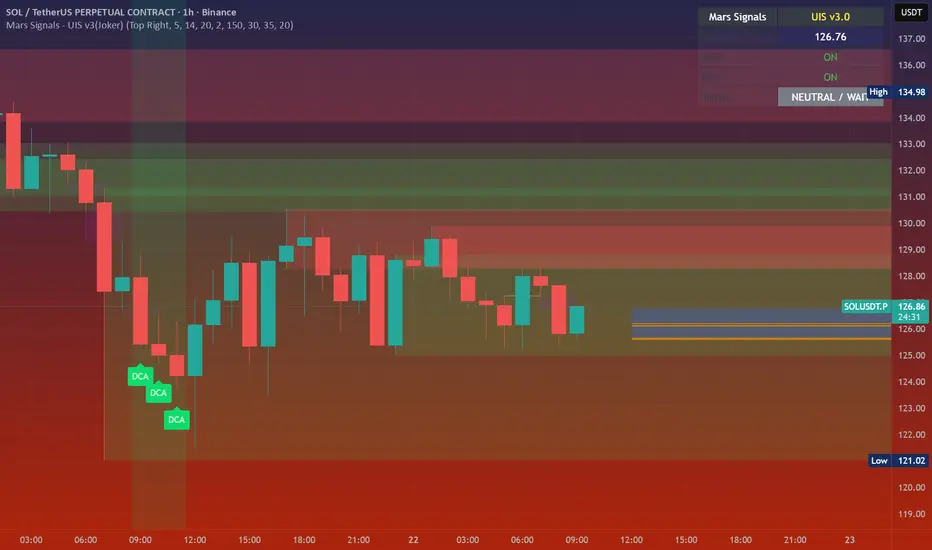
Mars Signals - Ultimate Institutional Suite v3.0(Joker)Comprehensive Trading Manual Mars Signals – Ultimate Institutional Suite v3.0 (Joker) ## Chapter 1 – Philosophy & System Architecture This script is not a simple “buy/sell” indicator. Mars Signals – UIS v3.0 (Joker) is designed as an institutional-style analytical assistant that layers several methodologies into a single, coherent framework. The system is built on four core pillars: 1. Smart Money Concepts (SMC) - Detection of Order Blocks (professional demand/supply zones). - Detection of Fair Value Gaps (FVGs) (price imbalances). 2. Smart DCA Strategy - Combination of RSI and Bollinger Bands - Identifies statistically discounted zones for scaling into spot positions or exiting shorts. 3. Volume Profile (Visible Range Simulation) - Distribution of volume by price, not by time. - Identification of POC (Point of Control) and high-/low-volume areas. 4. Wyckoff Helper – Spring - Detection of bear traps, liquidity grabs, and sharp bullish reversals. All four pillars feed into a Confluence Engine (Scoring System). The final output is presented in the Dashboard, with a clear, human-readable signal: - STRONG LONG 🚀 - WEAK LONG ↗ - NEUTRAL / WAIT - WEAK SHORT ↘ - STRONG SHORT 🩸 This allows the trader to see *how many* and *which* layers of the system support a bullish or bearish bias at any given time. ## Chapter 2 – Settings Overview ### 2.1 General & Dashboard Group - Show Dashboard Panel (`show_dash`) Turns the dashboard table in the corner of the chart ON/OFF. - Show Signal Recommendation (`show_rec`) - If enabled, the textual signal (STRONG LONG, WEAK SHORT, etc.) is displayed. - If disabled, you only see feature status (ON/OFF) and the current price. - Dashboard Position (`dash_pos`) Determines where the dashboard appears on the chart: - `Top Right` - `Bottom Right` - `Top Left` ### 2.2 Smart Money (SMC) Group - Enable SMC Strategy (`show_smc`) Globally enables or disables the Order Block and FVG logic. - Order Block Pivot Lookback (`ob_period`) Main parameter for detecting key pivot highs/lows (swing points). - Default value: 5 - Concept: A bar is considered a pivot low if its low is lower than the lows of the previous 5 and the next 5 bars. Similarly, a pivot high has a high higher than the previous 5 and the next 5 bars. These pivots are used as anchors for Order Blocks. - Increasing `ob_period`: - Fewer levels. - But levels tend to be more significant and reliable. - In highly volatile markets (major news, war events, FOMC, etc.), using values 7–10 is recommended to filter out weak levels. - Show Fair Value Gaps (`show_fvg`) Enables/disables the drawing of FVG zones (imbalances). - Bullish OB Color (`c_ob_bull`) - Color of Bullish Order Blocks (Demand Zones). - Default: semi-transparent green (transparency ≈ 80). - Bearish OB Color (`c_ob_bear`) - Color of Bearish Order Blocks (Supply Zones). - Default: semi-transparent red. - Bullish FVG Color (`c_fvg_bull`) - Color of Bullish FVG (upward imbalance), typically yellow. - Bearish FVG Color (`c_fvg_bear`) - Color of Bearish FVG (downward imbalance), typically purple. ### 2.3 Smart DCA Strategy Group - Enable DCA Zones (`show_dca`) Enables the Smart DCA logic and visual labels. - RSI Length (`rsi_len`) Lookback period for RSI (default: 14). - Shorter → more sensitive, more noise. - Longer → fewer signals, higher reliability. - Bollinger Bands Length (`bb_len`) Moving average period for Bollinger Bands (default: 20). - BB Multiplier (`bb_mult`) Standard deviation multiplier for Bollinger Bands (default: 2.0). - For extremely volatile markets, values like 2.5–3.0 can be used so that only extreme deviations trigger a DCA signal. ### 2.4 Volume Profile (Visible Range Sim) Group - Show Volume Profile (`show_vp`) Enables the simulated Volume Profile bars on the right side of the chart. - Volume Lookback Bars (`vp_lookback`) Number of bars used to compute the Volume Profile (default: 150). - Higher values → broader historical context, heavier computation. - Row Count (`vp_rows`) Number of vertical price segments (rows) to divide the total price range into (default: 30). - Width (%) (`vp_width`) Relative width of each volume bar as a percentage. In the code, bar widths are scaled relative to the row with the maximum volume. > Technical note: Volume Profile calculations are executed only on the last bar (`barstate.islast`) to keep the script performant even on higher timeframes. ### 2.5 Wyckoff Helper Group - Show Wyckoff Events (`show_wyc`) Enables detection and plotting of Wyckoff Spring events. - Volume MA Length (`vol_ma_len`) Length of the moving average on volume. A bar is considered to have Ultra Volume if its volume is more than 2× the volume MA. ## Chapter 3 – Smart Money Strategy (Order Blocks & FVG) ### 3.1 What Is an Order Block? An Order Block (OB) represents the footprint of large institutional orders: - Bullish Order Block (Demand Zone) The last selling region (bearish candle/cluster) before a strong upward move. - Bearish Order Block (Supply Zone) The last buying region (bullish candle/cluster) before a strong downward move. Institutions and large players place heavy orders in these regions. Typical price behavior: - Price moves away from the zone. - Later returns to the same zone to fill unfilled orders. - Then continues the larger trend. In the script: - If `pl` (pivot low) forms → a Bullish OB is created. - If `ph` (pivot high) forms → a Bearish OB is created. The box is drawn: - From `bar_index ` to `bar_index`. - Between `low ` and `high `. - `extend=extend.right` extends the OB into the future, so it acts as a dynamic support/resistance zone. - Only the last 4 OB boxes are kept to avoid clutter. ### 3.2 Order Block Color Guide - Semi-transparent Green (`c_ob_bull`) - Represents a Bullish Order Block (Demand Zone). - Interpretation: a price region with a high probability of bullish reaction. - Semi-transparent Red (`c_ob_bear`) - Represents a Bearish Order Block (Supply Zone). - Interpretation: a price region with a high probability of bearish reaction. Overlap (Multiple OBs in the Same Area) When two or more Order Blocks overlap: - The shared area appears visually denser/stronger. - This suggests higher order density. - Such zones can be treated as high-priority levels for entries, exits, and stop-loss placement. ### 3.3 Demand/Supply Logic in the Scoring Engine is_in_demand = low <= ta.lowest(low, 20) is_in_supply = high >= ta.highest(high, 20) - If current price is near the lowest lows of the last 20 bars, it is considered in a Demand Zone → positive impact on score. - If current price is near the highest highs of the last 20 bars, it is considered in a Supply Zone → negative impact on score. This logic complements Order Blocks and helps the Dashboard distinguish whether: - Market is currently in a statistically cheap (long-friendly) area, or - In a statistically expensive (short-friendly) area. ### 3.4 Fair Value Gaps (FVG) #### Concept When the market moves aggressively: - Some price levels are skipped and never traded. - A gap between wicks/shadows of consecutive candles appears. - These regions are called Fair Value Gaps (FVGs) or Imbalances. The market generally “dislikes” imbalance and often: - Returns to these zones in the future. - Fills the gap (rebalance). - Then resumes its dominant direction. #### Implementation in the Code Bullish FVG (Yellow) fvg_bull_cond = show_smc and show_fvg and low > high and close > high if fvg_bull_cond box.new(bar_index , high , bar_index, low, ...) Core condition: `low > high ` → the current low is above the high of two bars ago; the space between them is an untraded gap. Bearish FVG (Purple) fvg_bear_cond = show_smc and show_fvg and high < low and close < low if fvg_bear_cond box.new(bar_index , low , bar_index, high, ...) Core condition: `high < low ` → the current high is below the low of two bars ago; again a price gap exists. #### FVG Color Guide - Transparent Yellow (`c_fvg_bull`) – Bullish FVG Often acts like a magnet for price: - Price tends to retrace into this zone, - Fill the imbalance, - And then continue higher. - Transparent Purple (`c_fvg_bear`) – Bearish FVG Price tends to: - Retrace upward into the purple area, - Fill the imbalance, - And then resume downward movement. #### Trading with FVGs - FVGs are *not* standalone entry signals. They are best used as: - Targets (take-profit zones), or - Reaction areas where you expect a pause or reversal. Examples: - If you are long, a bearish FVG above is often an excellent take-profit zone. - If you are short, a bullish FVG below is often a good cover/exit zone. ### 3.5 Core SMC Trading Templates #### Reversal Long 1. Price trades down into a green Order Block (Demand Zone). 2. A bullish confirmation candle (Close > Open) forms inside or just above the OB. 3. If this zone is close to or aligned with a bullish FVG (yellow), the signal is reinforced. 4. Entry: - At the close of the confirmation candle, or - Using a limit order near the upper boundary of the OB. 5. Stop-loss: - Slightly below the OB. - If the OB is broken decisively and price consolidates below it, the zone loses validity. 6. Targets: - The next FVG, - Or the next red Order Block (Supply Zone) above. #### Reversal Short The mirror scenario: - Price rallies into a red Order Block (Supply). - A bearish confirmation candle forms (Close < Open). - FVG/premium structure above can act as a confluence. - Stop-loss goes above the OB. - Targets: lower FVGs or subsequent green OBs below. ## Chapter 4 – Smart DCA Strategy (RSI + Bollinger Bands) ### 4.1 Smart DCA Concept - Classic DCA = buying at fixed time intervals regardless of price. - Smart DCA = scaling in only when: - Price is statistically cheaper than usual, and - The market is in a clear oversold condition. Code logic: rsi_val = ta.rsi(close, rsi_len) = ta.bb(close, bb_len, bb_mult) dca_buy = show_dca and rsi_val < 30 and close < bb_lower dca_sell = show_dca and rsi_val > 70 and close > bb_upper Conditions: - DCA Buy – Smart Scale-In Zone - RSI < 30 → oversold. - Close < lower Bollinger Band → price has broken below its typical volatility envelope. - DCA Sell – Overbought/Distribution Zone - RSI > 70 → overbought. - Close > upper Bollinger Band → price is extended far above the mean. ### 4.2 Visual Representation on the Chart - Green “DCA” Label Below Candle - Shape: `labelup`. - Color: lime background, white text. - Meaning: statistically attractive level for laddered spot entries or short exits. - Red “SELL” Label Above Candle - Warning that the market is in an extended, overbought condition. - Suitable for profit-taking on longs or considering short entries (with proper confluence and risk management). - Light Green Background (`bgcolor`) - When `dca_buy` is true, the candle background turns very light green (high transparency). - This helps visually identify DCA Zones across the chart at a glance. ### 4.3 Practical Use in Trading #### Spot Trading Used to build a better average entry price: - Every time a DCA label appears, allocate a fixed portion of capital (e.g., 2–5%). - Combining DCA signals with: - Green OBs (Demand Zones), and/or - The Volume Profile POC makes the zone structurally more important. #### Futures Trading - Longs - Use DCA Buy signals as low-risk zones for opening or adding to longs when: - Price is inside a green OB, or - The Dashboard already leans LONG. - Shorts - Use DCA Sell signals as: - Exit zones for longs, or - Areas to initiate shorts with stops above structural highs. ## Chapter 5 – Volume Profile (Visible Range Simulation) ### 5.1 Concept Traditional volume (histogram under the chart) shows volume over time. Volume Profile shows volume by price level: - At which prices has the highest trading activity occurred? - Where did buyers and sellers agree the most (High Volume Nodes – HVNs)? - Where did price move quickly due to low participation (Low Volume Nodes – LVNs)? ### 5.2 Implementation in the Script Executed only when `show_vp` is enabled and on the last bar: 1. The last `vp_lookback` bars (default 150) are processed. 2. The minimum low and maximum high over this window define the price range. 3. This price range is divided into `vp_rows` segments (e.g., 30 rows). 4. For each row: - All bars are scanned. - If the mid-price `(high + low ) / 2` falls inside a row, that bar’s volume is added to the row total. 5. The row with the greatest volume is stored as `max_vol_idx` (the POC row). 6. For each row, a volume box is drawn on the right side of the chart. ### 5.3 Color Scheme - Semi-transparent Orange - The row with the maximum volume – the Point of Control (POC). - Represents the strongest support/resistance level from a volume perspective. - Semi-transparent Blue - Other volume rows. - The taller the bar → the higher the volume → the stronger the interest at that price band. ### 5.4 Trading Applications - If price is above POC and retraces back into it: → POC often acts as support, suitable for long setups. - If price is below POC and rallies into it: → POC often acts as resistance, suitable for short setups or profit-taking. HVNs (Tall Blue Bars) - Represent areas of equilibrium where the market has spent time and traded heavily. - Price tends to consolidate here before choosing a direction. LVNs (Short or Nearly Empty Bars) - Represent low participation zones. - Price often moves quickly through these areas – useful for targeting fast moves. ## Chapter 6 – Wyckoff Helper – Spring ### 6.1 Spring Concept In the Wyckoff framework: - A Spring is a false break of support. - The market briefly trades below a well-defined support level, triggers stop losses, then sharply reverses upward as institutional buyers absorb liquidity. This movement: - Clears out weak hands (retail sellers). - Provides large players with liquidity to enter long positions. - Often initiates a new uptrend. ### 6.2 Code Logic Conditions for a Spring: 1. The current low is lower than the lowest low of the previous 50 bars → apparent break of a long-standing support. 2. The bar closes bullish (Close > Open) → the breakdown was rejected. 3. Volume is significantly elevated: → `volume > 2 × volume_MA` (Ultra Volume). When all conditions are met and `show_wyc` is enabled: - A pink diamond is plotted below the bar, - With the label “Spring” – one of the strongest long signals in this system. ### 6.3 Trading Use - After a valid Spring, markets frequently enter a meaningful bullish phase. - The highest quality setups occur when: - The Spring forms inside a green Order Block, and - Near or on the Volume Profile POC. Entries: - At the close of the Spring bar, or - On the first pullback into the mid-range of the Spring candle. Stop-loss: - Slightly below the Spring’s lowest point (wick low plus a small buffer). ## Chapter 7 – Confluence Engine & Dashboard ### 7.1 Scoring Logic For each bar, the script: 1. Resets `score` to 0. 2. Adjusts the score based on different signals. SMC Contribution if show_smc if is_in_demand score += 1 if is_in_supply score -= 1 - Being in Demand → `+1` - Being in Supply → `-1` DCA Contribution if show_dca if dca_buy score += 2 if dca_sell score -= 2 - DCA Buy → `+2` (strong, statistically driven long signal) - DCA Sell → `-2` Wyckoff Spring Contribution if show_wyc if wyc_spring score += 2 - Spring → `+2` (entry of strong money) ### 7.2 Mapping Score to Dashboard Signal - score ≥ 2 → STRONG LONG 🚀 Multiple bullish conditions aligned. - score = 1 → WEAK LONG ↗ Some bullish bias, but only one layer clearly positive. - score = 0 → NEUTRAL / WAIT Rough balance between buying and selling forces; staying flat is usually preferable. - score = -1 → WEAK SHORT ↘ Mild bearish bias, suited for cautious or short-term plays. - score ≤ -2 → STRONG SHORT 🩸 Convergence of several bearish signals. ### 7.3 Dashboard Structure The dashboard is a two-column table: - Row 0 - Column 0: `"Mars Signals"` – black background, white text. - Column 1: `"UIS v3.0"` – black background, yellow text. - Row 1 - Column 0: `"Price:"` (light grey background). - Column 1: current closing price (`close`) with a semi-transparent blue background. - Row 2 - Column 0: `"SMC:"` - Column 1: - `"ON"` (green) if `show_smc = true` - `"OFF"` (grey) otherwise. - Row 3 - Column 0: `"DCA:"` - Column 1: - `"ON"` (green) if `show_dca = true` - `"OFF"` (grey) otherwise. - Row 4 - Column 0: `"Signal:"` - Column 1: signal text (`status_txt`) with background color `status_col` (green, red, teal, maroon, etc.) - If `show_rec = false`, these cells are cleared. ## Chapter 8 – Visual Legend (Colors, Shapes & Actions) For quick reading inside TradingView, the visual elements are described line by line instead of a table. Chart Element: Green Box Color / Shape: Transparent green rectangle Core Meaning: Bullish Order Block (Demand Zone) Suggested Trader Response: Look for longs, Smart DCA adds, closing or reducing shorts. Chart Element: Red Box Color / Shape: Transparent red rectangle Core Meaning: Bearish Order Block (Supply Zone) Suggested Trader Response: Look for shorts, or take profit on existing longs. Chart Element: Yellow Area Color / Shape: Transparent yellow zone Core Meaning: Bullish FVG / upside imbalance Suggested Trader Response: Short take-profit zone or expected rebalance area. Chart Element: Purple Area Color / Shape: Transparent purple zone Core Meaning: Bearish FVG / downside imbalance Suggested Trader Response: Long take-profit zone or temporary supply region. Chart Element: Green "DCA" Label Color / Shape: Green label with white text, plotted below the candle Core Meaning: Smart ladder-in buy zone, DCA buy opportunity Suggested Trader Response: Spot DCA entry, partial short exit. Chart Element: Red "SELL" Label Color / Shape: Red label with white text, plotted above the candle Core Meaning: Overbought / distribution zone Suggested Trader Response: Take profit on longs, consider initiating shorts. Chart Element: Light Green Background (bgcolor) Color / Shape: Very transparent light-green background behind bars Core Meaning: Active DCA Buy zone Suggested Trader Response: Treat as a discount zone on the chart. Chart Element: Orange Bar on Right Color / Shape: Transparent orange horizontal bar in the volume profile Core Meaning: POC – price with highest traded volume Suggested Trader Response: Strong support or resistance; key reference level. Chart Element: Blue Bars on Right Color / Shape: Transparent blue horizontal bars in the volume profile Core Meaning: Other volume levels, showing high-volume and low-volume nodes Suggested Trader Response: Use to identify balance zones (HVN) and fast-move corridors (LVN). Chart Element: Pink "Spring" Diamond Color / Shape: Pink diamond with white text below the candle Core Meaning: Wyckoff Spring – liquidity grab and potential major bullish reversal Suggested Trader Response: One of the strongest long signals in the suite; look for high-quality long setups with tight risk. Chart Element: STRONG LONG in Dashboard Color / Shape: Green background, white text in the Signal row Core Meaning: Multiple bullish layers in confluence Suggested Trader Response: Consider initiating or increasing longs with strict risk management. Chart Element: STRONG SHORT in Dashboard Color / Shape: Red background, white text in the Signal row Core Meaning: Multiple bearish layers in confluence Suggested Trader Response: Consider initiating or increasing shorts with a logical, well-placed stop. ## Chapter 9 – Timeframe-Based Trading Playbook ### 9.1 Timeframe Selection - Scalping - Timeframes: 1M, 5M, 15M - Objective: fast intraday moves (minutes to a few hours). - Recommendation: focus on SMC + Wyckoff. Smart DCA on very low timeframes may introduce excessive noise. - Day Trading - Timeframes: 15M, 1H, 4H - Provides a good balance between signal quality and frequency. - Recommendation: use the full stack – SMC + DCA + Volume Profile + Wyckoff + Dashboard. - Swing Trading & Position Investing - Timeframes: Daily, Weekly - Emphasis on Smart DCA + Volume Profile. - SMC and Wyckoff are used mainly to fine-tune swing entries within larger trends. ### 9.2 Scenario A – Scalping Long Example: 5-Minute Chart 1. Price is declining into a green OB (Bullish Demand). 2. A candle with a long lower wick and bullish close (Pin Bar / Rejection) forms inside the OB. 3. A Spring diamond appears below the same candle → very strong confluence. 4. The Dashboard shows at least WEAK LONG ↗, ideally STRONG LONG 🚀. 5. Entry: - On the close of the confirmation candle, or - On the first pullback into the mid-range of that candle. 6. Stop-loss: - Slightly below the OB. 7. Targets: - Nearby bearish FVG above, and/or - The next red OB. ### 9.3 Scenario B – Day-Trading Short Recommended Timeframes: 1H or 4H 1. The market completes a strong impulsive move upward. 2. Price enters a red Order Block (Supply). 3. In the same zone, a purple FVG appears or remains unfilled. 4. On a lower timeframe (e.g., 15M), RSI enters overbought territory and a DCA Sell signal appears. 5. The main timeframe Dashboard (1H) shows WEAK SHORT ↘ or STRONG SHORT 🩸. Trade Plan - Open a short near the upper boundary of the red OB. - Place the stop above the OB or above the last swing high. - Targets: - A yellow FVG lower on the chart, and/or - The next green OB (Demand) below. ### 9.4 Scenario C – Swing / Investment with Smart DCA Timeframes: Daily / Weekly 1. On the daily or weekly chart, each time a green “DCA” label appears: - Allocate a fixed fraction of your capital (e.g., 3–5%) to that asset. 2. Check whether this DCA zone aligns with the orange POC of the Volume Profile: - If yes → the quality of the entry zone is significantly higher. 3. If the DCA signal sits inside a daily green OB, the probability of a medium-term bottom increases. 4. Always build the position laddered, never all-in at a single price. Exits for investors: - Near weekly red OBs or large purple FVG zones. - Ideally via partial profit-taking rather than closing 100% at once. ### 9.5 Case Study 1 – BTCUSDT (15-Minute) - Context: Price has sold off down towards 65,000 USD. - A green OB had previously formed at that level. - Near the lower boundary of this OB, a partially filled yellow FVG is present. - As price returns to this region, a Spring appears. - The Dashboard shifts from NEUTRAL / WAIT to WEAK LONG ↗. Plan - Enter a long near the OB low. - Place stop below the Spring low. - First target: a purple FVG around 66,200. - Second (optional) target: the first red OB above that level. ### 9.6 Case Study 2 – Meme Coin (PEPE – 4H) - After a strong pump, price enters a corrective phase. - On the 4H chart, RSI drops below 30; price breaks below the lower Bollinger Band → a DCA label prints. - The Volume Profile shows the POC at approximately the same level. - The Dashboard displays STRONG LONG 🚀. Plan - Execute laddered buys in the combined DCA + POC zone. - Place a protective stop below the last significant swing low. - Target: an expected 20–30% upside move towards the next red OB or purple FVG. ## Chapter 10 – Risk Management, Psychology & Advanced Tuning ### 10.1 Risk Management No signal, regardless of its strength, replaces risk control. Recommendations: - In futures, do not expose more than 1–3% of account equity to risk per trade. - Adjust leverage to the volatility of the instrument (lower leverage for highly volatile altcoins). - Place stop-losses in zones where the idea is clearly invalidated: - Below/above the relevant Order Block or Spring, not randomly in the middle of the structure. ### 10.2 Market-Specific Parameter Tuning - Calmer Markets (e.g., major FX pairs) - `ob_period`: 3–5. - `bb_mult`: 2.0 is usually sufficient. - Highly Volatile Markets (Crypto, news-driven assets) - `ob_period`: 7–10 to highlight only the most robust OBs. - `bb_mult`: 2.5–3.0 so that only extreme deviations trigger DCA. - `vol_ma_len`: increase (e.g., to ~30) so that Spring triggers only on truly exceptional volume spikes. ### 10.3 Trading Psychology - STRONG LONG 🚀 does not mean “risk-free”. It means the probability of a successful long, given the model’s logic, is higher than average. - Treat Mars Signals as a confirmation and context system, not a full replacement for your own decision-making. - Example of disciplined thinking: - The Dashboard prints STRONG LONG, - But price is simultaneously testing a multi-month macro resistance or a major negative news event is imminent, - In such cases, trade smaller, widen stops appropriately, or skip the trade. ## Chapter 11 – Technical Notes & FAQ ### 11.1 Does the Script Repaint? - Order Blocks and Springs are based on completed pivot structures and confirmed candles. - Until a pivot is confirmed, an OB does not exist; after confirmation, behavior is stable under classic SMC assumptions. - The script is designed to be structurally consistent rather than repainting signals arbitrarily. ### 11.2 Computational Load of Volume Profile - On the last bar, the script processes up to `vp_lookback` bars × `vp_rows` rows. - On very low timeframes with heavy zooming, this can become demanding. - If you experience performance issues: - Reduce `vp_lookback` or `vp_rows`, or - Temporarily disable Volume Profile (`show_vp = false`). ### 11.3 Multi-Timeframe Behavior - This version of the script is not internally multi-timeframe. All logic (OB, DCA, Spring, Volume Profile) is computed on the active timeframe only. - Practical workflow: - Analyze overall structure and key zones on higher timeframes (4H / Daily). - Use lower timeframes (15M / 1H) with the same tool for timing entries and exits. ## Conclusion Mars Signals – Ultimate Institutional Suite v3.0 (Joker) is a multi-layer trading framework that unifies: - Price structure (Order Blocks & FVG), - Statistical behavior (Smart DCA via RSI + Bollinger), - Volume distribution by price (Volume Profile with POC, HVN, LVN), - Liquidity events (Wyckoff Spring), into a single, coherent system driven by a transparent Confluence Scoring Engine. The final output is presented in clear, actionable language: > STRONG LONG / WEAK LONG / NEUTRAL / WEAK SHORT / STRONG SHORT The system is designed to support professional decision-making, not to replace it. Used together with strict risk management and disciplined execution, Mars Signals – UIS v3.0 (Joker) can serve as a central reference manual and operational guide for your trading workflow, from scalping to swing and investment positioning. Pine Script® göstergesiMarsSignals tarafından119
Average Price Calculator / VisualizerDCA Average Price Calculator - Visualize Your Breakeven & TP! Ever wished you could visualize your trades and instantly see your average entry price right here on TradingView? Especially if you're a DCA (Dollar-Cost Averaging) trader like me, tracking multiple entries can be a hassle. You're constantly switching to a spreadsheet or calculator to figure out your breakeven and take-profit levels. Well I've developed this DCA Average Price Calculator to solve exactly that problem, bringing all your position planning directly onto your chart. What It Does This indicator is a interactive tool designed to calculate the weighted average price of up to 10 separate trade entries. It then plots your crucial breakeven (average price) and a customizable take-profit target directly on your chart, giving you a clear visual of your position. Key Features Up to 10 Order Entries: Plan complex DCA strategies with support for up to ten individual buys. Flexible Size Input: Enter your position size in either USD Amount or Number of Shares/Contracts. The script is smart enough to know which one you're using. Instant Average Price Calculation: Your weighted average price (your breakeven point) is calculated and plotted in real-time as a clean yellow line. Customizable Take-Profit Target: Set your desired profit percentage and see your take-profit level instantly plotted as a green line. Detailed On-Chart Labels: Each order you plot is marked with a detailed label showing the entry price, the number of shares purchased, and the total USD value of that entry. Clean & Uncluttered UI: The main Average and TP labels are intelligently shifted to the right, ensuring they don't overlap with your entry markers, keeping your chart readable. How to Use It - Simple Steps Add the indicator to your chart. Open the script's 'Settings' menu. In the 'Take Profit' section, set your desired profit percentage (e.g., 1 for 1%). Under the 'Orders' section, begin filling in your entries. For each 'Order #', enter the Price. Next, enter the size. You can either fill in the 'Size (USD)' box OR the '/ Shares' box. Leave the one you're not using at 0. As you add orders, the 'Avg' (yellow) and 'TP' (green) lines, along with the blue order labels, will automatically appear and adjust on your chart! Who Is This For? DCA Traders: This is the ultimate tool for you! Position Traders: Keep track of scaling into a larger position over time. Manual Backtesters: Quickly simulate and visualize how a series of buys would have played out. Any Trader who wants a quick and easy way to calculate their average entry without leaving TradingView. I built this tool to improve my own trading workflow, and I hope it helps you as much as it has helped me. If you find it useful, please consider giving it a 'Like' and feel free to leave any feedback or suggestions in the comments! Happy tradingPine Script® göstergesiKB0006 tarafından10
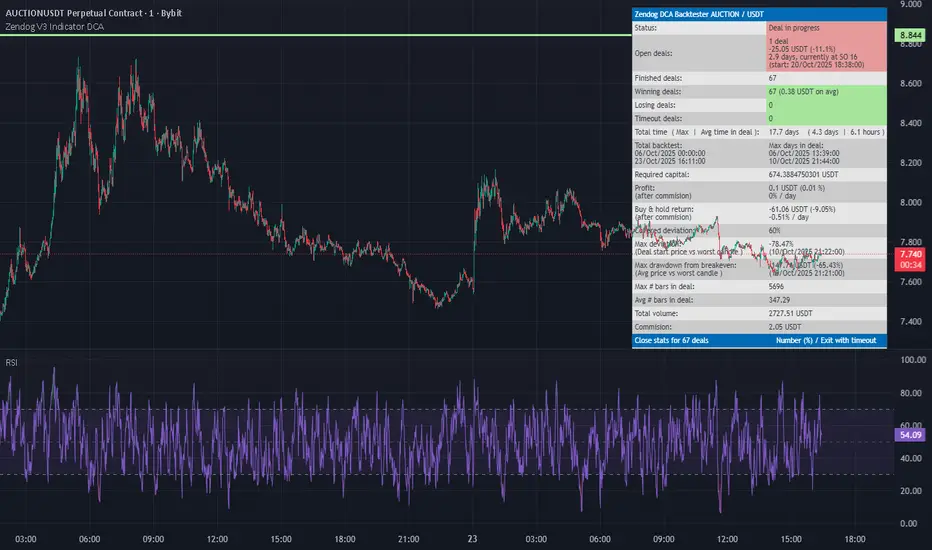
Zendog V3 Indicator DCAThis strategy is same as Zendog v3 but edited to be backtest compatible for SO additions through indicator for Longs Safety order type = External indicator External indicator = RSI 30/70 : Long Trigger Safety Order Value = 1 for Shorts Safety order type = External indicator External indicator = RSI 30/70 : Short Trigger Safety Order Value = 2Pine Script® stratejisimnmedipa tarafından29
DCA Percent SignalOverview The DCA Percent Signal Indicator generates buy and sell signals based on percentage drops from all-time highs and percentage gains from lowest lows since ATH. This indicator is designed for pyramiding strategies where each signal represents a configurable percentage of equity allocation. Definitions DCA (Dollar-Cost Averaging): An investment strategy where you invest a fixed amount at regular intervals, regardless of price fluctuations. This indicator generates signals for a DCA-style pyramiding approach. Gann Bar Types: Classification system for price bars based on their relationship to the previous bar: Up Bar: High > previous high AND low ≥ previous low Down Bar: High ≤ previous high AND low < previous low Inside Bar: High ≤ previous high AND low ≥ previous low Outside Bar: High > previous high AND low < previous low ATH (All-Time High): The highest price level reached during the entire chart period ATL (All-Time Low): The lowest price level reached since the most recent ATH Pyramiding: A trading strategy that adds to positions on favorable price movements Look-Ahead Bias: Using future information that wouldn't be available in real-time trading Default Properties Signal Thresholds: Buy Threshold: 10% (triggers every 10% drop from ATH) Sell Threshold: 30% (triggers every 30% gain from lowest low since ATH) Price Sources: ATH Tracking: High (ATH detection) ATL Tracking: Low (low detection) Buy Signal Source: Low (buy signals) Sell Signal Source: High (sell signals) Filter Options: Apply Gann Filter: False (disabled by default) Buy Sets ATL: False (disabled by default) Display Options: Show Buy/Sell Signals: True Show Reference Lines: True Show Info Table: False Show Bar Type: False How It Works Buy Signals: Trigger every 10% drop from the all-time highest price reached Sell Signals: Trigger every 30% increase from the lowest low since the most recent all-time high Smart Tracking: Uses configurable price sources for signal generation Key Features Configurable Thresholds: Adjustable buy/sell percentage thresholds (default: 10%/30%) Separate Price Sources: Independent sources for ATH tracking, ATL tracking, and signal triggers Configurable Signals: Uses low for buy signals and high for sell signals by default Optional Gann Filter: Apply Gann bar analysis for additional signal filtering Optional Buy Sets ATL: Option to set ATL reference point when buy signals occur Visual Debug: Detailed labels showing signal parameters and values Usage Instructions Apply to Chart: Use on any timeframe (recommended: 1D or higher for better signal quality) Risk Management: Adjust thresholds based on your risk tolerance and market volatility Signal Analysis: Monitor debug labels for detailed signal information and validation Signal Logic Buy signals are blocked when ATH increases to prevent buying at peaks Sell signals are blocked when ATL decreases to prevent selling at lows This ensures signals only trigger on subsequent bars, not the same bar that establishes new reference points Buy Signals: Calculate drop percentage from ATH to buy signal source Trigger when drop reaches threshold increments (10%, 20%, 30%, etc.) Always blocked on ATH bars to prevent buying at peaks Optional: Also blocked on up/outside bars when Gann filter enabled Sell Signals: Calculate gain percentage from lowest low to sell signal source Trigger when gain reaches threshold increments (30%, 60%, 90%, etc.) Always blocked when ATL decreases to prevent selling at lows Optional: Also blocked on down bars when Gann filter enabled Limitations Designed for trending markets; may generate many signals in sideways/ranging markets Requires sufficient price movement to be effective Not suitable for scalping or very short timeframes Implementation Notes Signals use optimistic price sources (low for buys, high for sells), these can be configured to be more conservative Gann filter provides additional signal filtering based on bar types Debug information available in data window for real-time analysis Detailed labels on each signal show ATH, lowest low, buy level, sell level, and drop/gain percentages Pine Script® göstergesiQuantAlchemy tarafından1156
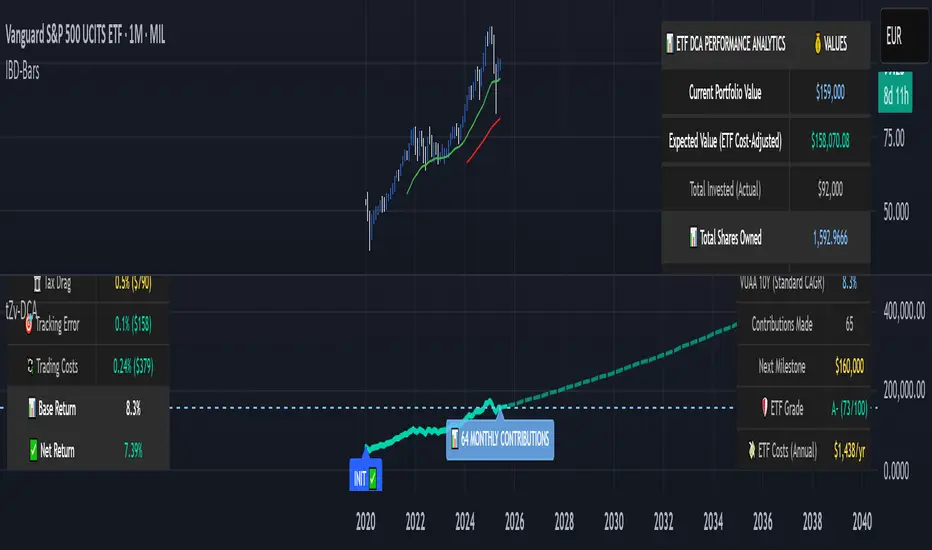
DCA Anchor (Weekly/Monthly/N Bars) [CHE] What is Dollar-Cost Averaging (DCA)? DCA is a position-building method where you invest a fixed amount at fixed intervals (e.g., weekly or monthly) regardless of price. Over time, this: reduces timing risk (you don’t need to guess tops/bottoms), smooths entry price by buying more units when price is low and fewer when price is high, keeps decisions simple and repeatable. Trade-offs: You’ll never catch the exact bottom. In strong uptrends, lump-sum can outperform. Fees matter if you buy very frequently. Simple math: Qty bought at time t = `amount / price_t` (net of fees if fees are not “on top”). Total qty = sum of all buys. Average price (cost basis) = `total invested / total qty`. Equity = `total qty last price`. P\&L = `equity − total invested` (and `%` = `P&L / total invested`). DCA Anchor (Weekly/Monthly/N Bars) Purpose: automate scheduled DCA buys on chart data, optionally add extra buys on drawdowns, track stats, and fire alerts. Core features Schedules: 1. Every N bars, 2. Weekly (first bar of a new week), 3. Monthly (first bar of a new month). A Start time input gates when the logic begins. Fees model: Fee on top: you pay `amount + fee` in cash; quantity = `amount / close`. Fee from amount: fee is deducted from the amount; quantity is smaller, cash outlay equals `amount`. Optional drawdown buys: Trigger when `close ≤ avgCost (1 − ddPct/100)`. Controls: drawdown % threshold, multiplier (extra size vs. base amount), and cooldown in bars. State & metrics: tracks total invested, total quantity, average price, equity, P\&L (abs/%). Visuals: Line plot of Average Price. Buy labels at execution bars (plan and drawdown). Compact table (positionable) with key stats (trades, invested, qty, avg price, equity, P\&L). Alerts: Plan Buy (Bar Close) and Drawdown Buy (Bar Close) — robust, non-repainting. Optional Intrabar Preview alerts for early heads-up (can fire before bar close). How to use it (quick start) 1. Add to chart → Inputs: Buy frequency: pick Every N bars, Weekly, or Monthly. Start time: date from which buys may begin. Buy amount: fixed cash per planned buy. Fees % and Fee on top? to match your broker/exchange model. (Optional) Enable drawdown buy, set threshold %, multiplier, and cooldown. Toggle Show buy labels and Show stats table. 2. Alerts (recommended): Use “DCA Plan Buy (Bar Close)” and/or “DCA Drawdown Buy (Bar Close)” with Once per bar close. If you need early signals, enable Intrabar pre-alerts and add the two Intrabar Preview alerts with Once per bar. 3. Interpretation: The yellow line is your average price. Green/orange markers show plan buys and drawdown buys. The table summarizes total trades, invested capital, quantity, average price, current equity, and P\&L. Practical notes All executions occur at bar close by default to avoid intrabar repainting. Weekly/monthly roll depends on the symbol’s exchange calendar. Backtest realism: no slippage, no partial fills. Fees are modeled as configured. If you buy very frequently, consider higher “N” or weekly/monthly to keep fees under control. If you want, I can tailor the defaults (amount, fee model, drawdown rules) to your typical markets and timeframes. Disclaimer No indicator guarantees profits. DCA Anchor (Weekly/Monthly/N Bars) is a decision aid; always combine with solid risk management and your own judgment. Backtest, forward test, and size responsibly. The content provided, including all code and materials, is strictly for educational and informational purposes only. It is not intended as, and should not be interpreted as, financial advice, a recommendation to buy or sell any financial instrument, or an offer of any financial product or service. All strategies, tools, and examples discussed are provided for illustrative purposes to demonstrate coding techniques and the functionality of Pine Script within a trading context. Any results from strategies or tools provided are hypothetical, and past performance is not indicative of future results. Trading and investing involve high risk, including the potential loss of principal, and may not be suitable for all individuals. Before making any trading decisions, please consult with a qualified financial professional to understand the risks involved. By using this script, you acknowledge and agree that any trading decisions are made solely at your discretion and risk. Enhance your trading precision and confidence 🚀 Best regards Chervolino Pine Script® göstergesichervolino tarafından26
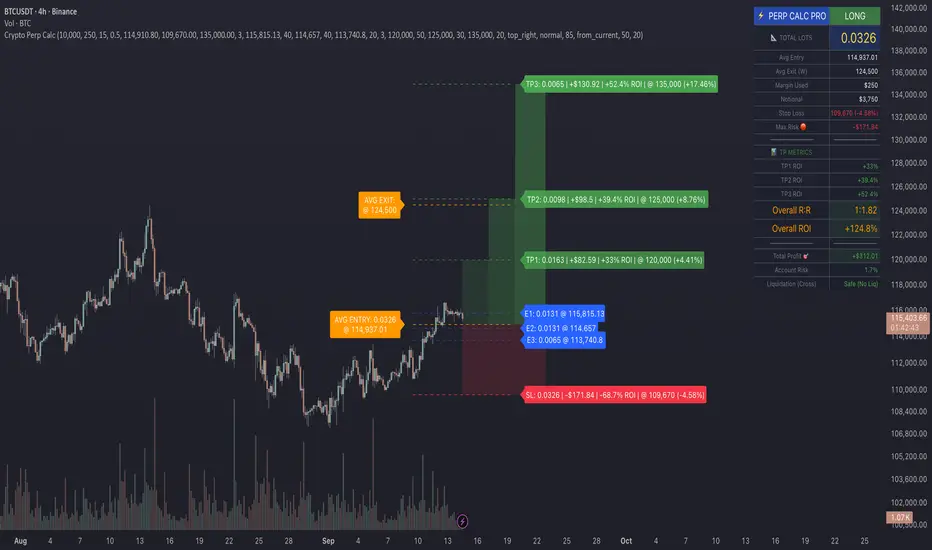
Crypto Perp Calc v1Advanced Perpetual Position Calculator for TradingView Description A comprehensive position sizing and risk management tool designed specifically for perpetual futures trading. This indicator eliminates the confusion of calculating leveraged positions by providing real-time position metrics directly on your chart. Key Features: Interactive Price Selection: Click directly on chart to set entry, stop loss, and take profit levels Accurate Lot Size Calculation: Instantly calculates the exact position size needed for your margin and leverage Multiple Entry Support: DCA into positions with up to 3 entry points with customizable allocation Multiple Take Profit Levels: Scale out of positions with up to 3 TP targets Comprehensive Risk Metrics: Shows dollar P&L, account risk percentage, and liquidation price Visual Risk/Reward: Color-coded boxes and lines display your trade setup clearly Real-time Info Table: All critical position data in one organized panel Perfect for traders using perpetual futures who need precise position sizing with leverage. --------- How to Use Quick Start (3 Clicks) 1. Add the indicator to your chart 2. Click three times when prompted: First click: Set your entry price Second click: Set your stop loss Third click: Set your take profit 3. Read the TOTAL LOTS value from the info table (highlighted in yellow) 4. Use this lot size in your exchange when placing the trade Detailed Setup Step 1: Configure Your Account Enter your account balance (total USDT in account) Set your margin amount (how much USDT to risk on this trade) Choose your leverage (1x to 125x) Select Long or Short position Step 2: Set Price Levels Main levels use interactive clicking (Entry, SL, TP) For multiple entries or TPs, use the settings panel to manually input prices and percentages Step 3: Read the Results The info table shows: TOTAL LOTS - The position size to enter on your exchange Margin Used - Your actual capital at risk Notional - Total position value (margin × leverage) Max Risk - Dollar amount you'll lose at stop loss Total Profit - Dollar amount you'll gain at take profit R:R Ratio - Risk to reward ratio Account Risk - Percentage of account at risk Liquidation - Price where position gets liquidated Step 4: Advanced Features (Optional) Multiple Entries (DCA): Enable "Use Multiple Entries" Set up to 3 entry prices Allocate percentage for each (must total 100%) See individual lot sizes for each entry Multiple Take Profits: Enable "Use Multiple TPs" Set up to 3 TP levels Allocate percentage to close at each level (must total 100%) View profit at each target Visual Elements Blue lines/labels: Entry points Red lines/labels: Stop loss Green lines/labels: Take profit targets Colored boxes: Visual risk (red) and reward (green) zones Info table: Can be positioned anywhere on screen Alerts Set price alerts for: Entry zones reached Stop loss approached Take profit levels hit Works with TradingView's alert system Tips for Best Results Always verify the lot size matches your intended risk Check the liquidation price stays far from your stop loss Monitor the account risk percentage (recommended: keep under 2-3%) Use the warning indicators if risk exceeds margin For quick trades, use single entry/TP; for complex strategies, use multiple levels Example Workflow Find your trade setup using your analysis Add this indicator and click to set levels Check risk metrics in the table Copy the TOTAL LOTS value Enter this exact position size on your exchange Set alerts for key levels if desired This tool bridges the gap between TradingView charting and exchange execution, ensuring your position sizing is always accurate when trading with leverage. Disclaimer, this was coded with help of AI, double check calculations if they are off. Pine Script® göstergesibujayjay tarafındanGüncellendi 226
Adaptive MVRV & RSI Strategy V6 (Dynamic Thresholds)Strategy Explanation This is an advanced Dollar-Cost Averaging (DCA) strategy for Bitcoin that aims to adapt to long-term market cycles and changing volatility. Instead of relying on fixed buy/sell signals, it uses a dynamic, weighted approach based on a combination of on-chain data and classic momentum. Core Components: Dual-Indicator Signal: The strategy combines two powerful indicators for a more robust signal: MVRV Ratio: An on-chain metric to identify when Bitcoin is fundamentally over or undervalued relative to its historical cost basis. Weekly RSI: A classic momentum indicator to gauge long-term market strength and identify overbought/oversold conditions. Dynamic, Self-Adjusting Thresholds: The core innovation of this strategy is that it avoids fixed thresholds (e.g., "sell when RSI is 70"). Instead, the buy and sell zones are dynamically calculated based on a long-term (2-year) moving average and standard deviation of each indicator. This allows the strategy to automatically adapt to Bitcoin's decreasing volatility and changing market structure over time. Weighted DCA (Scaling In & Out): The strategy doesn't just buy or sell a fixed amount. The size of its trades is scaled based on conviction: Buying: As the MVRV and RSI fall deeper into their "undervalued" zones, the percentage of available cash used for each purchase increases. Selling: As the indicators rise further into "overvalued" territory, the percentage of the current position sold also increases. This creates an adaptive system that systematically accumulates during periods of fear and distributes during periods of euphoria, with the intensity of its actions directly tied to the extremity of market conditions.Pine Script® stratejisiwjstienstra tarafından83
Ticker Pulse Meter BasicPairs nicely with the Contrarian 100 MA located here: and the Enhanced Stock Ticker with 50MA vs 200MA located here: Description The Ticker Pulse Meter Basic is a dynamic Pine Script v6 indicator designed to provide traders with a visual representation of a stock’s price position relative to its short-term and long-term ranges, enabling clear entry and exit signals for long-only trading strategies. By calculating three normalized metrics—Percent Above Long & Above Short, Percent Above Long & Below Short, and Percent Below Long & Below Short—this indicator offers a unique "pulse" of market sentiment, plotted as stacked area charts in a separate pane. With customizable lookback periods, thresholds, and signal plotting options, it empowers traders to identify optimal entry points and profit-taking levels. The indicator leverages Pine Script’s force_overlay feature to plot signals on either the main price chart or the indicator pane, making it versatile for various trading styles. Key Features Pulse Meter Metrics: Computes three percentages based on short-term (default: 50 bars) and long-term (default: 200 bars) lookback periods: Percent Above Long & Above Short: Measures price strength when above both short and long ranges (green area). Percent Above Long & Below Short: Indicates mixed momentum (orange area). Percent Below Long & Below Short: Signals weakness when below both ranges (red area). Flexible Signal Plotting: Toggle between plotting entry (blue dots) and exit (white dots) signals on the main price chart (location.abovebar/belowbar) or in the indicator pane (location.top/bottom) using the Plot Signals on Main Chart option. Entry/Exit Logic: Long Entry: Triggered when Percent Above Long & Above Short crosses above the high threshold (default: 20%) and Percent Below Long & Below Short is below the low threshold (default: 40%). Long Exit: Triggered when Percent Above Long & Above Short crosses above the profit-taking level (default: 95%). Visual Enhancements: Plots stacked area charts with semi-transparent colors (green, orange, red) for intuitive trend analysis. Displays threshold lines for entry (high/low) and profit-taking levels. Includes a ticker and timeframe table in the top-right corner for quick reference. Alert Conditions: Supports alerts for long entry and exit signals, integrable with TradingView’s alert system for automated trading. Technical Innovation: Combines normalized price metrics with Pine Script v6’s force_overlay for seamless signal integration on the price chart or indicator pane. Technical Details Calculation Logic: Uses confirmed bars (barstate.isconfirmed) to calculate metrics, ensuring reliability. Short-term percentage: (close - lowest(low, lookback_short)) / (highest(high, lookback_short) - lowest(low, lookback_short)). Long-term percentage: (close - lowest(low, lookback_long)) / (highest(high, lookback_long) - lowest(low, lookback_long)). Derived metrics: pct_above_long_above_short = (pct_above_long * pct_above_short) * 100. pct_above_long_below_short = (pct_above_long * (1 - pct_above_short)) * 100. pct_below_long_below_short = ((1 - pct_above_long) * (1 - pct_above_short)) * 100. Signal Plotting: Entry signals (long_entry) use ta.crossover to detect when pct_above_long_above_short crosses above entryThresholdhigh and pct_below_long_below_short is below entryThresholdlow. Exit signals (long_exit) use ta.crossover for pct_above_long_above_short crossing above profitTake. Signals are plotted as tiny circles with force_overlay=true for main chart or standard plotting for the indicator pane. Performance Considerations: Optimized for efficiency by calculating metrics only on confirmed bars and using lightweight plotting functions. How to Use Add to Chart: Copy the script into TradingView’s Pine Editor and apply it to your chart. Configure Settings: Short Lookback Period: Adjust the short-term lookback (default: 50 bars) for sensitivity. Long Lookback Period: Set the long-term lookback (default: 200 bars) for broader context. Entry Thresholds: Modify high (default: 20%) and low (default: 40%) thresholds for entry conditions. Profit Take Level: Set the exit threshold (default: 95%) for profit-taking. Plot Signals on Main Chart: Check to display signals on the price chart; uncheck for the indicator pane. Interpret Signals: Long Entry: Blue dots indicate a strong bullish setup when price is high relative to both lookback ranges and weakness is low. Long Exit: White dots signal profit-taking when strength reaches overbought levels. Use the stacked area charts to assess trend strength and momentum. Set Alerts: Create alerts for Long Entry and Long Exit conditions using TradingView’s alert system. Customize Visuals: Adjust colors and thresholds via TradingView’s settings for better visibility. The ticker table displays the symbol and timeframe in the top-right corner. Example Use Cases Swing Trading: Use entry signals to capture short-term bullish moves within a broader uptrend, exiting at profit-taking levels. Trend Confirmation: Monitor the green area (Percent Above Long & Above Short) for sustained bullish momentum. Market Sentiment Analysis: Use the stacked areas to gauge bullish vs. bearish sentiment across timeframes. Notes Testing: Backtest the indicator on your chosen market and timeframe to validate its effectiveness. Compatibility: Built for Pine Script v6 and tested on TradingView as of June 20, 2025. Limitations: Signals are long-only; adapt the script for short strategies if needed. Enhancements: Consider adding a histogram for the difference between metrics or additional thresholds for nuanced trading. Acknowledgments Inspired by public Pine Script examples and designed to simplify complex market dynamics into a clear, actionable tool. For licensing or support, contact Chuck Schultz (@chuckaschultz) on TradingView. Share feedback in the comments, and happy trading! Pine Script® göstergesichuckaschultz tarafından61
DCA Investment Tracker Pro [tradeviZion]DCA Investment Tracker Pro: Educational DCA Analysis Tool An educational indicator that helps analyze Dollar-Cost Averaging strategies by comparing actual performance with historical data calculations. --- 💡 Why I Created This Indicator As someone who practices Dollar-Cost Averaging, I was frustrated with constantly switching between spreadsheets, calculators, and charts just to understand how my investments were really performing. I wanted to see everything in one place - my actual performance, what I should expect based on historical data, and most importantly, visualize where my strategy could take me over the long term . What really motivated me was watching friends and family underestimate the incredible power of consistent investing. When Napoleon Bonaparte first learned about compound interest, he reportedly exclaimed "I wonder it has not swallowed the world" - and he was right! Yet most people can't visualize how their $500 monthly contributions today could become substantial wealth decades later. Traditional DCA tracking tools exist, but they share similar limitations: Require manual data entry and complex spreadsheets Use fixed assumptions that don't reflect real market behavior Can't show future projections overlaid on actual price charts Lose the visual context of what's happening in the market Make compound growth feel abstract rather than tangible I wanted to create something different - a tool that automatically analyzes real market history, detects volatility periods, and shows you both current performance AND educational projections based on historical patterns right on your TradingView charts. As Warren Buffett said: "Someone's sitting in the shade today because someone planted a tree a long time ago." This tool helps you visualize your financial tree growing over time. This isn't just another calculator - it's a visualization tool that makes the magic of compound growth impossible to ignore. --- 🎯 What This Indicator Does This educational indicator provides DCA analysis tools. Users can input investment scenarios to study: Theoretical Performance: Educational calculations based on historical return data Comparative Analysis: Study differences between actual and theoretical scenarios Historical Projections: Theoretical projections for educational analysis (not predictions) Performance Metrics: CAGR, ROI, and other analytical metrics for study Historical Analysis: Calculates historical return data for reference purposes --- 🚀 Key Features Volatility-Adjusted Historical Return Calculation Analyzes 3-20 years of actual price data for any symbol Automatically detects high-volatility stocks (meme stocks, growth stocks) Uses median returns for volatile stocks, standard CAGR for stable stocks Provides conservative estimates when extreme outlier years are detected Smart fallback to manual percentages when data insufficient Customizable Performance Dashboard Educational DCA performance analysis with compound growth calculations Customizable table sizing (Tiny to Huge text options) 9 positioning options (Top/Middle/Bottom + Left/Center/Right) Theme-adaptive colors (automatically adjusts to dark/light mode) Multiple display layout options Future Projection System Visual future growth projections Timeframe-aware calculations (Daily/Weekly/Monthly charts) 1-30 year projection options Shows projected portfolio value and total investment amounts Investment Insights Performance vs benchmark comparison ROI from initial investment tracking Monthly average return analysis Investment milestone alerts (25%, 50%, 100% gains) Contribution tracking and next milestone indicators --- 📊 Step-by-Step Setup Guide 1. Investment Settings 💰 Initial Investment: Enter your starting lump sum (e.g., $60,000) Monthly Contribution: Set your regular DCA amount (e.g., $500/month) Return Calculation: Choose "Auto (Stock History)" for real data or "Manual" for fixed % Historical Period: Select 3-20 years for auto calculations (default: 10 years) Start Year: When you began investing (e.g., 2020) Current Portfolio Value: Your actual portfolio worth today (e.g., $150,000) 2. Display Settings 📊 Table Sizes: Choose from Tiny, Small, Normal, Large, or Huge Table Positions: 9 options - Top/Middle/Bottom + Left/Center/Right Visibility Toggles: Show/hide Main Table and Stats Table independently 3. Future Projection 🔮 Enable Projections: Toggle on to see future growth visualization Projection Years: Set 1-30 years ahead for analysis Live Example - NASDAQ:META Analysis: Settings shown: $60K initial + $500/month + Auto calculation + 10-year history + 2020 start + $150K current value --- 🔬 Pine Script Code Examples Core DCA Calculations: // Calculate total invested over time months_elapsed = (year - start_year) * 12 + month - 1 total_invested = initial_investment + (monthly_contribution * months_elapsed) // Compound growth formula for initial investment theoretical_initial_growth = initial_investment * math.pow(1 + annual_return, years_elapsed) // Future Value of Annuity for monthly contributions monthly_rate = annual_return / 12 fv_contributions = monthly_contribution * ((math.pow(1 + monthly_rate, months_elapsed) - 1) / monthly_rate) // Total expected value theoretical_total = theoretical_initial_growth + fv_contributions Volatility Detection Logic: // Detect extreme years for volatility adjustment extreme_years = 0 for i = 1 to historical_years yearly_return = ((price_current / price_i_years_ago) - 1) * 100 if yearly_return > 100 or yearly_return < -50 extreme_years += 1 // Use median approach for high volatility stocks high_volatility = (extreme_years / historical_years) > 0.2 calculated_return = high_volatility ? median_of_returns : standard_cagr Performance Metrics: // Calculate key performance indicators absolute_gain = actual_value - total_invested total_return_pct = (absolute_gain / total_invested) * 100 roi_initial = ((actual_value - initial_investment) / initial_investment) * 100 cagr = (math.pow(actual_value / initial_investment, 1 / years_elapsed) - 1) * 100 --- 📊 Real-World Examples See the indicator in action across different investment types: Stable Index Investments: AMEX:SPY (SPDR S&P 500) - Shows steady compound growth with standard CAGR calculations Classic DCA success story: $60K initial + $500/month starting 2020. The indicator shows SPY's historical 10%+ returns, demonstrating how consistent broad market investing builds wealth over time. Notice the smooth theoretical growth line vs actual performance tracking. MIL:VUAA (Vanguard S&P 500 UCITS) - Shows both data limitation and solution approaches Data limitation example: VUAA shows "Manual (Auto Failed)" and "No Data" when default 10-year historical setting exceeds available data. The indicator gracefully falls back to manual percentage input while maintaining all DCA calculations and projections. MIL:VUAA (Vanguard S&P 500 UCITS) - European ETF with successful 5-year auto calculation Solution demonstration: By adjusting historical period to 5 years (matching available data), VUAA auto calculation works perfectly. Shows how users can optimize settings for newer assets. European market exposure with EUR denomination, demonstrating DCA effectiveness across different markets and currencies. NYSE:BRK.B (Berkshire Hathaway) - Quality value investment with Warren Buffett's proven track record Value investing approach: Berkshire Hathaway's legendary performance through DCA lens. The indicator demonstrates how quality companies compound wealth over decades. Lower volatility than tech stocks = standard CAGR calculations used. High-Volatility Growth Stocks: NASDAQ:NVDA (NVIDIA Corporation) - Demonstrates volatility-adjusted calculations for extreme price swings High-volatility example: NVIDIA's explosive AI boom creates extreme years that trigger volatility detection. The indicator automatically switches to "Median (High Vol): 50%" calculations for conservative projections, protecting against unrealistic future estimates based on outlier performance periods. NASDAQ:TSLA (Tesla) - Shows how 10-year analysis can stabilize volatile tech stocks Stable long-term growth: Despite Tesla's reputation for volatility, the 10-year historical analysis (34.8% CAGR) shows consistent enough performance that volatility detection doesn't trigger. Demonstrates how longer timeframes can smooth out extreme periods for more reliable projections. NASDAQ:META (Meta Platforms) - Shows stable tech stock analysis using standard CAGR calculations Tech stock with stable growth: Despite being a tech stock and experiencing the 2022 crash, META's 10-year history shows consistent enough performance (23.98% CAGR) that volatility detection doesn't trigger. The indicator uses standard CAGR calculations, demonstrating how not all tech stocks require conservative median adjustments. Notice how the indicator automatically detects high-volatility periods and switches to median-based calculations for more conservative projections, while stable investments use standard CAGR methods. --- 📈 Performance Metrics Explained Current Portfolio Value: Your actual investment worth today Expected Value: What you should have based on historical returns (Auto) or your target return (Manual) Total Invested: Your actual money invested (initial + all monthly contributions) Total Gains/Loss: Absolute dollar difference between current value and total invested Total Return %: Percentage gain/loss on your total invested amount ROI from Initial Investment: How your starting lump sum has performed CAGR: Compound Annual Growth Rate of your initial investment (Note: This shows initial investment performance, not full DCA strategy) vs Benchmark: How you're performing compared to the expected returns --- ⚠️ Important Notes & Limitations Data Requirements: Auto mode requires sufficient historical data (minimum 3 years recommended) CAGR Limitation: CAGR calculation is based on initial investment growth only, not the complete DCA strategy Projection Accuracy: Future projections are theoretical and based on historical returns - actual results may vary Timeframe Support: Works ONLY on Daily (1D), Weekly (1W), and Monthly (1M) charts - no other timeframes supported Update Frequency: Update "Current Portfolio Value" regularly for accurate tracking --- 📚 Educational Use & Disclaimer This analysis tool can be applied to various stock and ETF charts for educational study of DCA mathematical concepts and historical performance patterns. Study Examples: Can be used with symbols like AMEX:SPY , NASDAQ:QQQ , AMEX:VTI , NASDAQ:AAPL , NASDAQ:MSFT , NASDAQ:GOOGL , NASDAQ:AMZN , NASDAQ:TSLA , NASDAQ:NVDA for learning purposes. EDUCATIONAL DISCLAIMER: This indicator is a study tool for analyzing Dollar-Cost Averaging strategies. It does not provide investment advice, trading signals, or guarantees. All calculations are theoretical examples for educational purposes only. Past performance does not predict future results. Users should conduct their own research and consult qualified financial professionals before making any investment decisions. --- © 2025 TradeVizion. All rights reserved. Pine Script® göstergesiTradeVizion tarafındanGüncellendi 44107
SmartScale Envelope DCA This is a Dollar-Cost Averaging (DCA) long strategy that buys when price dips below a moving average envelope and adds to the position in a stepwise, risk-controlled way. It uses up to 8 buy-ins, applies a cooldown between entries, and exits based on either a take profit from average entry price or a stop loss. Backtest range limits trades to the last 365 days for backtest control. All input settings can and should be adjusted to the chart, as volatility in price action varies. Simply go into the inputs settings, and start from the top and move down to get better backtest results. Moving from the top down has been proven to give the best results. Then, move to properties and set your order size, pyramiding, and so on. It may be necessary to then fine tune your adjustments a second time to dial it in. Works well on 1 hour time frames and in volatility. Happy Trading!Pine Script® stratejisiSimple_Investment_Strategies tarafından62