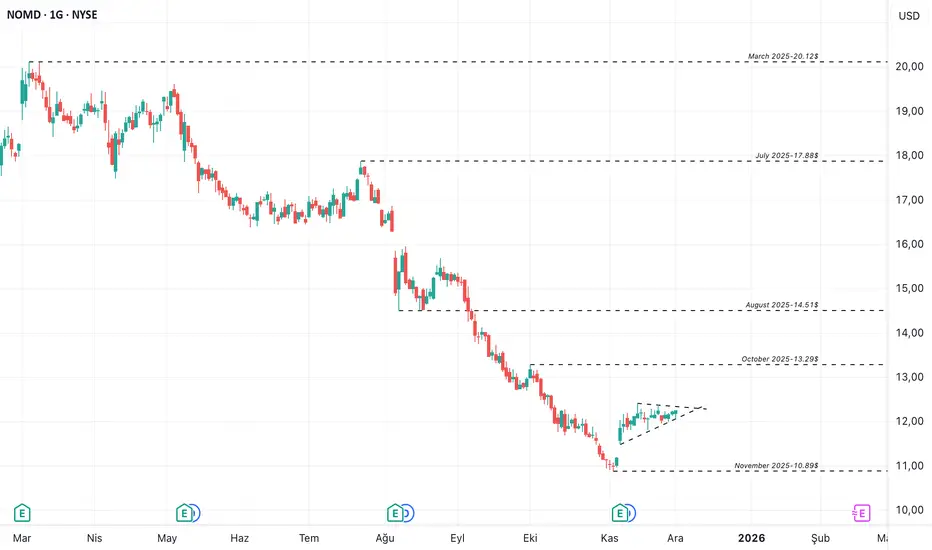
NOMADDespite being one of Europe’s leading frozen food companies, Nomad Foods (NOMD) continues to trade at a significant and persistent valuation discount in the market. The Q3 2025 financial results affirm this thesis while highlighting the short-term risks that sustain the current discount.
1. Financial Metrics and Deep Valuation Status
NOMD is priced at an extremely low multiple compared to its peers in the consumer staples sector, indicating that the stock is severely undervalued relative to its profitability and book value:
• Price-to-Earnings (P/E) Ratio: The company's P/E ratio is around ~8.08x (initial analysis: 8.15x). This is a remarkably low multiple compared to the sector average (18x-22x), suggesting the stock is heavily discounted relative to its earnings power.
• Price-to-Book Value (P/BV) Ratio: NOMD’s P/BV ratio is ~0.61x. Compared to a sector average of 3x-5x, this indicates an extreme undervaluation, with the company trading below its book value (equity).
• Dividend Yield: The calculated current dividend yield is between 5.55% - 5.95%. This rate is significantly higher than the peer average (2.0%-2.5%), making the stock an attractive income vehicle.
• Net Debt/Adjusted EBITDA: The company's leverage ratio is in the 3.0x-3.5x range. While the Q3 EBITDA decline nominally pushed this ratio higher, the level remains consistent with the average for large consumer goods companies (2.5x-3.5x), but is a key risk factor to monitor.
2. Outlook and Strengthening Upside Catalysts
Analysts maintain high price targets for NOMD, trusting the following catalysts to close the discount:
• Productivity Program Confirmed (Key Value Driver): The company confirmed in Q3 2025 that its multi-year program, targeting €200 million in operational savings over the 2026-2028 period, is on track. The primary goal is to boost margins and Adjusted EBITDA, which is the most tangible catalyst for future valuation improvement.
• Aggressive Shareholder Return Strategy:
• Share Buybacks: Management is committed to continued aggressive buybacks while the stock remains undervalued. Q3 results showed €151.4 million in buybacks during the first nine months, a direct route to boosting Earnings Per Share (EPS) at low multiples.
• Dividend Increase: The recent increase in the quarterly dividend from $0.15 to $0.17 per share signals management's confidence in future strong cash flows.
• Strong Free Cash Flow (FCF) and Discipline: Despite short-term fluctuations in EBITDA, the company maintains its full-year 2025 target for Adjusted Free Cash Flow (FCF) conversion at 90% or greater. This strong cash generation capability ensures the sustainability of its dividend and buyback programs.
• Cost Discipline: The company successfully reduced Adjusted Operating Expenses by 11.9% in Q3 2025, driven by high single-digit reductions in overhead, confirming a strong focus on capital discipline.
3. Key Risks and Q3 2025 Updates
The primary obstacles to potential upside, and the factors sustaining NOMD's discount, are:
• Market Risks (Volume Pressure Continues): Due to consumer price sensitivity driven by high inflation, organic revenue declined by 1.6% in Q3 2025, with 0.5% attributed to volume contraction. This pressure led to a 420 basis points contraction in the gross margin, confirming the ongoing risk of consumers trading down to cheaper private-label alternatives.
• Financial Risk (Leverage Management): The elevated leverage ratio remains a risk factor in a high-interest rate environment. However, this risk is mitigated by the company's robust 90%+ FCF conversion target and a reduction in net interest payments over the nine-month period. Strong cash flow allows the company to manage debt service while continuing to fund shareholder returns.
• Execution Risk: The risk that the €200 million Productivity Program may not be successfully executed, or that brand investment may be compromised, could cause the discount to persist. Initial cost reduction steps, however, suggest effective risk management.